
Banks vs Dealership Financing: Canada Interest Rate 2025 Comparison
11 September 2025Introduction
In 2025, navigating auto financing in Canada is no longer straightforward. The Bank of Canada’s policy interest rate stands at 2.75% (July 2025), down from the peaks of 5%+ in 2023, but still well above the near-zero rates Canadians enjoyed during the pandemic years. That difference matters: a car loan that would have cost you 3% APR in 2021 might now come in at 6–8%, depending on your credit profile.
Why does this matter so much for buyers? Because unlike mortgages, which stretch over 20–25 years and are secured against appreciating real estate, car loans are short-term and secured against depreciating assets. Your vehicle starts losing value the moment you drive it off the lot. Every percentage point of APR adds up, and because the car itself loses value, you can easily end up owing more than the car is worth.
The big decision every buyer faces: should you go through a bank or credit union, or accept the dealership’s financing offer? Banks are often more transparent and stable, while dealerships lure buyers with promotional rates that may or may not save money.
This guide breaks it all down. We’ll cover:
- Current car loan interest rates in Canada (2025)
- How bank car loans and dealership financing actually work
- Key differences in Ontario, British Columbia, and Alberta
- Expanded FAQs on what Canadians are asking Google
- Actionable tips to lock in the lowest APR
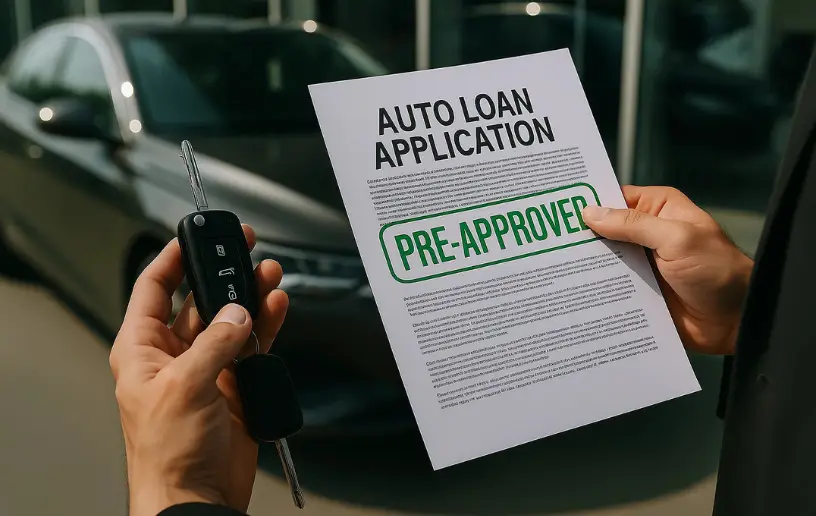
And if you want to skip the theory, you can apply now for a pre-approved loan with Auto Lending Canada. In minutes, you’ll know your borrowing power and walk into a dealership with confidence.
The Canadian Car Loan Rate Landscape in 2025
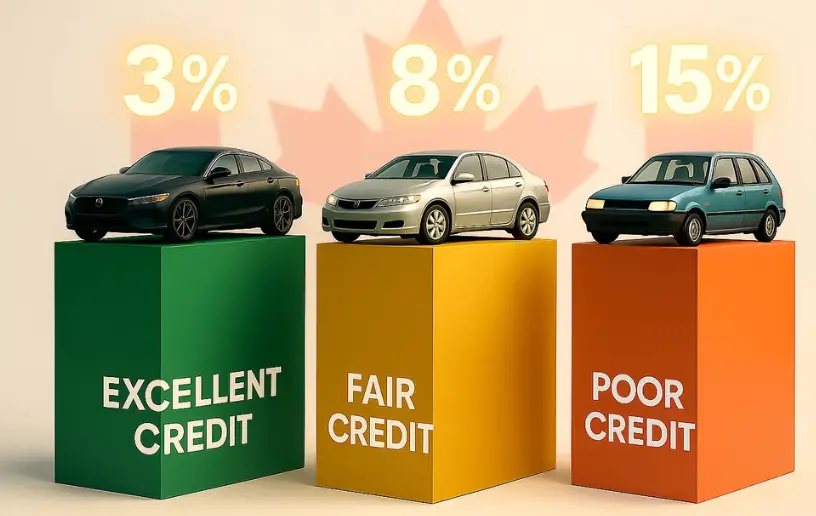
The average car loan interest rate in Canada in 2025 falls in the mid-single digits, but the range depends heavily on your credit profile.
- Excellent credit (680+): Borrowers in this range often qualify for the lowest APRs on the market. With strong credit, you may see offers between 3% and 7% for new vehicles, especially when dealership promotions are available. Lenders view you as low-risk, so terms are more flexible and approvals are faster.
- Fair credit (600–679): Most Canadians fall here, where rates typically land between 8% and 12%. You can still get approved for a car loan, but you’ll need to compare offers carefully to avoid overpaying. Down payments and shorter terms can help improve your approval odds.
- Poor credit (<600): Borrowers in this tier face the toughest terms, often paying 14% to 30%+ APR, especially on used cars. Approval is still possible, but usually with higher overall borrowing costs.
It’s not just about banks and dealerships anymore. Credit unions have become a strong alternative, often giving slightly better rates for members and using more flexible underwriting standards that look beyond just your credit score. Many Canadians find credit unions more approachable and easier to negotiate with.
The reality is this: the “headline rate” you see in ads rarely matches what you’ll actually get. Factors like your credit score, income, debt-to-income ratio, down payment, vehicle type, and province all influence the final offer.
That’s where Auto Lending Canada comes in. With a single application, you can access offers from banks, dealerships, credit unions, and online lenders—all compared side by side. Instead of applying separately and guessing who will give you the best deal, Auto Lending Canada connects you with multiple lenders at once to secure the most competitive rate for your unique profile.
Provincial Snapshot: Ontario, British Columbia, Alberta
Ontario
- Dealership promotions can still hit 0% APR for certain new models, but only with excellent credit and specific conditions.
- Used car financing via dealerships typically starts around 5.9% APR for good credit.
- Banks remain strong competitors, particularly for borrowers with clean credit histories.
Key takeaway: In Ontario, dealership financing is often the best bet for new vehicles if you qualify for promotions. For used cars, banks usually edge out dealers.
British Columbia
- Dealership promos for new vehicles often land in the 3%–5% APR range for strong credit buyers.
- Used car loans with good credit typically sit around 4%–6% APR.
- With weaker credit, dealership APRs can shoot above 10%–12%.
Key takeaway: In BC, dealerships can be competitive for prime borrowers, but banks and credit unions are safer bets for used vehicles and fair credit profiles.
Alberta
- Used car loan rates for fair/good credit usually range from 7%–8% APR.
- Dealership new-car promos exist, but are less common than in Ontario or BC.
- Subprime borrowers often face rates of 15%+ APR, no matter the lender.
Key takeaway: In Alberta, competition is thinner. Bank and credit union offers tend to be steadier than dealership financing, especially for used cars.
How Bank Car Loans Work
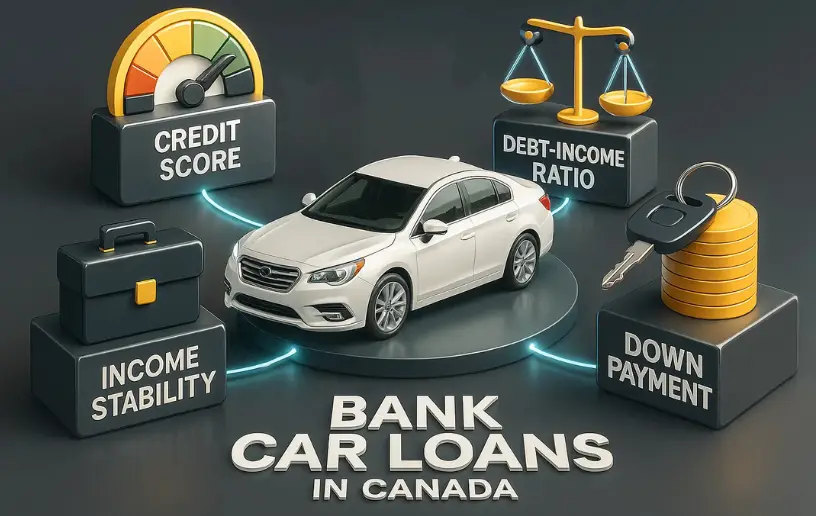
Bank car loans are the traditional route most Canadians are familiar with. When you borrow from a bank or credit union, you’re dealing with established institutions that prioritize stability and transparency.
Banks typically offer secured auto loans, which means the car itself is used as collateral. If payments aren’t made, the lender has the right to repossess the vehicle. This security allows banks to offer lower rates compared to unsecured loans. While unsecured personal loans can technically be used to buy a car, they usually carry much higher interest rates.
What banks look for:
- Credit score: The higher, the better. Borrowers with a score above 680 are seen as low-risk and qualify for the most competitive rates.
- Income stability: Banks want proof that you can handle monthly payments. They’ll review employment history, pay stubs, or tax filings.
- Debt-to-income ratio: If too much of your income is already tied up in other debts, approval gets harder.
- Down payment: The more you put down, the more confidence a bank has in your ability to manage the loan.
Pros of Bank Car Loans in Canada
- Competitive rates for strong credit profiles: Banks reward borrowers with excellent credit by offering some of the lowest rates available. This can translate to thousands in savings over the life of the loan.
- Clearer terms and fewer surprises: Bank contracts are usually standardized and transparent, so you know exactly what you’re paying and when.
- Flexible repayment schedules: Most banks let you choose monthly, biweekly, or even accelerated payments, which can help reduce interest faster.
- Refinancing options: If your financial situation improves, banks often allow refinancing at a lower rate to save on interest.
Cons of Bank Car Loans in Canada
- Slower approval process: Applications can take several days to process, which isn’t ideal if you want to drive away the same day.
- Strict credit requirements: Borrowers with fair or poor credit may either face very high APRs or outright rejection.
- No dealership promotions: Banks don’t offer flashy incentives like 0% APR, so you might miss out on promotional deals tied to new car sales.
Example: A borrower with a 720 credit score applies for a $30,000 car loan at a bank. With 20% down, the bank may offer 6% APR over 60 months. A friend with a 620 score and the same down payment may be approved at 12% APR—or even declined. That’s nearly a difference of $5,000 in interest over the term.
Instead of applying at one bank and waiting, Auto Lending Canada lets you submit one application and see offers from multiple banks and credit unions at once. This saves time and ensures you don’t miss out on a better rate from a competitor.
How Dealership Financing Works

Dealership financing often feels easier—you pick your car, sign paperwork, and drive away the same day. Behind the scenes, dealerships either work with finance companies owned by automakers (like Toyota Financial or Ford Credit) or with external lenders.
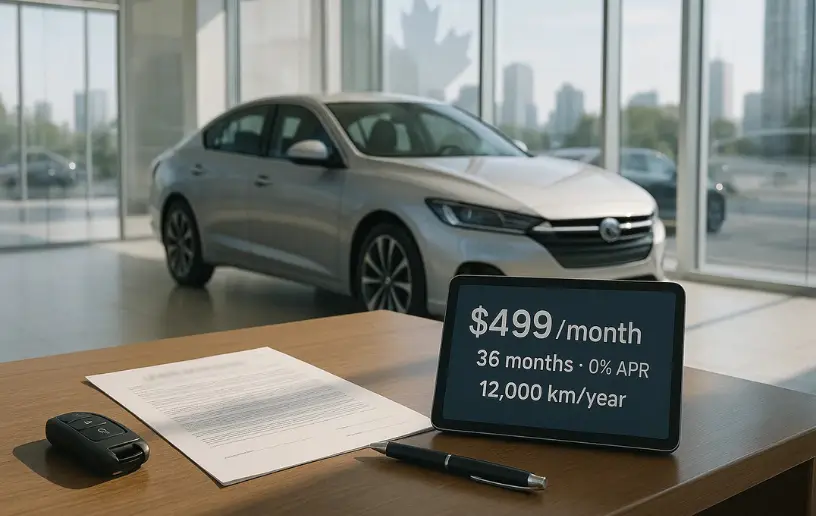
Promotional offers: Dealers sometimes advertise 0% or very low APRs. These deals usually apply only to certain new models and require excellent credit. The catch? You might have to give up cash rebates, accept specific trims, or lock into shorter terms.
Hidden add-ons: What looks like a low APR can quickly get expensive if extras are rolled into the loan such as:-
- Freight and pre-delivery inspection fees.
- Documentation and admin charges.
- Extended warranties and insurance bundles.
- Add-ons like rustproofing, tire packages, or paint protection.
Pros of Dealership Car Financing in Canada
- Fast approvals: Dealers can get you approved the same day, which makes the process seamless if you need a car quickly.
- Attractive promotions: Manufacturer-backed financing arms sometimes offer 0% or low APRs that banks can’t match, especially on new models.
- Convenience: You handle both the purchase and financing in one place, without running around to multiple institutions.
Cons of Dealership Car Financing in Canada
- Higher APR if you don’t qualify for promos: Outside of promotions, dealer-arranged loans are often more expensive than bank loans.
- Risk of upselling and hidden costs: Dealers may bundle add-ons like extended warranties or gap insurance into the loan without fully explaining the impact.
- Longer loan terms: Dealerships often push 72–96 month loans, which reduce monthly payments but significantly increase total borrowing costs.
Example: Imagine a dealer offering 0% APR on a $35,000 vehicle, but only if you skip the $3,000 rebate available for cash buyers. On paper, 0% looks unbeatable, but over five years you’ve actually financed more money than you needed to.
By checking your pre-approval before you step into the showroom, you know if the dealer’s offer is truly better. If it isn’t, you can confidently say no and stick with the lower total cost of borrowing.
Banks vs Dealerships: Who Wins?
- Banks: Best for used cars, borrowers with stable income and strong credit. Transparent terms and lower long-term cost.
- Dealerships: Best if you catch a genuine promotion. Works well for new cars and top-tier credit borrowers.
- Bad credit borrowers: Both paths are expensive; this is where Auto Lending Canada helps by letting you compare offers from multiple lenders in one place.
Real-World Examples
Ontario (New Car, Excellent Credit)
- Bank APR: 6.9% → ~$6,000 interest over 60 months.
- Dealer Promo APR: 2.99% → ~$3,000 interest.
- Dealer wins — if you qualify.
BC (Used Car, Good Credit)
- Bank APR: 9% → ~$7,500 interest over 72 months.
- Dealer APR: 12% → ~$10,500 interest.
- The bank wins.
Alberta (Used Car, Fair Credit)
- Bank APR: 11% → ~$6,500 interest over 60 months.
- Dealer APR: 14% → ~$8,500 interest.
- Bank wins again.
Tips to Get the Lowest Interest Rates in Canada for Car Financing
1) Check your credit report
Small errors, like outdated balances or incorrect late payments, can drag down your score and push up your APR. Fixing them before you apply ensures you don’t overpay.
2) Boost your credit score
Paying bills on time and reducing credit balances steadily improves your score. Even a small bump can move you into a lower-interest tier.
3) Shop across lenders with Auto Lending Canada
Rates differ between banks, credit unions, dealerships, and online lenders. Auto Lending Canada brings them together so you can compare offers without multiple applications.
4) Get pre-approved
A pre-approval through Auto Lending Canada shows you what you really qualify for and gives you leverage before you walk into a dealership.
5) Negotiate with dealers
Dealers often add a margin to financing. Showing them a lower pre-approved rate forces them to compete for your business.
6) Pick shorter terms
A shorter loan means higher monthly payments but saves thousands in total interest compared to long terms like 84 or 96 months.
7) Avoid unnecessary add-ons
Products like extended warranties or tire protection are optional, but when rolled into your loan, they inflate your balance and cost more in the long run.
Common Mistakes to Avoid during Auto Financing
1) Accepting the first dealership offer
Convenience makes it tempting, but without comparing, you could end up locked into a much higher APR than necessary.
2) Falling for 0% APR promotions
These deals often mean skipping rebates or discounts, so the car ends up costing more even without interest charges.
3) Stretching loans to 96 months
While monthly payments drop, the interest adds up significantly, leaving you paying thousands extra.
4) Overlooking hidden add-ons
Dealers may include extras like gap insurance or paint protection in your paperwork. If you don’t catch them, you’re paying for items you may not even want.
5) Skipping pre-approval
Without pre-approval, you lose negotiating power. With it, you know your baseline rate and can push lenders to match or beat it.
Which is Best for You? Bank Loan or Dealership Financing?
Here’s the bottom line:
- Banks and credit unions provide stability, transparency, and often the best value for used car financing.
- Dealerships can win on new vehicles if you qualify for rare promotional rates, but hidden costs and long terms can erase the advantage.
- Provincial differences matter: Ontario sees more aggressive dealer offers, BC offers a balance of dealer and bank competitiveness, while Alberta’s used car APRs tend to run higher.
The smartest step you can take is to apply now for a pre-approved loan with Auto Lending Canada. It’s fast, free, and connects you to banks, credit unions, dealers, and online lenders in one application. That means you’ll walk into the dealership knowing exactly what rate you deserve—and with the leverage to negotiate the best possible deal. Start your auto loan application today!
Frequently Asked Questions on Bank Loans & Dealership Financing in Canada
1) What is the average car loan interest rate in Canada in 2025?
About 6.9% for new cars (good credit). Used cars: 8%–12%. Bad credit: 14%–30%+.
2) Is bank financing always cheaper?
Not always. Dealer promos can undercut banks, but conditions apply.
3) Can I get a car loan with bad credit?
Yes, but expect steep APRs. Using Auto Lending Canada to compare multiple lenders helps avoid overpaying.
4) What’s the minimum credit score needed?
Some lenders approve as low as 550, but APR will be high. For decent rates, aim for 680+.
5) Do immigrants/newcomers qualify for auto loans?
Yes, but limited Canadian credit history usually means higher APR or a required co-signer.
6) How much down payment is ideal?
10%–20% is recommended. Larger down payments may risk and APR.
7) Are online lenders safe?
Yes, many are regulated and offer quick approvals. Always check lender credibility.
8) What fees should I expect?
Admin fees, documentation, freight/PDI, extended warranties, gap insurance—all of which may inflate cost.
9) Should I choose shorter or longer terms?
Shorter = higher monthly, less total interest. Longer = lower monthly, more total cost.