

Car Financing on Disability Income in Canada
06 February 2026Canadians living with a disability, a dependable vehicle is a practical necessity that supports independence, mobility, and daily functioning. Transportation often plays a direct role in accessing medical care, maintaining employment where possible, supporting family members, and managing everyday responsibilities that would otherwise be difficult or impossible without reliable access to a vehicle.
This always raises one question repeatedly among Canadians who rely on disability income:
Can you get approved for a car loan in Canada if your income comes from disability benefits?
The answer is Yes. Many Canadians across the country are approved for auto financing every year while receiving disability income. However, approval is not automatic, and outcomes can vary widely from application to application.
To elaborate, approval depends on how your income is structured, how Canadian auto lenders assess financial risk, and how your application is presented within those lending guidelines. Disability income on its own does not disqualify an applicant. What matters is how lenders evaluate income stability, affordability, credit history, and the specific vehicle being financed.
This guide is designed to explain, in clear and factual terms, how Canadian auto lenders view CPP Disability benefits, Registered Disability Savings Plans (RDSP), and other forms of disability income. This gives an overview of the qualification rules that influence approvals, highlights the factors lenders care about most, and helps borrowers understand the common mistakes that often lead to declines.
Understanding Disability Income in Canada
Auto lenders do not make approval decisions based on labels or assumptions about a borrower’s circumstances. Their focus is risk assessment. Every application is evaluated through a financial lens that measures whether the loan is likely to be repaid as agreed over the full term.
From a lender’s perspective, risk is primarily determined by four core factors.
The first is income stability, which refers to how predictable and consistent the borrower’s income is over time.
The second is affordability, meaning whether the proposed vehicle payment fits realistically within the borrower’s overall monthly obligations.
The third is credit behavior, which reflects how the borrower has managed credit in the past.
The fourth is vehicle choice, as the age, mileage, and value of the vehicle directly affect the lender’s exposure over the life of the loan.
Because of this approach, what matters is the type of disability income, how reliably it is paid, and how it fits into the broader financial picture. Some forms of disability income are viewed as highly stable and predictable, while others are assessed more cautiously depending on lender policy and supporting factors.
As a result, not all disability related income is viewed the same way. Understanding how lenders interpret different income sources is essential for setting realistic expectations and structuring an application that aligns with approval criteria.
CPP Disability Benefits
What Is CPP Disability?
CPP Disability is a federal benefit paid to Canadians who have contributed to the Canada Pension Plan and are no longer able to work on a regular basis due to a severe and prolonged disability. Payments are issued monthly and are supported by formal eligibility requirements set by the federal government.
Is CPP Disability Considered Acceptable Income?
Yes. Most Canadian auto lenders accept CPP Disability as qualifying income when reviewing a car loan application.
From an auto lender’s perspective, CPP Disability has several important strengths. It is government backed, which reduces uncertainty around payment continuation. It is paid on a consistent monthly schedule, making it easier to assess affordability. It is designed to be long term rather than temporary, and it can be verified through official award letters and bank statements. These factors make CPP Disability one of the more straightforward disability income sources for lenders to evaluate.
What Matters Most When Using CPP Disability Income?
When assessing an application that relies on CPP Disability income, lenders typically focus on a few core elements. They look at how long the borrower has been receiving CPP Disability benefits, whether payments are consistent and ongoing, and whether the income comfortably supports the proposed vehicle payment after accounting for existing financial obligations.
In many cases, CPP Disability income is considered more stable than contract work, commission based earnings, or seasonal employment. That stability can work in a borrower’s favour, particularly when the vehicle choice and overall application are structured within lender guidelines.
Provincial Disability Benefits
In addition to federal programs such as CPP Disability, many Canadians rely on provincial disability benefits as their primary source of income. Common examples include the Ontario Disability Support Program in Ontario, Assured Income for the Severely Handicapped in Alberta, and Persons with Disabilities assistance in British Columbia.
These programs are also regularly used as qualifying income in auto financing applications. However, lender treatment of provincial disability benefits can vary more widely than it does with CPP Disability. This variation is driven by internal lender policies, regional practices, and how each lender assesses long term income stability.
Some lenders accept provincial disability benefits with little additional scrutiny, provided the overall application meets affordability and credit guidelines. While some lenders apply more conservative affordability thresholds, request additional documentation to confirm ongoing eligibility, or place greater emphasis on credit history and vehicle selection.
For borrowers who rely on provincial disability benefits, selecting a lender whose guidelines align with their income type is often one of the most important factors in achieving approval.
RDSP Disability Benefits
What an RDSP Is Designed For?
A Registered Disability Savings Plan is a long term savings program created to help Canadians with disabilities build financial security over time. It is structured to encourage saving through a combination of personal contributions and government support, including the Canada Disability Savings Grant and the Canada Disability Savings Bond.
The primary purpose of an RDSP is to support future financial needs, particularly in later years. It is not designed to function as a regular source of monthly income or as a replacement for employment or disability benefit payments.
Can RDSP Funds Be Used as Income for a Car Loan?
In most cases, No. Auto lenders generally do not count RDSP balances or RDSP withdrawals as qualifying income when assessing a car loan application.
This is because RDSP funds are not paid out as guaranteed monthly amounts, withdrawals can be irregular, and early withdrawals may trigger repayment obligations for grants and bonds received from the government. From a lender’s perspective, this makes RDSP funds unreliable for servicing a fixed monthly loan payment.
How an RDSP Can Still Help an Auto Financing Application?
Although RDSP funds are usually not treated as income, they can still play a positive supporting role in an auto financing application. RDSP funds may be used toward a down payment, which can reduce the amount being financed and lower lender risk. It may also demonstrate long term financial planning and stability, which can strengthen the overall profile of an applicant.
Using RDSP funds to reduce the Loan to Value ratio can improve approval odds by limiting exposure for the lender. However, attempting to present RDSP withdrawals as proof of income often leads to confusion, extended review times, and in some cases outright declines. Understanding the intended role of an RDSP helps borrowers avoid these issues and structure their applications more effectively.
How Canadian Auto Lenders Qualify Disability Income

Income Stability Comes First
- Predictable Income: Lenders prefer income that arrives on a consistent monthly schedule, making payments easier to assess and plan around.
- Length of time receiving benefits: A longer history on disability benefits signals reliability and reduces concern about sudden income changes.
- Likelihood of income continuation: Lenders assess whether the income is expected to remain in place for the full loan term.
Affordability and Monthly Obligation Review
- Personal loans and lines of credit: Fixed loan payments reduce the amount available for a vehicle payment.
- Buy now pay later accounts: These obligations are increasingly scrutinized due to their cumulative impact on affordability.
- Proposed car payment: The vehicle payment must fit comfortably within the borrower’s remaining income.
- Total obligations over gross income: For fixed disability income, manageable monthly expenses matter more than income level alone.
Credit Profile and Payment Behavior
- Payment history: A consistent record of on time payments signals reliability and lowers perceived risk.
- Collections and write offs: Unresolved or recent negative accounts can significantly affect approval decisions.
- Length of credit history: A longer, well managed credit file provides more data for lenders to assess risk.
- Improving credit trends: Demonstrated recovery and responsible use of credit can offset income limitations.
Vehicle and Loan Structure Considerations
- Vehicle age and mileage: Newer or lower mileage vehicles reduce repair risk and support longer loan terms.
- Loan term length: The financing term must align with the expected lifespan of the vehicle.
- Loan to value ratio: Lower loan amounts relative to vehicle value reduce lender exposure
- Down payment or trade equity: Equity lowers risk and can improve approval odds on fixed income.
To know more about how vehicle choice can help or decline your loan. Read our latest blog Why Vehicle Choice Matters in Canadian Auto Loan Approvals
Overall Risk Alignment
- Balanced application structure: Income, credit, vehicle, and loan terms must work together within lender guidelines.
- Risk reduction approach: Applications that minimize uncertainty are more likely to receive approval, even on disability income.
Not sure how lenders would view your disability income, credit, or vehicle choice? A pre-approval helps clarify what you qualify for before you start shopping.
Documentation Generally Required
Applicants who rely on disability income are usually asked to provide clear documentation that confirms income, identity, and overall eligibility. This allows lenders to verify stability and assess risk accurately.
- CPP Disability or benefit award letter: Confirms the type of benefit, eligibility status, and ongoing nature of the income.
- Recent bank statements showing deposits: Used to verify consistent receipt of disability payments over time.
- Government issued identification: Confirms identity and supports compliance with lender and regulatory requirements.
- Proof of residence: Establishes address stability and regional eligibility.
Optional but helpful documentation
- Down payment confirmation: Demonstrates financial preparedness and can reduce lender risk.
- Trade in details: Equity from a trade can improve loan to value ratios and approval odds.
- Co-borrower information if applicable: A qualified co-borrower can strengthen affordability and credit considerations.
Common Reasons Applications Get Declined
Many auto loan declines involving disability income are avoidable and do not reflect a borrower’s inability to qualify in general. Instead, they are often the result of misalignment between the application and lender requirements.
- Treating RDSP withdrawals as income: RDSP funds are not considered reliable monthly income and are typically excluded from qualification.
- Choosing an ineligible vehicle: Vehicles that exceed age, mileage, or value limits often trigger automatic declines.
- Excessive debt obligations: High existing payments can reduce affordability on fixed income.
- Thin or damaged credit files: Limited credit history or unresolved negative accounts increase perceived risk.
- Applying with the wrong lender tier: Not all lenders assess disability income the same way, and poor lender matching leads to unnecessary declines.
Myth vs Reality
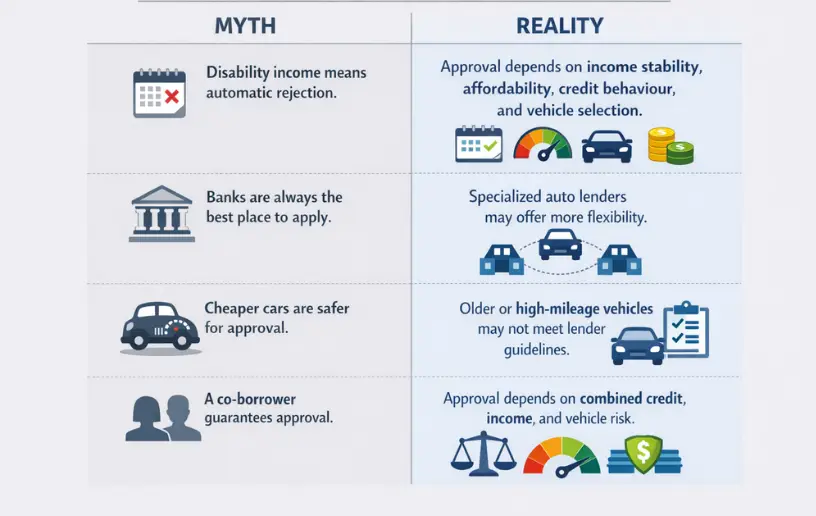
Myth: Disability income means automatic rejection
Reality: Many Canadians on disability income are approved for auto financing every day. Approval depends on income stability, affordability, credit behavior, and vehicle selection, not the income label.
Myth: Banks are always the best place to apply
Reality: Major banks often have stricter underwriting rules. Specialized auto lenders and credit focused finance companies frequently offer more flexibility for applicants relying on disability income.
Myth: Cheaper cars are safer for approval
Reality: Lower priced vehicles are often older or higher mileage, which can fall outside lender eligibility rules
Myth: A co-borrower guarantees approval
Reality: A co-borrower can help, but approval still depends on the combined credit, income, and overall risk profile. A weak vehicle choice or excessive debt can still result in a decline.
Informed Decisions Create Stronger Financing Outcomes
Car financing on disability income in Canada is not based on special treatment, exceptions, or workarounds. It is based on alignment. Successful outcomes occur when the type of income, credit profile, vehicle choice, and lender guidelines are properly matched from the outset.
Understanding how lenders assess risk gives borrowers greater control over the process. It helps avoid common missteps, reduces unnecessary stress, and leads to financing decisions that support long term financial stability and reliable transportation.
Auto Lending Canada focuses on structured pre-approvals that reflect how lenders actually assess disability income, helping borrowers understand their real options before committing to a vehicle. By clarifying real options before a vehicle is chosen, borrowers are better positioned to move forward with confidence.