
Car Loan Calculator Saskatchewan: Estimate Your Monthly Payments (2026)
25 August 2026If you're shopping for a vehicle in Regina, Saskatoon, or anywhere else in the province, a car loan calculator Saskatchewan drivers can actually trust starts with understanding the math behind the monthly number, not just plugging in figures and hoping for the best. Saskatchewan has a few quirks that don't show up in generic loan calculators built for Ontario or BC, and they can change your payment by real money. This guide walks through the amortization formula lenders actually use, the inputs that move your payment the most, and three worked examples based on realistic Saskatchewan vehicle prices and credit profiles.
How a Car Loan Calculator Saskatchewan Payment Actually Works
Every car loan calculator, whether it's a slick app or a spreadsheet someone built in an afternoon, runs on the same amortization formula. Lenders don't just divide the total cost by the number of months. They calculate a payment that covers both principal and interest so the balance hits zero exactly on your last payment date. The formula looks like this:
M = P × [r(1+r)^n] / [(1+r)^n - 1]
M is your monthly payment, P is the principal (the amount you're actually financing), r is your monthly interest rate (annual rate divided by 12), and n is the number of monthly payments in your term. It looks intimidating written out, but the idea behind it is simple: more of each early payment goes toward interest, and more of each later payment goes toward principal, even though the total payment stays the same for the whole loan. If you want to see how that plays out payment by payment, our guide on car loan terms and amortization schedules in Canada breaks down a full schedule line by line.
The part that trips people up usually isn't the formula, it's figuring out what P actually is. Your principal isn't the sticker price of the car. It's the sticker price, plus tax, plus any fees, minus your down payment and trade-in value. Get that number wrong and every payment estimate downstream is wrong too.
Why Saskatchewan's Tax Rules Change the Numbers
This is the part that catches a lot of Saskatchewan buyers off guard. Unlike Alberta, which charges no provincial sales tax on vehicles, Saskatchewan applies both the 5% federal GST and a 6% provincial PST to most vehicle purchases, for a combined 11%. That tax gets added to the purchase price before you finance it, so it directly inflates your principal. On a $30,000 vehicle, that's an extra $3,300 rolled into the loan if you're not paying it out of pocket. A calculator that skips this step, or borrows a generic 13% HST figure from Ontario, is going to underestimate your Saskatchewan car loan payments by a noticeable margin. Private used vehicle sales through SGI follow their own PST rules, so it's worth confirming the exact tax treatment for your specific purchase before you lock in a number.
What Actually Moves Your Monthly Payment
Five things determine your payment, and they don't carry equal weight. Principal is the biggest lever by far. Every dollar you add to the loan, whether from a higher-priced vehicle, added tax, or rolled-in fees, increases your payment proportionally over the life of the loan.
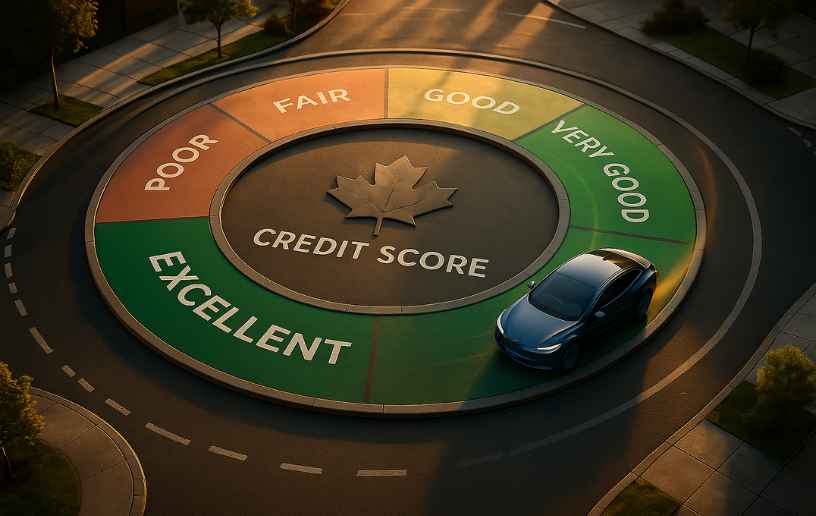
Your interest rate is largely a function of credit history, though the lender, loan term, and vehicle age all factor in too. A two-point difference in rate might sound small on a rate sheet, but compounded over 60 or 72 monthly payments it adds up to real dollars, which is why comparing more than one lender before signing is worth the extra hour.
Term length cuts the other way. Stretching a loan from 60 to 84 months lowers the monthly payment, sometimes by a lot, but it also means paying interest for two extra years. Down payment and trade-in value work identically to each other: both reduce principal dollar for dollar, which lowers your monthly payment and your total interest at the same time. One wrinkle worth knowing is that the trade-in value SGI or a dealer assigns your vehicle may come in lower than what you'd get selling it privately.
Three Worked Examples for Saskatchewan Buyers
Numbers land differently depending on your credit profile and what you're shopping for, whether that's a used commuter car in Saskatoon or a newer truck in Regina. Here are three scenarios built around realistic Saskatchewan pricing.
Example 1: Established Credit, Used Sedan
A buyer in Saskatoon with strong credit history finds a $22,000 used sedan. After GST and PST, the taxable total comes to $24,420. They put $2,000 down, leaving a principal of $22,420. At a 7.5% annual rate over 60 months, the monthly payment works out to roughly $450. Over the full term, they'll pay about $4,580 in interest.
Example 2: Average Credit, Regina Family Vehicle
A Regina family with average credit and no trade-in is looking at a $35,000 SUV. With tax, that's $38,850 financed at a 10.5% rate over 72 months. Their monthly payment lands around $685, and total interest over six years comes to roughly $9,300. Because their rate is higher and their term is longer, they end up paying more than double the interest of Example 1, even though the loan amount is only about 70% bigger. Anyone in a similar spot can dig into local rate ranges and dealer considerations in our Regina car loan guide.
Example 3: Rebuilding Credit, Newer Truck
A buyer working to rebuild their credit is financing a $28,000 used truck with a $1,500 trade-in. After tax, principal comes to $29,580. At a 15% rate over 72 months, the payment is roughly $625 a month, with total interest around $15,530, more than half the original loan amount. The loan size here sits between Examples 1 and 2, but the interest cost is easily the highest of the three, and rate alone accounts for that.
These figures are illustrative estimates, not quotes. Your actual Saskatchewan car loan payments will depend on the lender, your credit file at the time of application, the specific vehicle, and any fees added to the deal. For a step-by-step walkthrough of building your own estimate, see how to calculate your car loan payments.
How Rate and Term Length Change Total Interest Paid
The three examples above hint at something worth spelling out on its own: term length and interest rate interact in ways that aren't obvious from the monthly payment alone. A longer term almost always lowers your monthly payment, which is exactly why it's tempting. But stretch Example 2's SUV loan from 60 months to 84 months and the payment drops to around $600 a month, while total interest climbs to roughly $12,650, over $3,300 more for a smaller monthly bill.
Rate matters even more. Going from a 7.5% rate to a 15% rate on a similarly sized loan, roughly the gap between Examples 1 and 3, can more than triple the total interest cost even when the principal is comparable. That's the real argument for shopping your rate before you shop your term. A shorter term at a lower rate is usually cheaper overall, even when the monthly number looks less comfortable on paper. Our Saskatchewan car loan guide covers current rate ranges by credit tier across the province, and this breakdown of the real car loan calculator formula goes deeper into the mechanics for readers outside Saskatchewan too.
Building Your Own Estimate
To put together a reasonably accurate car payment calculator Saskatchewan estimate before you talk to a lender, gather these numbers first: the vehicle price you're targeting, your expected down payment, any trade-in value, and a realistic sense of your credit tier (lenders typically sort applicants into ranges rather than judging off a single score). Add 11% for GST and PST to get your taxable total, subtract your down payment and trade-in, and that's your principal. From there, the term and rate you qualify for do the rest.
Pre-qualification estimates and final loan offers can differ once a lender reviews your full application, income, and the specific vehicle you choose. Rates and approval terms vary by lender and aren't guaranteed in advance, so treat any calculator output, including the examples above, as a planning tool rather than a locked-in number.
If you want a clearer picture of what you might actually qualify for, you can get pre-approved and see real rate options without committing to anything. It's a fast way to check an actual offer against the estimates you've worked out here, using your real credit profile and the vehicle you have in mind.