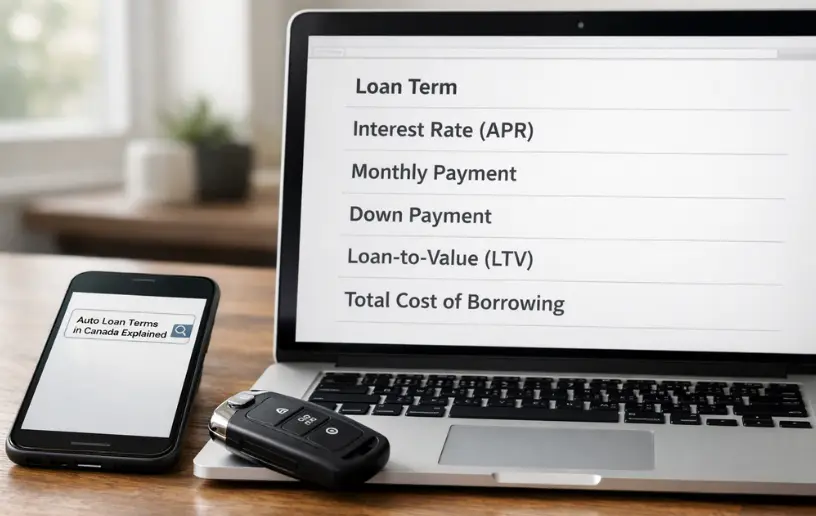
Auto Loan Terms in Canada Explained
08 February 2026Vehicle financing in Canada involves more than determining an affordable monthly installment.
Every auto loan agreement contains structured financial components that directly influence:
- The total cost of borrowing over the life of the loan
- Your approval eligibility and available lending options
- The pace at which you build equity in the vehicle
- Your overall financial exposure and credit risk
A clear understanding of these terms before entering into a financing agreement can prevent unnecessary interest costs, strengthen your negotiating position, and protect your long-term credit stability.
This 2026 guide provides a comprehensive, professionally structured overview of the key auto loan terms used by Canadian lenders, presented with clarity and practical context for informed decision-making.
What Is the Principal on a Car Loan?
The Principal is the net amount advanced by the lender to finance the purchase of the vehicle, excluding interest, borrowing costs, and added products (such as warranties or insurance, unless those are rolled into the loan).
Example
- Vehicle purchase price: $35,000
- Down payment: $5,000
- Principal financed: $30,000
If additional items, such as extended warranties, gap insurance, or dealer fees are included in the financing, the principal may increase accordingly.
Not sure how much you qualify for?
Get pre-approved today with Auto Lending Canada in minutes, no impact to your credit score.
Fixed vs. Variable Auto Loan Rates in Canada
In Canadian auto finance, most vehicle loans are structured with fixed interest rates to provide payment stability. Variable-rate auto loans exist but are less common and are typically tied to broader lending products such as lines of credit.
Below is a structured comparison:
| Feature | Fixed Rate Auto Loan | Variable Rate Auto Loan |
| Popularity in Canada | Most common structure | Rare for traditional auto loans |
| Payment Stability | Monthly payment remains consistent throughout the term | Payment may fluctuate based on interest rate changes |
| Protection from Rate Increases | Yes, locked for entire term | No, affected by changes to Bank of Canada prime rate |
| Budget Predictability | High | Moderate to Low |
| Typical Borrower Preference | Long-term stability and predictable budgeting | Borrowers anticipating falling rates |
| Risk Level | Lower interest-rate risk | Higher exposure to rate volatility |
What Is APR on a Car Loan in Canada?
APR (Annual Percentage Rate) represents the total cost of borrowing expressed as a yearly percentage. Unlike the nominal interest rate, APR provides a more comprehensive measure because it incorporates certain additional borrowing costs required under the loan agreement.
Under Federal and Provincial consumer protection regulations, lenders are legally required to disclose the APR so borrowers can compare financing offers transparently.
Why APR Matters More Than the Interest Rate
The advertised interest rate reflects only the base cost of interest charged on the principal. While APR, reflects the total borrowing expense, making it the more accurate comparison tool when evaluating multiple lenders.
Example
On a $40,000 auto loan over 72 months:
- 6% APR results in approximately $7,700 in total interest
- 8% APR results in approximately $10,600 in total interest
The difference is nearly $3,000 over the life of the loan.
What Is a Loan Term (And Is 84 Months Too Long?)
The loan term is the length of time you agree to repay your auto loan. It directly affects your monthly payment, total interest paid, and how quickly you build equity in the vehicle.
Common Auto Loan Terms in Canada
- 60 months (5 years)
- 72 months (6 years)
- 84 months (7 years)
Longer loan terms reduce the required monthly payment, which can improve affordability and approval flexibility. Along that, they also increase the total interest paid and slow the pace at which equity is built.
Term Comparison
| Factor | 36 Months | 84 Months |
| Monthly Payment | Higher | Lower |
| Total Interest Paid | Lower | Significantly Higher |
| Equity Build Speed | Fast | Slow |
| Negative Equity Risk | Low | Higher |
Is 84 Months Too Long?
An 84-month term is not unsuitable, but it carries higher financial exposure. Vehicles depreciate faster than the loan balance declines during extended terms, increasing the risk of negative equity.
While longer terms can improve affordability and expand approval options, particularly for higher-priced vehicles or tighter monthly budgets. Borrowers should carefully balance immediate payment comfort against long-term financial impact before selecting an extended repayment period.
Before choosing a long-term loan, see what options you qualify for.
Auto Lending Canada matches you with lenders based on your credit profile.
What Is Loan-to-Value (LTV) Ratio?
Loan-to-Value (LTV) measures how much you are borrowing compared to what the vehicle is worth.
Formula: LTV = Loan Amount ÷ Vehicle Value
Example
If you finance $33,000 on a vehicle valued at $30,000, your LTV is 110%.
An LTV under 100% is generally considered strong. It indicates you are financing less than or equal to the vehicle’s value, which reduces lender risk.
What Is Negative Equity in a Car Loan?
Negative equity occurs when the outstanding loan balance exceeds the vehicle’s current market value. In practical terms, you owe more on the loan than the car could sell for at that moment.
Example
If your remaining loan balance is $28,000 but the vehicle’s market value is $23,000, you are carrying $5,000 in negative equity.
Why Negative Equity Is Common in Canada
1. Extended Loan Terms (72–84 Months): Longer amortization periods reduce monthly payments but slow down principal reduction, while vehicles continue to depreciate.
2. Rapid First-Year Depreciation: Most vehicles lose 15–25% of their value within the first year. Depreciation often outpaces principal repayment early in the loan.
3. Rolling Previous Loan Balances: When borrowers trade in a vehicle that already has negative equity, the remaining balance is often added to the new loan. This increases the new Loan-to-Value (LTV) ratio and compounds long-term costs.
What Is Gap Insurance in Canada?
Gap insurance protects you if your vehicle is declared a total loss and your standard auto insurance payout is less than the remaining balance on your loan.
It covers the financial “gap” between:
- The insurance settlement amount (based on current market value)
- The outstanding balance owed on your auto loan
Example
- Remaining loan balance: $28,000
- Insurance payout after total loss: $23,000
- Gap insurance covers the $5,000 shortfall
Without gap coverage, you would remain responsible for paying that difference out of pocket.
When Is Gap Insurance Most Beneficial?
Gap insurance is typically recommended for:
- High Loan-to-Value (LTV) financing, particularly above 100%
- Long-term loans (72–84 months) where depreciation outpaces loan repayment
- Regions with higher accident frequency, including snow-heavy provinces where winter driving conditions increase total-loss risk
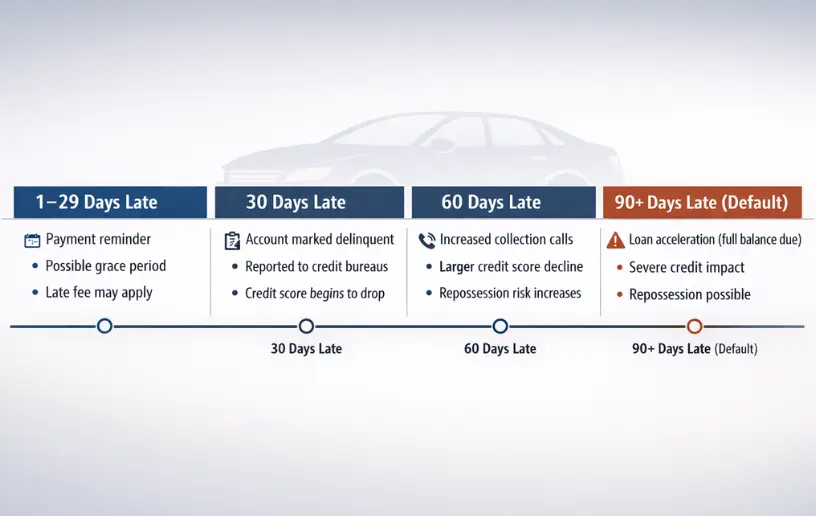
What Happens If You Miss a Car Payment?
| Timeline | Lender Action | Credit Impact | Financial / Legal Consequences |
| 1–29 Days Late | Payment reminder; possible grace period (10–15 days typical) | Usually not yet reported if paid within grace period | Late fee may apply ($25–$50 typical) |
| 30 Days Late | Account marked delinquent | Reported to Equifax and TransUnion | Credit score begins to decline |
| 60 Days Late | Increased collection activity | Larger credit score drop | Higher repossession risk |
| 90+ Days Late (Default) | Loan acceleration (entire balance may become due) | Severe impact (often 100+ point drop) | Repossession possible; account sent to collections |
How Do Credit Scores Affect Auto Loan Approval in Canada?
Credit scores play a central role in determining auto loan approval, interest rates, and financing terms. In Canada, lenders primarily rely on credit reports from Equifax and TransUnion, both of which use a scoring scale ranging from 300 to 900.
General Credit Tiers in Canadian Auto Lending
| Credit Score Range | Tier Classification | Typical Lending Impact |
| 720+ | Prime | Lowest APRs, strongest terms, widest lender access |
| 660–719 | Near-Prime | Competitive rates with moderate flexibility |
| 600–659 | Subprime | Higher interest rates, stricter approval conditions |
| Below 600 | Deep Subprime | Limited lender pool, highest APR range |
Unsure where your credit stands?
Apply with Auto Lending Canada and get matched to lenders based on your real credit tier — not assumptions.
What Is the Debt Service Ratio (DSR)?
The Debt Service Ratio measures how much of your gross monthly income is allocated toward debt obligations. Canadian lenders use it to determine whether you can realistically manage a new auto loan.
There are two key components:
1. Gross Debt Service (GDS)
This includes housing-related expenses such as:
- Rent or mortgage payments
- Property taxes
- Heating costs
- Condo fees (if applicable)
2. Total Debt Service (TDS)
This includes everything in GDS plus:
- Credit card minimum payments
- Lines of credit
- Student loans
- Existing car loans
- The proposed new auto loan
Most Canadian lenders prefer a TDS below 40–44% of gross monthly income. Staying within this range signals manageable risk and improves approval strength.
What Is a Cosigner on a Car Loan?
A cosigner is a second applicant who agrees to take full legal responsibility for the auto loan alongside the primary borrower. If the primary borrower misses payments or defaults, the cosigner is equally liable for repayment.
Common situations where cosigners are helpful:
- New immigrants establishing credit in Canada
- First-time vehicle buyers
- Borrowers rebuilding credit
Some Canadian lenders may allow cosigner release after 12–24 months of consistent, on-time payments, subject to credit re-evaluation.
Want to understand the risks and responsibilities before adding a cosigner?
Read our complete guide: Thinking of Co-Signing a Car Loan? Read This First, to make an informed decision.
What Fees Should You Watch For?
Beyond interest rates, several additional charges can affect the total cost of financing. Understanding these fees helps prevent unnecessary borrowing expenses and improves negotiation leverage.
Origination Fee
An origination or processing fee may apply, particularly with subprime lenders. It typically ranges from 1–2% of the loan amount and may be deducted upfront or added to the financed balance, increasing the total borrowing cost. Many prime lenders and credit unions waive this fee.
Dealer Reserve
Dealer reserve is compensation earned when a dealership presents a higher interest rate than the lender’s approved base rate. For example, if a lender approves 6% and the contract is written at 7%, the difference may generate commission. Borrowers can request the lender’s “buy rate” for clarity.
Late Fees
If a payment is missed beyond the grace period, usually 10–15 days, a late fee may be charged. This is commonly $25–$50 per occurrence and may include additional interest. Repeated late payments can negatively affect credit standing.
Prepayment Privileges
Most Canadian auto loans are open, allowing early repayment without penalties. Borrowers may make lump-sum principal payments, choose accelerated bi-weekly schedules, or pay off the balance in full at any time. Confirming these terms before signing ensures future flexibility.
Extended Warranty / Add-Ons
Products such as extended warranties, rust protection, tire protection, GAP coverage, or theft deterrent packages are often presented during financing. When rolled into the loan, they increase both principal and total interest.
NSF (Non-Sufficient Funds) Fee
If a scheduled payment fails due to insufficient funds, lenders may charge an NSF fee — commonly $40–$60 per incident — in addition to potential bank charges.
Lien Registration Fee
When financing a vehicle, the lender registers a lien against it. This government filing fee usually ranges from $30–$100 depending on the province and may be added to the loan balance.
Can You Refinance a Car Loan in Canada?
Yes. Refinancing means replacing your existing auto loan with a new one, typically to improve your loan terms.
Borrowers usually refinance to:
- Secure a lower interest rate
- Reduce total interest costs
- Shorten the remaining loan term
- Remove a cosigner after establishing payment history
Most Canadian lenders require:
- At least 6 months of on-time payment history
- No recent late payments or delinquencies
- Sufficient vehicle value relative to the remaining balance
Refinancing is most effective after your credit score has improved or your financial position has strengthened.
Think you may qualify for a better rate?
Read our full guide: Refinancing Your Auto Loan in Canada to see if refinancing makes financial sense for you.
Frequently Asked Questions About Auto Loans in Canada
1. What credit score do I need for a car loan in Canada?
Most approvals begin around 600, but better rates are available above 660 and strongest terms above 720.
2. Is 84-month financing bad?
Not always, but it increases total interest and negative equity risk.
3. Can I get a car loan with bad credit?
Yes. Subprime lenders specialize in credit-challenged borrowers, but rates are higher.
4. How much down payment is required?
10–20% is ideal, but zero-down options exist.
5. Does paying off a car loan early hurt credit?
No. Early payoff may slightly reduce mix diversity but improves overall profile.
6. Can I trade in a car with negative equity?
Yes, but the remaining balance is added to your new loan, increasing LTV and interest costs.