
Why Car Loans Get Declined Due to Income and Employment Issues in Canada
30 January 2026One of the most frustrating experiences for Canadian car buyers is having an auto loan application declined despite earning what appears to be a strong and reliable income. Many people assume that if their monthly income comfortably covers a car payment, car loan approval should follow. In reality, this is one of the most common misconceptions in Canadian auto financing and often leads to unexpected rejection.
Auto lenders in Canada do not approve car loans based solely on income amount. Instead, they assess whether an applicant’s income qualifies under lender specific underwriting guidelines. This difference between earning income and qualifying income is where many Canadians encounter problems. Income and employment issues remain one of the leading reasons car loans are declined in Canada, yet these criteria are rarely explained clearly by car dealerships, banks, credit unions, or online auto lenders.
This guide explains how lenders actually evaluate income and employment in Canada, why certain income types create challenges, and how declines usually come down to structure, timing, and documentation rather than the borrower’s worthiness.
Role of Income and Employment in Canadian Auto Loan Decisions
Canadian auto lenders evaluate every car loan application through the lens of repayment risk. Their primary concern is not how high an applicant’s income appears on paper, but how predictable and sustainable that income is over the full term of the auto loan. Income predictability carries more weight than income size because car loans in Canada are fixed monthly obligations that must be paid consistently, regardless of job changes, reduced hours, or shifts in economic conditions.
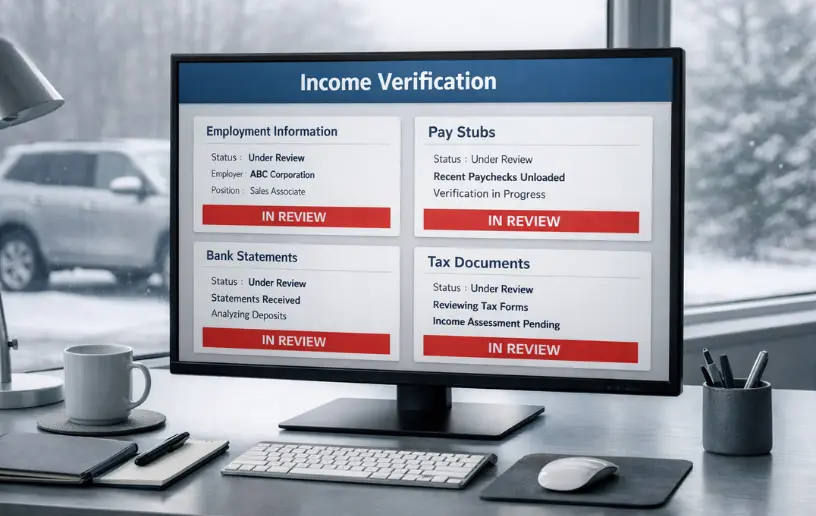
Canadian auto lenders rely heavily on verified income when making approval decisions. Verified income is income that can be confirmed through acceptable documentation such as recent pay stubs, employment letters, T4 slips, T1 tax returns, or Notices of Assessment from the Canada Revenue Agency. Stated income, which refers to the amount an applicant reports on a loan application, is not sufficient on its own.
Employment verification plays a central role in this process. Lenders typically confirm employment status, length of employment, income consistency, and job type directly with the employer or through verification systems. Any discrepancies between submitted documents and employer confirmation can delay approval or result in a decline.
Stable Income Meant by Lenders in Canada
In Auto Lending, stable income is not a subjective or flexible concept. It is defined by specific underwriting benchmarks designed to measure how likely an applicant is to maintain consistent earnings throughout the full term of a car loan. These benchmarks are applied regardless of how high the income appears on paper.
Full time employment is generally viewed as the lowest risk because hours and income are predictable. Part time employment can be acceptable when it is permanent and consistent, but lenders typically average earnings over several months to confirm reliability. Contract roles are evaluated more cautiously, even when income is high, because contracts can end without notice and may not guarantee renewal.
The way income is earned also influences stability assessments. Salaried income is considered the most stable because pay remains fixed regardless of hours worked. Hourly income is evaluated based on consistency of scheduled hours rather than peak earning periods. Commission based income is treated with greater caution and is usually averaged over six to twelve months. In some cases, lenders may require up to two years of income history to confirm that commission earnings are sustainable and not the result of short term performance spikes.
Understanding how lenders define stable income helps Canadian borrowers anticipate potential challenges and prepare applications that align with lender expectations. In many cases, approval depends less on how much income is earned and more on how consistent, verifiable, and predictable that income appears over time.
Why Did My Employment Verification Failed?
Many car loan applicants assume that submitting recent pay stubs is sufficient for approval. In reality, Canadian auto lenders rely on independent employment verification to confirm that income is legitimate, ongoing, and consistent with the information provided on the loan application. When verification cannot be completed successfully, approvals are often delayed or declined, regardless of income level or credit history.
Lenders may verify employment through direct contact with an employer by phone or email, written employment confirmations, or automated verification systems. Challenges arise when human resources departments respond slowly, provide incomplete information, or are unavailable within required timelines. Verification can also be difficult for small businesses or employers without formal payroll or human resources processes, which may limit a lender’s ability to confirm income.
Mismatched information is another common cause of verification failure. Differences between employer names listed on pay stubs and the legal entity confirmed by the employer, as well as inconsistencies in employment dates or income details, can render income unverifiable
Why Is Approval More Complex for Self-Employed and Gig Workers?
Self-employed and gig-economy borrowers are assessed under different lending criteria because their income is not supported by a traditional employer. To establish stability and reliability, most Canadian auto lenders require a minimum of two years of self-employment history.
Income Documentation Requirements for Self-Employed Borrowers
Lenders typically rely on Notices of Assessment (NOAs), T1 Generals, and business financial statements to verify income. Bank statements may be reviewed to confirm cash flow consistency, but they rarely replace tax-filed income when underwriting an auto loan.
Net Income vs. Gross Revenue
Auto lenders focus on net income after deductions, not total business revenue. While legitimate tax deductions reduce taxable income, they can also lower the income lenders use to calculate affordability and debt service ratios, directly impacting approval strength.
Income Stability and Year-Over-Year Trends
Consistent or improving income trends increase lender confidence. Declining income, large year-over-year fluctuations, or significant gaps between reporting periods may trigger additional conditions or reduce available financing options.
Gig Economy Income
Income from rideshare, delivery, freelancing, or platform-based work is considered higher risk due to demand variability and platform dependency. Lenders may assess average earnings over a longer period to account for seasonal changes and algorithm-driven income shifts.
Down Payment and Credit Strength Can Offset Risk
Stronger credit profiles, lower existing debt, or larger down payments can help offset income volatility. Some lenders use these compensating factors to approve self-employed or gig workers who may not meet traditional income thresholds.
Why Lenders Often Exclude Cash Payments, Tips, and Undeclared Earnings?
Income that is not fully reported to the Canada Revenue Agency is rarely accepted by Canadian auto lenders. Documents like T4 slips, T1 returns, and Notices of Assessment confirm that income is legitimate and traceable, so unreported earnings are often excluded from approval calculations.
Tips and cash wages, common in service industries, are only considered if consistently declared on tax filings. Undocumented or irregular deposits raise concerns about stability and source, making lenders reluctant to include them.
Auto lenders in Canada follow strict regulatory and anti money laundering standards. Income that does not match CRA records creates compliance issues, not just credit risk. Because lenders are required to verify where income comes from and how it is earned, any inconsistency between reported income and supporting documents can lead to a decline.
Borrowers who rely on cash income or tips can improve future approval chances by accurately reporting all earnings over time and maintaining consistent tax filings. Once informal income is properly documented and reflected in CRA records, lenders may reassess eligibility, making approval more achievable in subsequent applications.
Document Issues That Trigger Income Related Declines
- Missing or outdated pay stubs – Lenders cannot verify current income without recent evidence, making it difficult to assess repayment ability.
- Incorrect employer names or legal entity discrepancies – Any mismatch between documents and the employer’s official records raises questions about authenticity.
- Inconsistent employment dates – Differences in start or end dates across documents suggest instability or potential misrepresentation.
- Mismatched income figures – When pay stubs, tax returns, or bank statements show different amounts, lenders cannot reliably calculate qualifying income.
- Altered or forged documents – Signs of tampering immediately undermine credibility and typically lead to automatic declines.
- Incomplete or missing employment verification letters – Without confirmation from the employer, lenders cannot confirm employment or income legitimacy.
- Tax documents that are outdated or missing pages – Incomplete CRA records prevent lenders from verifying long-term income stability.
Each of these issues creates uncertainty for lenders. Because financing relies heavily on verifiable, consistent income, even small discrepancies can delay approval or lead to a decline.
How Credit and Income Work Together in Approval Decisions
| Factor | Role in Approval | Impact on Decision |
| Credit Score | Measures past borrowing and repayment behavior | Indicates general creditworthiness; strong credit alone does not guarantee approval |
| Income Stability | Confirms the ability to make consistent monthly payments | Often the deciding factor when credit meets minimum requirements |
| Verified Income | Verified via pay stubs, tax returns, bank statements | Ensures the lender can rely on the income; unverifiable income can override strong credit |
| Subprime Applicants | Borrowers with lower credit scores or higher risk profiles | Lenders weigh income stability more heavily; unstable income may lead to decline even with improved credit |
| Income vs Credit Interaction | Both are considered together | A borrower with average credit but stable income may be approved, while a borrower with excellent credit but unstable income may be declined |
What to Do If Your Car Loan Was Declined for Income or Employment Reasons

A car loan denial due to income or employment issues is disappointing but recoverable, data from Canada's Financial Consumer Agency (FCAC) indicates that over 50% of applicants secure approval upon reapplication after targeted improvements. These declines typically reflect documentation gaps, timing issues, or stability concerns rather than insurmountable barriers. Avoid immediate re-submissions, as they can signal risk across lender networks like Equifax and TransUnion, reducing future options.
Step 1: Analyze the Decline Notice Precisely
Review the lender's rejection letter for specific language, which provides critical clues:
- Employment Verification Failure (EV Fail): Indicates unconfirmed income or role details (accounts for approximately 65% of such cases).
- Income Stability Insufficient: Highlights short tenure, probationary status, or fluctuating earnings.
- Debt-to-Income Ratio Exceeds Limits: Suggests total obligations surpass verifiable income thresholds.
Submit a formal request for detailed reasons if not provided (lenders are obligated under FCAC guidelines within 30 days). Obtain complimentary credit reports from Equifax and TransUnion to identify discrepancies, such as outdated employer records.
Step 2: Implement Corrective Measures and Observe Waiting Periods
Lenders share application data, so a 90-day minimum wait is standard; 3-6 months is optimal to demonstrate refreshed stability.
- Update Documentation: Collect four or more recent paystubs (less than 30 days old), the latest Notice of Assessment (NOA), and an employer verification letter on official letterhead specifying position, salary, start date, and probation status.
- Specialized Profiles: For self-employed or gig workers, compile 12 months of bank statements alongside T2125 tax schedules; consider notarized summaries for income variability.
- Probationary Employees: Secure confirmation of completed probation plus additional tenure proof.
Additionally, maintain liquid reserves equivalent to 3-6 months of expenses to strengthen your debt-service profile.
Step 3: Strengthen Your Financial Profile Before Reapplying
Proactively address underlying factors:
- Enhance Verification Readiness: Establish direct deposit trails and obtain pre-emptive HR confirmations.
- Optimize Credit Position: Reduce credit utilization below 30% to mitigate income weaknesses, as robust credit (700+) offsets stability concerns in 40% of reviews.
- Incorporate a Guarantor: A co-signer with established income and credit may improve approval probability by up to 70%.
- Demonstrate Income Trends: Provide evidence of increases, such as consecutive paystubs reflecting raises or stabilized side income over 6 months.
Step 4: Consider Professional Support for Optimal Lender Matching
After completing your waiting period and strengthening your financial profile, Get Pre-Approved with Auto Lending Canada, we maintain a broad network of lenders across Canada. This network allows us to precisely match your unique situation, whether it's probationary employment, gig economy income, or self-employment challenges, to lenders with the right appetite and guidelines.
Conclusion: Income Issues Are Fixable With the Right Approach
Income related car loan declines are rarely personal. In most cases, they stem from structural factors such as documentation issues, timing, or specific lender policies. By understanding how Canadian auto lenders assess income and employment, buyers can approach the financing process strategically and avoid common mistakes that often lead to declines.
With proper preparation, accurate documentation, and a clear presentation of verifiable income, most income-related obstacles can be overcome. Even self-employed borrowers, gig workers, or those with variable income can improve approval chances by aligning their application with lender requirements. What may feel like a setback can instead become an opportunity to strengthen your profile and secure financing.
Auto Lending Canada helps vehicle buyers secure pre-approval, giving them a clear understanding of their financing potential before visiting a dealership. By guiding applicants through the pre-approval process and ensuring income and employment information is properly presented, Auto Lending Canada helps buyers start the car buying journey with confidence.