How to Get a Car Loan When You’re Self-Employed in Canada (2026 Guide)
19 May 2026Being self-employed comes with flexibility, independence, and the freedom to build your own career path. Whether you are a freelancer, contractor, small business owner, consultant, or gig worker, self-employment is becoming increasingly common across Canada. However, when it comes to applying for a car loan, many self-employed individuals often wonder:
“Can I actually get approved without a regular salary?”
The good news is — yes, you absolutely can.
While getting a car loan as a self-employed individual in Canada may involve a few extra steps compared to salaried applicants, many lenders today offer financing solutions specifically designed for self-employed buyers. The key lies in understanding what lenders look for and preparing your application the right way.
In this guide, we’ll explain everything you need to know about self-employed car loans in Canada, including eligibility requirements, documents needed, common challenges, and practical tips to improve your approval chances.
Why Getting a Car Loan Can Be More Challenging for Self-Employed Buyers
Although self-employed Canadians can qualify for car financing, lenders may view self-employment as slightly higher risk compared to traditional employment. Here are some common reasons why approvals may take more effort.
Irregular Income
Unlike salaried employees who receive fixed monthly pay, self-employed individuals often experience fluctuating income throughout the year. Some months may be highly profitable, while others may be slower. This variation can make lenders cautious when assessing repayment capacity.
Difficulty Verifying Earnings
Traditional employees can easily prove income through salary slips or employer verification letters. Self-employed applicants usually need to provide:
- Tax returns
- Business income records
- Bank statements
- Notices of Assessment
If financial records are incomplete or inconsistent, approval may become more difficult.
Higher Perceived Risk
Some lenders believe self-employed income can be less predictable, especially for newly established businesses or freelancers with inconsistent work history. However, strong financial management and proper documentation can significantly reduce this concern.
Limited Financial Documentation
Many self-employed individuals try to minimize taxable income through deductions and business expenses. While this may reduce taxes, it can sometimes lower the officially reported income shown to lenders. As a result, lenders may approve a smaller loan amount than expected.
Can Self-Employed Individuals Get Car Loans in Canada?
Yes, self-employed individuals can absolutely get car loans in Canada. Many lenders and dealerships regularly work with freelancers, contractors, business owners, consultants, and gig workers.
However, the approval process is often slightly different compared to salaried employees. Since self-employed applicants do not typically receive fixed monthly paychecks or employment letters, lenders may require additional financial verification before approving a loan.
The main challenge for self-employed borrowers is proving income stability and repayment ability. Because self-employment income can fluctuate from month to month, lenders usually take a closer look at an applicant’s overall financial profile.
Some common challenges self-employed buyers may face include:
- Irregular monthly income
- Limited proof of consistent earnings
- Higher scrutiny during verification
- Additional documentation requirements
Despite these challenges, many self-employed Canadians successfully qualify for auto financing every year. Strong financial records, organized documentation, and responsible credit management can significantly improve approval chances.
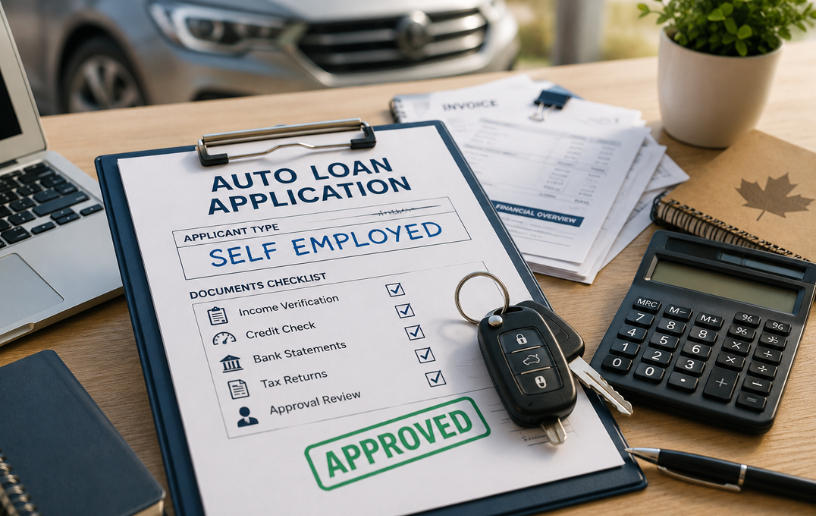
Documents Needed for a Self-Employed Car Loan in Canada
When applying for a self-employed auto loan, preparing your documents in advance can make the process smoother and faster.
Here are the most commonly required documents:
- Government-issued photo ID
- Driver’s license
- Proof of address
- Recent bank statements
- Personal tax returns (usually last 1-2 years)
- Notice of Assessment (NOA)
- Business registration documents
- GST/HST filings (if applicable)
- Proof of business ownership
- Income proof
- Vehicle information (if already selected)
Some lenders may request additional paperwork depending on your financial profile and loan amount.
Minimum Requirements to Qualify for a Self-Employed Auto Loan
While approval criteria vary between lenders, most self-employed applicants are generally evaluated based on a few key financial and eligibility requirements.
Credit Score
Most lenders prefer applicants with a healthy credit history and a reasonable credit score. A stronger score not only improves approval chances but may also help secure lower interest rates and better financing terms.
Proof of Stable Income
Lenders need confidence that you can comfortably manage monthly loan payments. Self-employed applicants are usually required to demonstrate stable income through tax returns, bank statements, or business financial records.
Self-Employment History
Many lenders prefer borrowers who have been self-employed for at least one to two years. A longer business track record often indicates greater financial stability and lower lending risk.
Debt-to-Income Ratio
Your existing financial obligations are also considered during the approval process. Lower debt levels generally improve borrowing capacity and reduce lender concerns.
Down Payment
While not always mandatory, a larger down payment can strengthen your application by reducing the total financed amount and lowering lender risk.
Canadian Residency and Identification
Applicants typically need valid Canadian residency status along with government-issued identification to qualify for vehicle financing.
How to Improve Your Chances of Getting Approved
If you are self-employed, taking a few proactive steps before applying for a car loan can significantly improve your approval chances and financing options.
Organize Your Financial Documents
Having updated tax returns, bank statements, and business records ready in advance can help speed up the approval process and create a stronger impression with lenders.
Improve Your Credit Health
Paying bills on time, reducing outstanding balances, and avoiding missed payments can gradually improve your credit profile and increase lender confidence.
Save for a Larger Down Payment
A higher down payment lowers the lender’s risk and may help you qualify for better loan terms, lower monthly payments, and reduced interest costs.
Reduce Existing Debt
Paying down current loans and credit card balances can improve your debt-to-income ratio and strengthen your financial position before applying.
Maintain Consistent Banking Activity
Regular deposits and healthy account management help demonstrate stable business income and responsible financial habits.
Choose a Realistic Vehicle Budget
Applying for financing on a vehicle that comfortably fits your income level can improve approval chances and reduce future financial strain.
Consider Getting Pre-Approved
Pre-approval helps you understand your financing eligibility before shopping for a vehicle and can make the buying process smoother and more efficient.
Can You Get a Car Loan with Bad Credit and Self-Employment?
Yes, it is possible to get a car loan even if you are self-employed and have bad credit.
Many specialized lenders in Canada offer financing options for:
- Low credit scores
- Past bankruptcies
- Missed payments
- Limited credit history
However, there are a few important things to keep in mind.
Higher Interest Rates
Bad credit borrowers often receive higher interest rates because lenders view them as higher risk.
Improving your credit before applying may help secure better terms.
Strong Income Proof Becomes More Important
If your credit score is low, lenders may focus more heavily on:
- Income stability
- Bank deposits
- Down payment amount
Providing clear documentation becomes especially important.
Beware of Predatory Lending
Not all lenders offer fair financing terms. Always review:
- Interest rates
- Loan duration
- Hidden fees
- Total repayment amount
Carefully comparing financing options can help avoid unnecessary financial stress.
Best Vehicles for Self-Employed Buyers on a Budget
For many self-employed individuals, balancing affordability with reliability is important when purchasing a vehicle. Here are a few practical vehicle considerations:
Fuel Efficiency
Lower fuel costs can help reduce ongoing monthly expenses, especially for individuals who drive frequently for work.
Reliability
Reliable vehicles help avoid unexpected repair costs and downtime.
Lower Insurance Costs
Certain vehicles are cheaper to insure, which can improve overall affordability.
Used Vehicles
Well-maintained used cars often provide excellent value while reducing loan amounts and monthly payments.
Choosing a financially practical vehicle may improve both loan approval chances and long-term financial comfort.
Self-Employed vs Salaried Applicants: what’s different at a glance?
While both salaried and self-employed individuals can qualify for car financing, the approval process may differ slightly.
| Factor | Salaried Employee | Self-Employed Applicant |
| Income Verification | Pay stubs | Tax returns & bank statements |
| Approval Speed | Usually faster | May require additional review |
| Documentation | Simpler | More extensive |
| Income Stability | Easier to verify | Evaluated more carefully |
| Flexibility | Standard employment | Depends on business history |
Self-employed applicants may face additional verification, but strong financial records can still lead to successful approvals.
Final Thoughts
Being self-employed does not mean you have to struggle when applying for a car loan in Canada. While the process may involve additional income verification and documentation, many lenders actively work with self-employed borrowers every day.
The key to improving your approval chances is preparation. Maintaining organized financial records, improving your credit score, reducing debt, and choosing a realistic vehicle budget can all help strengthen your application.
Whether you are a freelancer, entrepreneur, contractor, or small business owner, understanding the financing process can help you make informed decisions and secure a loan that fits your financial situation comfortably.
If you are exploring options for auto financing in Canada, working with experienced lenders who understand self-employed income structures can make the process much smoother and more manageable.
Frequently Asked Questions
Can freelancers get car loans in Canada?
Yes, freelancers can qualify for car loans in Canada if they can demonstrate stable income, reasonable credit history, and proper financial documentation.
What credit score do self-employed people need for a car loan?
Requirements vary by lender, but higher credit scores generally improve approval chances and help secure better interest rates.
Can I get a car loan with only bank statements?
Some lenders may accept bank statements as part of income verification, especially for self-employed applicants. Additional documents may still be required.
Do self-employed applicants pay higher interest rates?
Not necessarily. Interest rates depend on factors such as credit score, income stability, debt levels, and loan amount.
Can gig workers qualify for auto financing?
Yes, gig workers such as rideshare drivers and delivery professionals may qualify if they can demonstrate consistent earnings and meet lender requirements.
Is a down payment mandatory for self-employed buyers?
Not always, but making a down payment can improve approval chances and reduce overall loan costs.