Fixed vs. Variable Rate Auto Loans in Canada
27 April 2026When you're financing a vehicle in Canada, one of the first decisions you'll face is choosing between a fixed or variable interest rate on your auto loan. It might sound like a minor detail — but over the life of a loan, this choice can meaningfully impact how much you pay in total and how easy it is to manage your monthly budget.
The better choice depends on your financial situation, your risk tolerance, and what's happening in the broader interest rate environment. This guide breaks down how each type works, what the pros and cons are, and how to figure out which one makes more sense for you.
How Do Auto Loan Interest Rates Work in Canada?
When a lender offers you an auto loan, they charge interest on the amount you borrow — this is how they make money and account for the risk of lending. Your interest rate is expressed as an Annual Percentage Rate (APR) and is determined by several factors:
- Your credit score and credit history
- The loan term (how many months you'll be repaying)
- Whether the vehicle is new or used
- The lender's current rate environment and policies
- Your debt-to-income ratio
In Canada, auto loan rates typically range from as low as 0% on promotional dealer financing for new vehicles, up to 15–29% or higher for borrowers with challenged credit. The rate you're offered reflects the lender's assessment of how likely you are to repay — and whether your loan is fixed or variable determines how that rate behaves over time.
What Is a Fixed Rate Auto Loan?
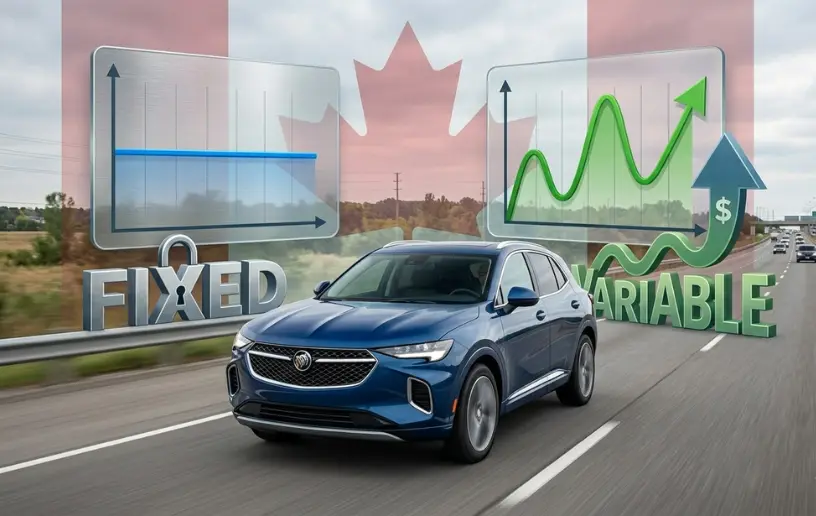
A fixed rate auto loan locks in your interest rate at the time of signing. It doesn't change — regardless of what happens to interest rates in the broader economy — for the entire duration of your loan.
This means your monthly payment stays exactly the same from your first payment to your last. Whether the Bank of Canada raises rates five times or cuts them significantly, your loan is unaffected.
How It Works in Practice
Imagine you borrow $25,000 at a fixed rate of 7.99% over 60 months. Your monthly payment is calculated at the outset and remains constant at approximately $507/month for the full five years. You know exactly what you owe, when you owe it, and what your total cost of borrowing will be on day one.
Pros of a Fixed Rate Auto Loan
- Predictable monthly payments — easy to budget and plan around
- Full protection if interest rates rise during your loan term
- Simpler to understand — no need to track rate fluctuations
- Peace of mind, particularly for first-time borrowers
Cons of a Fixed Rate Auto Loan
- If rates drop significantly, you don't benefit — you're locked in
- Fixed rates are sometimes slightly higher than initial variable rates, as lenders price in the certainty premium
- Less flexibility if your financial circumstances change
What Is a Variable Rate Auto Loan?
A variable rate auto loan — sometimes called a floating rate loan — has an interest rate that can change over the life of the loan. In Canada, variable rates are typically tied to the lender's prime rate, which itself follows the Bank of Canada's overnight lending rate.
When the Bank of Canada raises its benchmark rate, prime rates at financial institutions tend to follow, and your variable loan rate goes up. When the Bank cuts rates, your rate may decrease. This creates both opportunity and uncertainty.
How It Works in Practice
Using the same $25,000 example: if you start with a variable rate of 6.99%, your initial monthly payment would be slightly lower than the fixed-rate scenario. But if the Bank of Canada raises its rate by 0.50% over the following year, your rate — and your payment — adjusts upward accordingly.
Important: Variable rate auto loans are significantly less common in Canada than variable rate mortgages. Many auto lenders offer fixed rates exclusively. It's worth confirming with your lender whether a variable option is even available.
Pros of a Variable Rate Auto Loan
- Potentially lower starting rate compared to fixed options
- If rates fall, your interest costs decrease automatically
- Can result in lower total interest paid if rate environment is favourable
Cons of a Variable Rate Auto Loan
- Monthly payments can increase unpredictably
- Harder to budget when payments fluctuate
- In a rising rate environment, you pay significantly more over time
- Less widely available from Canadian auto lenders
Fixed vs. Variable Rate Auto Loans: At a Glance
| Fixed Rate | Variable Rate | |
| Monthly Payment | Always the same | Can change over time |
| Interest Rate | Locked in at signing | Tied to lender's prime rate |
| Budgeting | Easy to plan ahead | Requires flexibility |
| If Rates Drop | No benefit | Payments may decrease |
| If Rates Rise | Fully protected | Payments may increase |
| Best For | Stability seekers | Risk-tolerant borrowers |
| Availability in Canada | Very common | Less common |
The Canadian Rate Environment: Why It Matters
The current and anticipated interest rate environment in Canada plays a significant role for your choice between fixed and variable rate.
The Bank of Canada adjusts its overnight lending rate to manage inflation and economic growth. When inflation is high, the Bank raises rates to cool borrowing and spending. When the economy needs a boost, it cuts rates to encourage lending and investment. These decisions ripple through to the rates offered by banks, credit unions, and auto lenders.
In a high-rate environment — where rates are elevated and cuts are anticipated — a variable rate loan could become more attractive, since there's a reasonable expectation that your rate (and payment) could fall over time. In a low-rate environment where rates are expected to rise, locking in a fixed rate offers protection against future increases.
Keep in Mind: No one can predict interest rate movements with certainty — not economists, not lenders, not the Bank of Canada itself. Base your decision on your personal financial situation, not rate speculation.
Which Type of Loan Is Right for You?
Here's a practical framework to help guide your decision:
Choose a Fixed Rate Auto Loan If...
- You're on a tight or structured monthly budget and need payment certainty
- You're a first-time borrower and want simplicity over optimization
- You're financing over a longer term (48–84 months) and want to eliminate rate risk
- Interest rates are currently low and you want to lock them in before potential increases
- Financial predictability is more important to you than potentially saving money
Consider a Variable Rate Auto Loan If...
- You have financial flexibility and can absorb higher payments if rates rise
- You're financing over a shorter term (24–36 months), limiting your exposure to rate changes
- The variable rate offered is meaningfully lower than available fixed rates
- You believe rates are likely to decrease during your loan period
- Your lender actually offers this option — confirm availability first
Get A Pre-Approved Auto Loan in Canada
One of the best steps you can take before visiting a dealership — regardless of whether you go fixed or variable — is to get pre-approved for an auto loan. A pre-approval gives you a confirmed rate and loan amount from a lender before you start shopping, which puts you in a much stronger negotiating position.
When you're pre-approved, you walk into a dealership knowing your budget, your rate, and your monthly payment range. You're not reliant on whatever financing the dealer happens to offer on the day — and you have a benchmark to compare against if the dealer's financing desk presents an alternative.
Pre-approvals in Canada are typically valid for 30–90 days and have no impact on your credit score when done through a soft credit pull. They're one of the most practical tools available to Canadian car buyers.
Other Loan Terms That Matter Alongside Your Rate
Interest rate type is important, but it's not the only variable that determines the true cost of your auto loan. When comparing loan offers, also pay attention to:
1) Loan term
Longer terms mean lower monthly payments but significantly more interest paid overall. A 84-month loan at 7% costs far more in total than a 48-month loan at the same rate.
2) Total cost of borrowing
Ask your lender for the total amount repayable — principal plus all interest — not just the monthly payment.
3) Prepayment privileges
Can you make extra payments or pay off the loan early without penalty? This is especially valuable if you later want to refinance.
4) Fees
Some lenders charge origination fees, administration fees, or early repayment penalties. Read the fine print.
5) Rate type disclosure
Ensure the rate quoted is APR (Annual Percentage Rate), which includes fees, rather than a nominal rate that understates the true cost.
Summing Up
For most Canadian borrowers, a fixed rate auto loan is the more practical and popular choice — it's straightforward, predictable, and protects you from rate volatility over the life of your loan. Variable rate loans can make sense in specific circumstances, particularly for shorter loan terms or when rate decreases appear likely, but they require more financial flexibility and a higher tolerance for uncertainty.
Whatever you choose, the most important step is to shop around. Rates and terms vary meaningfully between banks, credit unions, and specialized auto lenders. Getting pre-approved before you shop puts you in the best possible position — you'll know exactly what you qualify for, and you can make your rate type decision with full information in hand.
Ready to get started? Getting pre-approved for an auto loan in Canada takes minutes and gives you the clarity you need to shop with confidence. Auto Lending Canada makes the process simple — no obligation, no impact to your credit score to get started.