Can You Get a Car Loan During a Consumer Proposal in Canada?
29 March 2026Filing a consumer proposal is one of the more responsible financial decisions a Canadian in debt can make. It is a legal agreement under the Bankruptcy and Insolvency Act that allows you to repay a negotiated portion of your unsecured debt over a period of up to five years, without surrendering your assets and without the long term consequences of bankruptcy.
But life does not pause while you work through a proposal. Jobs change, vehicles break down, and the need for reliable transportation does not disappear because your financial situation is complicated. For many Canadians in a consumer proposal, a car is not a luxury — it is what gets them to work, to medical appointments, and through daily life.
So the question of whether you can get a car loan during a consumer proposal is both practical and urgent. Here is everything you need to know.
What Is a Consumer Proposal?
A consumer proposal is a formal legal agreement between you and your creditors, administered under Canada's Bankruptcy and Insolvency Act. It allows you to negotiate a settlement where you repay a portion of what you owe, not necessarily the full amount — over a period of up to five years. Once your creditors accept the terms and you complete every payment, the remaining balance of the included debt is legally forgiven.
It is available to Canadians who owe up to $250,000 in unsecured debt, not including the mortgage on their primary residence. It is filed through a Licensed Insolvency Trustee, who is a federally regulated professional responsible for administering the process.
The moment a consumer proposal is filed, a legal stay of proceedings comes into effect. That means creditors are immediately prohibited from contacting you, garnishing your wages, or taking any legal action to collect the debts included in the proposal. For many Canadians, that alone brings significant relief.
What a Consumer Proposal Actually Does to Your Credit
When you file a consumer proposal in Canada, both Equifax and TransUnion assign an R7 rating to your credit report. This indicates that you are repaying your debts through a formal, negotiated settlement. The R7 status remains on your file for a defined period—either three years after the proposal is fully paid off or six years from the filing date, whichever comes first.
For perspective, an R1 rating reflects excellent credit, while an R9 indicates uncollectable debt or bankruptcy. An R7 rating falls between these, and is viewed more favorably than bankruptcy. This distinction can influence how lenders evaluate your risk level.
Unlike bankruptcy, a consumer proposal does not affect secured debts such as a car loan or mortgage. As long as you continue making your payments, you can retain your vehicle while managing your proposal obligations.
In practical terms, your credit score will be lower, and traditional lenders may consider you a higher-risk borrower. However, you are not excluded from accessing credit and this is a key point many people overlook while in a consumer proposal.
Can You Get a Car Loan in a Consumer Proposal?
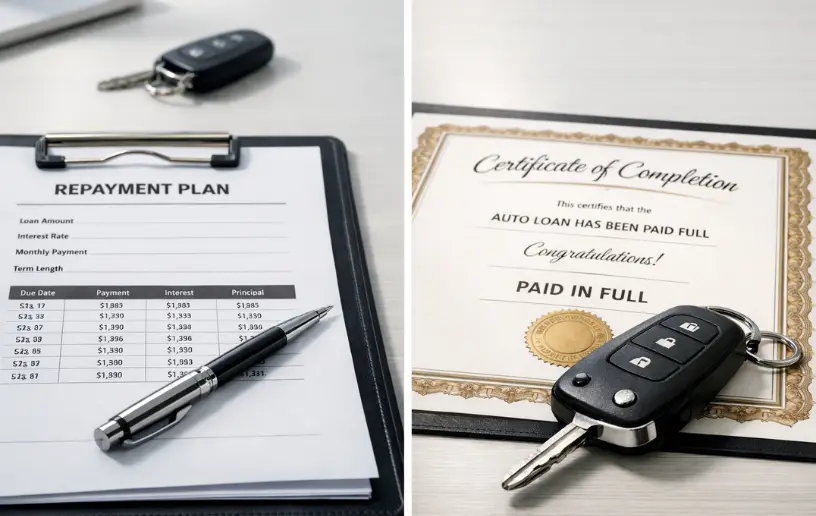
Being in an active consumer proposal does not prevent you from qualifying for vehicle financing. With approval from your Licensed Insolvency Trustee, a stable income, and the right lender, financing is still achievable. In fact, a properly managed auto loan can contribute to rebuilding your credit while you complete your proposal.
There are two key scenarios to consider:
During an active consumer proposal
You can apply for a car loan while your proposal is ongoing. However, you will need written consent from your Licensed Insolvency Trustee, and your options will generally be limited to lenders who specialize in higher-risk or credit-rebuilding financing. Approval is possible, but the process is typically more selective.
After completing your proposal
Once you receive your Certificate of Full Performance, your financing options broaden significantly. While it is possible to apply for a car loan at any stage, including during the proposal, approval tends to be easier—and often comes with more favorable terms—after the proposal has been fully completed.
Which Lenders Will Work With You
This is where many Canadians in a consumer proposal get frustrated, and understandably so. Walking into a bank branch and asking for a car loan during a consumer proposal will almost certainly result in a decline. Major chartered banks and most credit unions use automated underwriting systems that flag consumer proposals immediately.
Getting a car loan while currently in or coming out of a consumer proposal is possible if you apply through a private lender, show your proof of consumer proposal documents, and can ensure that your debt to income ratio is manageable.
The lenders worth focusing on are:
Subprime and specialty auto lenders: These institutions exist specifically for borrowers with complicated credit histories. Consumer proposals are well within their scope. They assess your application based on income stability, time into the proposal, and the loan to value ratio of the vehicle rather than your credit score alone.
Dealerships with subprime financing networks: Many dealerships in Canada maintain relationships with multiple subprime lenders and can submit your application to several simultaneously. This is often the most efficient route for someone in a consumer proposal, since the dealership handles much of the lender coordination on your behalf.
Co-signers: A good option for those applying for a loan during a consumer proposal is to find a co-signer. This lessens the risk to lenders and provides a backup plan if repayment becomes difficult. A creditworthy co-signer does not eliminate the challenge, but it significantly improves your approval odds and can result in a meaningfully lower interest rate.
What Lenders Will Actually Look At
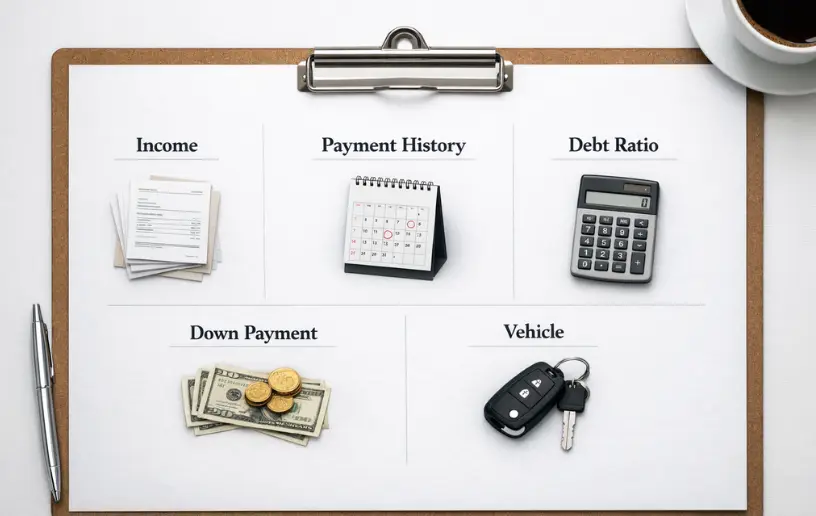
When a subprime lender evaluates a car loan application from someone in a consumer proposal, their decision rests on a different set of factors than a standard credit approval.
- Income stability: It is the single most important factor. Lenders want to see consistent, verifiable income — pay stubs, a letter of employment, or tax returns for the self employed. They need confidence that the monthly loan payment is affordable alongside the existing proposal payments.
- Payment history: Stable employment, consistent income, and at least six months of on time proposal payments significantly improve your approval chances. A borrower who has made every proposal payment on time for a year is in a materially stronger position than someone who filed six weeks ago.
- Debt to income ratio: The combined total of your proposal payment, loan payment, housing costs, and living expenses needs to remain manageable. Lenders will calculate this and use it as one of their primary approval criteria.
- Down payment: A down payment of 10% to 20% of the vehicle's value reduces the lender's exposure and demonstrates financial discipline. It does not guarantee approval, but it shifts the conversation considerably in your favor.
- Vehicle age and value: Reliable, reasonably priced vehicles are easier to finance. Extremely high value vehicles may reduce approval chances. Lenders who work in the consumer proposal space prefer vehicles under 10 years old and under 150,000 km because their collateral holds value better over the loan term.
What to Expect on Interest Rates
Honesty matters here. Interest rates during a consumer proposal will be higher than what you would have accessed before filing — sometimes significantly so.
Interest rates are typically higher than prime loans but often lower than post bankruptcy rates. Where a borrower with strong credit might access rates in the 7% to 10% range, someone in an active consumer proposal is more realistically looking at rates between 15% and 29.99% depending on the lender, the vehicle, and their specific financial profile.
The total cost of borrowing is the number to focus on — not just the monthly payment. A $15,000 loan at 24.99% over 60 months costs nearly $11,000 in interest. That is a real cost, and it is worth knowing before you sign anything.
The strategic response to a high rate is straightforward: put down as much as possible, choose the shortest term you can manage, and plan to refinance once your proposal is completed and your credit begins to recover.
Want to understand how rates work? Read: Understanding Car Loan Interest Rates in Canada
A Practical Example: How This Works in Real Life
Consider someone like David, a warehouse supervisor in Hamilton who is 18 months into a 48 month consumer proposal. His van broke down beyond repair and he needs a vehicle to get to work. Without it, he risks losing his job — and his job is what funds his proposal payments.
David speaks to his Licensed Insolvency Trustee first. He explains that he needs financing of approximately $14,000 for a reliable used vehicle, and that the monthly payment would be approximately $420. His trustee reviews his budget, confirms the payment is manageable alongside his proposal obligations, and provides written permission to take on new credit.
Armed with that approval, David works with a dealership that has established relationships with subprime lenders. He has saved $2,000 as a down payment, has 18 months of on time proposal payments behind him, and has held his current job for three years. Three lenders come back with offers. He takes the best one, reads the full contract, and drives away in a reliable vehicle that he can afford.
Eighteen months later, David completes his consumer proposal. He now has a consistent car loan payment history running alongside his certificate of completion. His credit profile is in a meaningfully stronger position than it was the day he filed — and he is already eligible to explore refinancing at a lower rate.
This is not an unusual outcome. It is what happens when someone in a consumer proposal approaches vehicle financing with the right preparation and the right expectations.
Understanding Your Existing Car Loan
If you already have a car loan when you file a consumer proposal, the situation differs from applying for new financing.
An auto loan is a form of secured debt, which means the lender’s rights over the vehicle remain in effect. As long as you continue making your payments, you can typically keep your car. However, if payments are missed, the lender has the right to repossess the vehicle.
A consumer proposal does not directly affect your existing car loan, provided you can manage both your proposal payments and your auto loan obligations at the same time.
If your current car payments become unaffordable, there are still options available. You may be able to negotiate revised terms with your lender, voluntarily surrender the vehicle and include any remaining balance as unsecured debt within your proposal, or consult your Licensed Insolvency Trustee to determine the most suitable approach within your financial plan.
Read more about exiting a car loan: Exiting a Car Loan in Canada: Your Options Explained
The Step by Step Summary
If you are in an active consumer proposal and need a car loan, here is the process in plain terms:
1. Speak to your Licensed Insolvency Trustee. Explain why you need the vehicle, what you expect to borrow, and what the monthly payment would be. Get written permission before applying anywhere.
2. Pull your credit reports. Check both Equifax and TransUnion for errors. Make sure your proposal documents are submitted to both bureaus so your report accurately reflects your situation. Errors on a credit report during a proposal are more common than people realize.
3. Save a down payment. Even $1,500 to $2,000 improves your position. More is better.
4. Focus on subprime and specialty lenders. Avoid major banks and instead work with dealerships that have established subprime financing relationships or lenders who specifically work with consumer proposal borrowers.
5. Choose a practical vehicle. Reliable, reasonably priced, and within the preferred age and mileage range that lenders in this space are comfortable financing.
6. Read the full contract. Understand the interest rate, the total cost of borrowing, the term length, and any prepayment penalties before you sign anything.
7. Make every payment on time. Set up automatic payments if possible. Consistent on time payments during a proposal build the credit history that makes everything easier once the proposal is complete.
Navigating credit after financial difficulty? Read: Can You Finance a Car After Bankruptcy in Canada?
Before You Sign Anything
A consumer proposal is not the end of your ability to access credit — it is a structured path through a difficult financial period. The car loan landscape during a proposal is more limited than it would be otherwise, and the rates will be higher than you would like. But financing is available, approval is achievable with the right preparation, and a responsibly managed car loan during this period actively contributes to your financial recovery rather than setting it back.
The most important thing you can do is start the right way: talk to your trustee first, understand what you can genuinely afford, and work with lenders who have experience in this specific situation.
Looking for financing that works with your situation? At Auto Lending Canada, we work with all credit types across Canada — including those in an active consumer proposal. Find out what you qualify for today.