
Exiting a Car Loan in Canada: Your Options Explained
15 March 2026You took on a car loan that made sense at the time. Now it does not. Whether your financial situation has changed, you got a bad deal, or life simply moved in a different direction, you are not as trapped as you feel. There are real, legitimate options available to Canadians in this situation, and this guide walks through every single one of them.
The most important thing to understand upfront is this: the earlier you act, the more options you have. A borrower who reaches out to their lender before missing a payment has significantly more leverage than one who has already fallen three months behind. Whatever your situation, now is the right time to deal with it.
Before You Do Anything: Know Your Numbers
Every option in this guide depends on two numbers. Before you make a single call or visit a single dealership, you need to know both of them clearly.
What you owe: Contact your lender and ask for a loan payout quote. This is the exact amount required to close the loan today, including any accrued interest. It is almost always higher than your remaining balance shown on a statement.
What the car is worth: Check Canadian Black Book in your province for comparable vehicles. This gives you a realistic market value, not a wishful one.
The difference between these two numbers defines your situation entirely. If your car is worth more than you owe, you have positive equity and the most options available. If you owe more than the car is worth, you are in negative equity — commonly called being underwater and some options will require you to cover that gap out of pocket.
Also pull out your original loan agreement and look for any prepayment penalty clause. Many Canadian lenders charge a fee for paying off a loan early. Knowing this figure before you act prevents expensive surprises.
Option 1: Refinance Your Loan
Refinancing means replacing your current loan with a new one, ideally at a better interest rate, a lower monthly payment, or both. It does not get you out of the loan entirely, but it can make it significantly more manageable.
This option makes the most sense if your credit score has improved since you took the original loan, if interest rates have dropped, or if you simply need breathing room in your monthly budget without giving up the vehicle.
The trade off worth understanding: extending your loan term lowers your monthly payment but increases the total interest you pay over the life of the loan. A $20,000 loan at 12% over 84 months instead of 60 months saves roughly $150 per month but costs you nearly $3,000 more in total interest. Run the full numbers before deciding.
To refinance, start with your current lender, they may offer a rate adjustment rather than lose you entirely. Then approach other lenders and credit unions for comparison.
Already thinking about refinancing? Read: Refinancing Your Auto Loan in Canada
Option 2: Sell the Car Privately
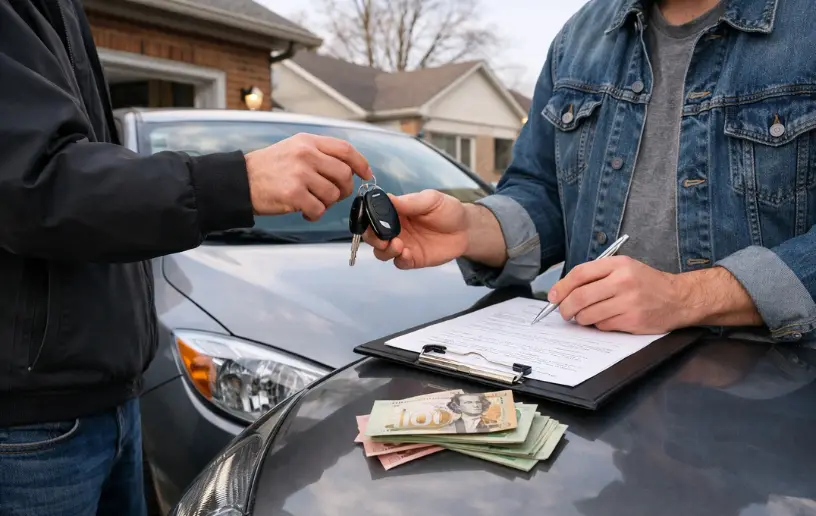
A private sale typically gets you more money than a trade-in at a dealership, which makes it the strongest financial exit if you are willing to put in the effort.
If you have positive equity: The process is straightforward. Find a buyer, get a formal payout quote from your lender, complete the sale, pay off the loan, and keep the difference.
Important note: Your vehicle has a lien on it until the loan is paid. Be transparent with the buyer and coordinate directly with your lender on how the title transfer works in your province.
If you are in negative equity: You will need to cover the shortfall out of pocket to clear the title before the buyer can take ownership. If you owe $18,000 and the car is worth $14,000, you need $4,000 to close the gap. That is a real cost, but for many people it is worth paying to stop ongoing interest accumulation on a depreciating asset.
Province specific considerations matter here. Ontario, British Columbia, and Alberta each have slightly different requirements around safety certificates, emissions testing, and ownership transfer. Check your provincial motor vehicle authority before listing the car.
Option 3: Trade In at a Dealership
The trade in route is faster and more convenient than a private sale, but that convenience comes at a cost. Dealerships will typically offer you less for your vehicle than the private market would.
If you have positive equity, a trade in is a clean and simple transaction. The dealer contacts your lender for a payout quote, applies the trade in value against it, and the difference either reduces what you owe on a new vehicle or comes back to you as cash.
But if you are rolling negative equity into a new loan, that is you owe more than your trade in is worth, many dealerships will offer to absorb that shortfall into your new financing. On paper it looks seamless. In reality, you are now paying interest on your old car's debt plus your new car's purchase price. This compounds the problem rather than solving it, and borrowers who go down this road often find themselves in a deeper hole two years later.
Comparing where to finance your next vehicle? Read: Best Time to Trade In Your Car in Canada
Option 4: Pay Off the Loan Early
The cleanest exit of all, assuming you have access to the funds. A lump sum payoff eliminates the loan entirely, releases the lien on the vehicle, and frees you from any further interest accumulation.
Canadians use various sources for early payoffs — savings, a tax refund, an inheritance, a personal loan at a lower rate, or a Home Equity Line of Credit for homeowners.
Before you pay, get the exact prepayment penalty from your lender in writing. Open loans have no penalty and can be paid off at any time. Closed loans typically carry a fee ranging from three months of interest to a percentage of the remaining balance. If the penalty is significant, run the math to confirm the payoff still makes financial sense compared to riding out the remaining term.
Once paid, request written confirmation from the lender that the lien has been discharged and update your vehicle registration accordingly. Do not skip this step.
Option 5: Voluntary Surrender
If you genuinely cannot make payments and have exhausted every other avenue, voluntary surrender is the option of last resort. It means contacting your lender, arranging to return the vehicle, and accepting the financial and credit consequences that follow.
Here is what most people do not realize: voluntary surrender does not wipe out what you owe. The lender will sell the vehicle, typically at auction, and if the sale price does not cover your outstanding balance, you are still responsible for the difference. That remaining amount is called a deficiency balance, and the lender will pursue it.
The credit impact is significant. A voluntary surrender is recorded negatively on your credit file and stays there for six years in most provinces. It is less damaging than a repossession which carries additional collection costs and fees on top of everything else but it is not a clean slate.
Before surrendering, ask your lender for a written estimate of the expected deficiency balance. Understand your rights under your province's consumer protection legislation, and consider whether your broader financial situation warrants a conversation with a Licensed Insolvency Trustee first.
Option 6: Transfer the Loan to Another Person
Some lenders allow what is called a loan assumption, where a qualified buyer takes over your loan entirely. If approved, the loan transfers to the new borrower, you are released from the obligation, and the vehicle changes hands.
In practice, this is less straightforward than it sounds. The new borrower must meet the lender's credit requirements, the lender must agree to the transfer, and not all loan agreements permit this. It is more common in dealership arranged financing than direct lender loans.
If you find a willing buyer and your lender is open to the arrangement, it can be a genuinely clean exit, particularly if the vehicle has positive equity and is attractive to someone in the market.
Beware of informal arrangements where someone simply starts paying you and you continue making loan payments on their behalf. If they stop paying, the legal and financial responsibility remains entirely yours. Any transfer needs to be formally documented through the lender, not arranged between two individuals on a handshake.
Option 7: Speak to a Licensed Insolvency Trustee

If the car loan is one problem among several — credit card debt, a mortgage you are struggling with, collection calls from multiple creditors, then the car loan conversation is really part of a much bigger picture.
A Licensed Insolvency Trustee (LIT) is a federally regulated professional who can review your entire debt situation and advise on whether a Consumer Proposal or Bankruptcy would be the most practical path forward. In some cases, these processes can restructure or discharge the car loan as part of a broader resolution.
Initial consultations with most Licensed Insolvency Trustees in Canada are free. This is not a sign of failure — it is access to expert guidance on a genuinely complex situation.
Exploring all your options after financial hardship? Read: Can You Finance a Car After Bankruptcy in Canada?
Your Options at a Glance
| Option | Best For | Credit Impact | Approximate Cost |
| Refinance | Cash flow pressure, improved credit | None to positive | Low |
| Private Sale | Positive or slight negative equity | None | Medium effort |
| Trade In | Positive equity, new vehicle needed | None | Below market value |
| Early Payoff | Access to lump sum | Positive | High upfront |
| Voluntary Surrender | Cannot pay, all else exhausted | Significant | Possible shortfall |
| Loan Transfer | Willing qualified buyer | None if approved | Low |
| Insolvency Trustee | Debt is broader than car loan | Varies | Low to none |
What Not to Do
A few mistakes Canadians make regularly in this situation:
- Simply stopping payments is the worst thing you can do. It triggers repossession, damages your credit severely, and still leaves you responsible for any deficiency balance after the vehicle is sold.
- Rolling negative equity into a new loan without understanding the full math is how people end up owing $30,000 on a car worth $18,000 two years later.
- Selling privately without a payout quote first is a legal problem. The lien on the vehicle follows the car, not the seller. A buyer who discovers a lien after purchase has grounds for a serious dispute.
- Assuming voluntary surrender erases the debt: The deficient balance remains collectible.
There Is a Way Forward
Getting out of a car loan in Canada is not simple, but it is entirely achievable with the right information and the right timing. The option that is right for you depends on three things: your equity position, your credit standing, and whether the car loan is your only financial challenge or part of a larger picture.
Start with the numbers. Know what you owe and what the car is worth before you make any decision. From there, every option in this guide becomes clearer.
And if you are in a position where keeping up with payments is genuinely difficult, act now, not later. The earlier you engage your lender or a financial professional, the more room you have to maneuver.
Need financing that actually works for your situation? At Auto Lending Canada, we work with all credit types across Canada. See what you qualify for today.