
Car Loans in Calgary: 2026 Rates, Requirements & How to Get Approved
23 August 2026Price out a car loan in Calgary this year and the numbers move around more than you'd expect. A dealership finance office quotes one rate, your bank quotes another, an online lender quotes a third. Some of that is normal, since lenders price risk differently. But part of it is that Alberta's car market has its own quirks: higher average vehicle prices than most of the country, a strong appetite for trucks and SUVs, and insurance costs that push some buyers toward longer loan terms just to keep the monthly payment livable.
This guide covers what car loan rates and approvals actually look like in Calgary right now, what lenders check before they say yes, and how to use a calculator to get a realistic number before you set foot on a lot.
What Car Loan Rates Look Like in Calgary Right Now
Rates in Calgary track the national picture closely, since most lenders serving Alberta also lend across the rest of the country. A few local factors nudge things, but the base bands are similar. Prime borrowers, meaning strong credit, stable income, low existing debt, are typically seeing rates in roughly the 6.9% to 9.9% range on new vehicles through banks, credit unions, and captive finance arms like GM Financial, Ford Credit, or Toyota Financial Services. Used vehicles usually run a point or two higher. Part of that is the vehicle itself being worth less as collateral, and part of it is that used-car loans carry more risk of the vehicle needing repairs the borrower can't absorb.
Once you move into non-prime or subprime territory, rates climb fast, sometimes into the high teens or beyond, depending on the lender and how far below the "clean credit" line the applicant sits. There's more detail on how these bands actually work, and why the posted rate on a dealership sign rarely matches what you're offered, in our breakdown of how car loan interest rates get set in Canada.
Why Calgary Specifically
Two things set Calgary apart from, say, Toronto or Vancouver. First, the average transaction price for a vehicle here tends to skew higher, largely because trucks and full-size SUVs make up a bigger share of sales. Makes sense given the climate and how much driving people do outside the city. A bigger loan amount means the interest rate matters more in dollar terms, even when the rate itself is identical to what someone in Ontario would get. Second, Alberta has no provincial sales tax. Compared to buyers in provinces charging 13-15% HST, that's a real advantage: it's one of the few places in the country where the sticker price and the out-the-door price aren't miles apart.
What Lenders Actually Look At
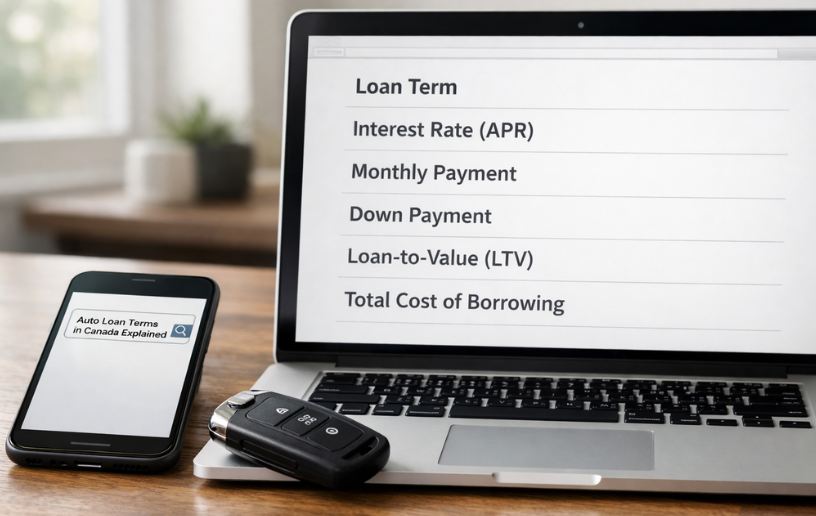
Every lender has its own scorecard, but the inputs are pretty consistent across the board:
- Credit score and credit history length, not just the number but how consistently you've paid things on time
- Debt-to-income ratio, including your existing car payment if you're trading in a vehicle that isn't paid off
- Employment stability, meaning how long you've been at your current job and whether income is salaried, hourly, or variable
- Down payment or trade-in equity
- Loan-to-value ratio, or how much you're asking to borrow relative to what the vehicle is actually worth
Income verification matters more than people expect. A lot of Calgary applicants work in oil and gas, construction, or trades, where pay can be commission-based or tied to overtime. Lenders sometimes average income over a longer period rather than taking the most recent pay stub at face value. If your income fluctuates, having a few months of bank statements ready alongside pay stubs speeds things up.
How Credit Tiers Change the Math
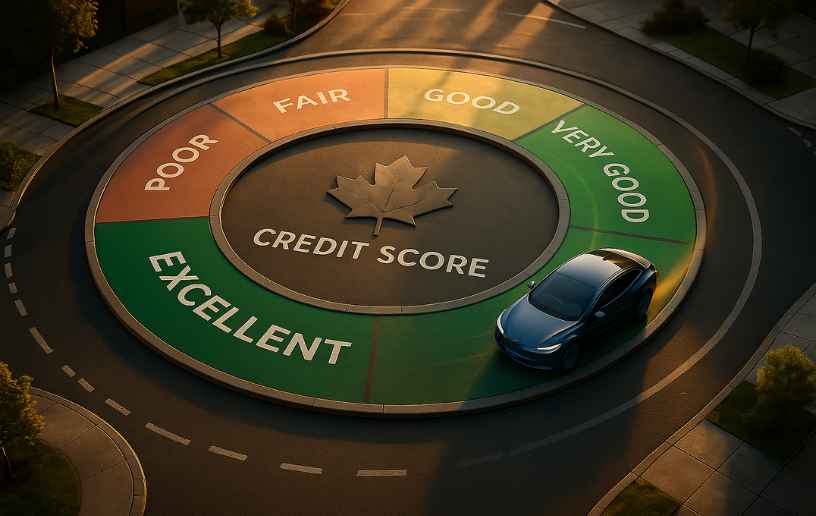
Lenders sort applicants into tiers, and Calgary follows the same general bands as the rest of Alberta and most of Canada. Super prime and prime borrowers, typically 720 and up, get the lowest rates and the widest choice of lenders. Near-prime, roughly 650 to 719, still qualifies at most banks and credit unions, just at a somewhat higher rate. Below that, into non-prime and subprime, fewer traditional lenders approve the loan outright, and the ones that do price in more risk.
None of this is unique to Calgary; it's how risk-based pricing works everywhere. But because average loan sizes here run higher, a few extra percentage points shows up as a bigger dollar difference over the life of the loan than it might on a cheaper vehicle elsewhere. Our Alberta car loan guide goes into more detail on how these tiers apply provincewide, if you're comparing Calgary to Edmonton, Red Deer, or anywhere else.
New vs. Used Financing
New vehicle loans and used vehicle loans aren't priced the same way, and it's worth knowing why before you start shopping.
New vehicles depreciate the moment they leave the lot, but lenders treat them as lower risk because the value and condition are known quantities. No wear, no mystery maintenance history. That's part of why new-car rates tend to sit lower. Manufacturer incentive financing, the 0.9%, 1.9%, sometimes even 0% offers, also only applies to new inventory, and usually only to buyers with strong credit.
Used vehicles are a different story. Age, mileage, and vehicle history all factor into the rate, and many lenders cap how old a vehicle can be and still qualify for financing, commonly somewhere around 8 to 10 years or a mileage ceiling. If you're looking at a used truck or SUV with higher mileage from farm or work use, which isn't unusual in this region, expect the lender to ask more questions about condition and possibly require an inspection report.
Loan Terms and What They Actually Cost You
Terms in Calgary run anywhere from 36 to 96 months, though 60 to 72 months is the most common range for new purchases and 48 to 60 for used. Longer terms lower the monthly payment, which is tempting when insurance, fuel, and everything else in Alberta is already stretching a budget. But they also mean more interest paid overall, and a longer stretch where you can owe more than the vehicle is worth, especially in the first couple of years.
Running the actual numbers before you sign anything matters more than most people realize. A car loan calculator lets you plug in the vehicle price, your estimated rate, the term, and your down payment to see the real monthly payment and total interest cost, not the rounded-off figure a salesperson gives you verbally. We break down the actual formula lenders use, not just a black-box calculator, in this guide to how car loan calculators work in Canada. Running two or three term lengths side by side before you negotiate is a few minutes well spent.
Getting Approved in Calgary With Bad Credit
Bad credit doesn't automatically rule out financing in Calgary, but it changes what the process looks like. Lenders who work with non-prime and subprime applicants exist specifically because banks alone don't serve that segment well, and Calgary has enough of them, through both dealership networks and online lenders, that a lower score isn't the dead end it might feel like.
What tends to help: a larger down payment reduces the loan-to-value ratio and gives the lender less to lose if something goes wrong, which can open up options that wouldn't otherwise be on the table. Steady income and time at your current job or address carries weight too, sometimes more than the credit score itself. A cosigner with stronger credit can help as well, if that's an option.
To be clear about what this means in practice: approval isn't guaranteed for any applicant, and no legitimate lender can promise an outcome before reviewing your file. Rates and terms for lower credit tiers will generally run higher than prime rates, sometimes substantially. What a subprime-friendly lender offers is a real shot at approval and a path to rebuilding credit through consistent payments, not a guarantee. For more on how the approval process works when your credit isn't clean, our guide to bad credit car loans in Canada covers the documentation lenders typically ask for and how rates compare across credit tiers.
Why Apply Online Instead of Just Walking Into One Dealership
Walking into a single Calgary dealership means you're seeing one lender's offer, maybe two if the finance manager shops it around. Applying online with a lender that works across Alberta changes that math, because your application gets checked against a wider network of banks, credit unions, and specialty lenders at once, instead of whatever the dealership happens to have a relationship with.
That matters more than it sounds like. Two lenders can look at the same file and land on rates a full point or two apart, and there's no way to know which one a given dealership defaults to unless you compare. It also means you can walk into a dealership already knowing your approved rate and budget. That shifts the negotiating leverage back toward you: the dealer is now competing against a number you already have in hand, rather than setting the number for you.
Getting a sense of where you stand before you shop costs nothing and takes a few minutes. If you want to see what you'd actually qualify for, you can get pre-approved online through Auto Lending Canada's application and use that number as your starting point, whether you end up buying in Calgary, Airdrie, Okotoks, or anywhere else in the province.