
Car Loan Down Payment in Canada Explained
02 April 2026Getting a car loan in Canada doesn’t legally require a down payment. However, in practice, lenders strongly favor borrowers who can contribute upfront, as it reduces risk and improves overall loan terms.
A down payment influences more than just approval, it affects your interest rate, monthly payments, and the total cost of your vehicle over time. The amount you put down can determine how flexible your financing options are and how much you ultimately pay.
Understanding how down payments work, what lenders expect, and how different scenarios impact your financing will help you make a more informed and cost-effective decision. Here’s what you need to know.
What's a Down Payment and Why It Matters
A down payment is the upfront amount you pay toward a vehicle purchase, with the remaining balance financed through a lender.
For lenders, a down payment signals commitment and financial discipline. It reduces the amount they need to finance, which lowers their overall risk. In many cases, a larger down payment can lead to more favorable loan terms, including lower interest rates and improved chances of approval.
If you are curious about what options may be available to you right now, Auto Lending Canada can help you review your situation and get pre-approved today
Down Payment Requirements Across Canada
Different lenders have different expectations. Here's what you can typically expect:
| Lender Type | Typical Down Payment | Notes |
| Traditional Banks | 10-20% | Prime borrowers often get away with 10-15% |
| Credit Unions | 5-15% | More flexible, especially for members |
| Dealership Financing | 0-20% | Varies widely; zero-down promos have higher rates |
| Online/Alternative Lenders | 5-10% | Faster approval but higher interest rates |
Most mainstream lenders want to see at least 10% down. If you can manage 15-20%, you're in the sweet spot.
How Your Down Payment Affects Interest Rates
Each additional percentage you put toward a down payment can have a meaningful impact on your interest rate and total borrowing cost. Consider a $30,000 vehicle:
- 10% down ($3,000): You finance $27,000 at approximately 7.99%, resulting in about $6,200 in interest over five years.
- 15% down ($4,500): You finance $25,500 at roughly 6.99%, with total interest around $5,600—saving about $600.
- 20% down ($6,000): You finance $24,000 at approximately 5.99%, leading to about $4,800 in interest over five years. This results in total savings of roughly $1,400 compared to a 10% down payment.
The difference is significant. Increasing your down payment by just 10% in this scenario reduces your total interest cost by more than $1,400.
Your Credit Score and Down Payment
Credit scores and down payment requirements are closely connected in auto financing, as lenders evaluate both to assess overall risk. A lower credit score typically requires a higher down payment, as it signals financial commitment and helps reduce the lender’s exposure.
The relationship is relatively consistent across lending scenarios. Borrowers with excellent credit (750+) often qualify with down payments in the 5–10% range while accessing the most competitive interest rates. Those with good credit (700–749) generally see requirements around 10–15%. For fair credit (650–699), lenders typically expect 15–20% down. Applicants with scores below 650 are usually required to provide 20–25% or more, or turn to alternative lenders, where interest rates tend to be higher.
At its core, the principle is simple: stronger credit profiles lead to lower upfront requirements and better financing terms, while weaker credit histories require a larger initial investment to offset the increased lending risk.
Financing Options That Skip the Down Payment
- Zero-Down Financing is typically offered at model year-end or during promotional periods. However, it often comes with a trade-off—interest rates are usually 1–3% higher to offset the lender’s increased risk. On a $30,000 vehicle over five years, this can result in an additional $2,000–$3,000 in interest. It’s important to evaluate the total cost before proceeding.
- Lease-to-Own Programs allow you to lease a vehicle with the option to purchase it at the end of the term. These programs generally require lower upfront payments (around 5–10%), but you are effectively paying for the flexibility of leasing before committing to ownership. This option is best suited for individuals who are uncertain about keeping the vehicle long term.
- Using Your Trade-In is often one of the most practical options. If you already own a vehicle, its trade-in value can be applied toward your down payment. This reduces the amount you need to finance without requiring additional cash upfront.
How to Save for Your Down Payment
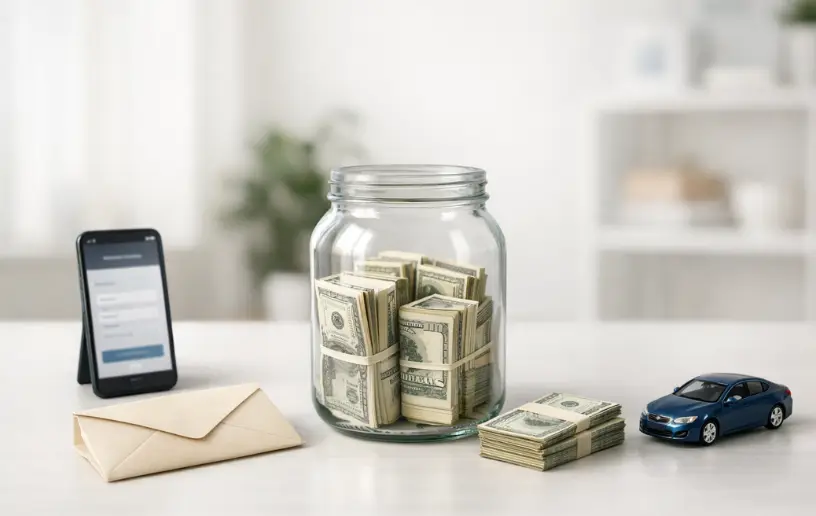
Saving for a down payment can be challenging, but with the right approach, it becomes far more manageable. Here are practical strategies that can help you build your fund consistently:
- Automate your savings : Set up automatic transfers from your primary account to a dedicated savings account on payday. This approach ensures consistency and removes the temptation to spend. Even saving $200 per month can grow to $2,400 over a year.
- Use your tax refund strategically : The average Canadian tax refund ranges between $1,500 and $2,500—enough to cover a significant portion of a down payment. Allocating this amount directly to your savings can accelerate your progress.
- Direct additional income toward savings : Bonuses, freelance earnings, or any extra income should be allocated to your down payment fund. Small contributions over time can make a meaningful difference.
- Evaluate your current vehicle’s value : If you own a car, consider getting it appraised. Even if there is an outstanding loan, the vehicle may still hold trade-in value that can be applied toward your next purchase.
- Consider family support carefully : Financial assistance from family can help, but lenders may require clarification on whether the funds are a gift or a loan. Ensure proper documentation if needed.
What to Avoid
- Do not use your emergency fund. Maintain at least 3–6 months of living expenses separately for financial security.
- Avoid taking high-interest personal loans solely to fund a down payment, as this increases your overall cost.
- Do not use credit cards for a down payment, as this simply adds more debt rather than reducing it.
A disciplined, structured approach to saving not only strengthens your financial position but also improves your overall financing terms when you are ready to purchase.
Common Mistakes People Make
Mistake 1: Not Shopping Around for Financing. Most people accept whatever the dealership offers. Don't do that. Get pre-approved at your bank or credit union first. You'll likely get a better rate, and you'll have leverage when negotiating with the dealer.
Mistake 2: Forgetting About Insurance. If you finance a car, the lender requires full coverage (comprehensive and collision). That's not optional. This can add $1,500-$3,000 a year to your costs. Budget for it before you commit.
Mistake 3: Buying More Car Than You Can Afford. Just because you can get approved for a $40,000 car doesn't mean you should. Factor in insurance, maintenance, fuel, and winter tires. Your monthly payment isn't the whole story.
Mistake 4: Negotiating Down Payment Instead of Price. Your down payment size isn't what matters, the total vehicle price does. Negotiate hard on the car price first, trade-in value second, and down payment last.
Mistake 5: Paying Down Payment Before Final Approval. Never pay your down payment until financing is fully approved and all terms are in writing. Protect yourself.
Negotiating at the Dealership

Preparation is your strongest advantage. Before visiting a dealership, secure a pre-approval for financing so you clearly understand your budget and interest rate. Research current market prices for similar vehicles and determine the value of your trade-in in advance.
At the dealership, keep the negotiation structured. Start by agreeing on the purchase price of the vehicle first. Do not introduce your down payment at this stage. Next, negotiate your trade-in value separately. Only after both figures are finalized should you move on to financing terms and down payment details.
Use your leverage strategically. Referencing a pre-approved rate (e.g., “I have an approval at 6.5%—can you offer better?”), indicating that you are comparing multiple dealerships, or committing to proceed immediately if specific terms are met can all strengthen your position.
Remain alert to potential warning signs. Avoid making any down payment before financing is fully approved. Be cautious of unexpected changes to agreed terms, particularly interest rates. If anything is unclear or presented informally, request written confirmation before proceeding.
If you are curious about what options may be available to you right now, Auto Lending Canada can help you review your situation and get pre-approved today
What Happens With Full Coverage Insurance
When you finance a vehicle, lenders require both comprehensive and collision coverage to protect their investment. As a result, insurance costs are typically higher. For a financed vehicle, full coverage can range from approximately $150 to $250 or more per month, depending on factors such as the vehicle type, location, and driver profile. In contrast, an unfinanced vehicle may only require liability coverage, which generally falls between $100 and $150 per month.
This difference can amount to an additional $500 to $1,500 annually, so it’s important to factor insurance costs into your overall budget before making a purchase.
If your down payment is less than 15%, it may be worth considering gap insurance. Typically costing between $500 and $1,000, gap insurance covers the difference between what you owe on your loan and the vehicle’s value if it is written off early in the term. In certain situations, it can provide valuable financial protection.
Understanding the Numbers
Let’s bring everything together with a practical example. Consider purchasing a $30,000 vehicle in Canada with a 5-year loan at 6.99% interest:
- 10% down ($3,000):
Monthly payment is approximately $527. Total interest paid is around $5,600, with insurance costs of about $2,000 per year. Your total cost over five years comes to roughly $39,100. - 15% down ($4,500):
Monthly payment drops to about $497. Total interest is approximately $4,900, with similar insurance costs. The total 5-year cost is around $37,950. - 20% down ($6,000):
Monthly payment further reduces to about $467. Total interest is roughly $4,200, with insurance remaining consistent. Your total cost over five years is approximately $37,200.
Increasing your down payment by $3,000 in this scenario results in savings of about $1,900 over the loan term. This highlights how a larger upfront investment can meaningfully reduce your overall cost of ownership.
Key Takeaways
Aim for a 15–20% down payment to improve approval chances and secure better interest rates. Build this through consistent savings such as automatic transfers, bonuses, and tax refunds.
Get pre-approved before shopping to understand your budget and strengthen your negotiating position. At the dealership, focus on negotiating the total vehicle price first—not the down payment.
Factor in the full cost of ownership, including insurance and maintenance, not just your monthly payment. Most importantly, avoid rushing—preparing financially in advance leads to better decisions.
While not mandatory, a larger down payment significantly reduces your total cost and improves loan terms.
Take the first step toward your next vehicle with Auto Lending Canada.