
How to Compare Two Car Loan Offers in Canada
17 March 2026Most Canadians spend more time researching the car than they do the loan that pays for it. That is understandable — the car is the exciting part. But the loan is where the real financial decision gets made. Two offers sitting in front of you can look completely different on the surface and cost almost the same over time, or look nearly identical and have thousands of dollars separating them once you do the full math.
This guide walks through exactly how to compare two car loan offers side by side — what numbers to look at, what questions to ask, and what dealers and lenders do not always volunteer upfront.
Why the Monthly Payment Is the Wrong Place to Start
Walk into almost any dealership in Canada and the conversation will eventually land on one question: what monthly payment works for you?
It is a reasonable sounding question. It is also the wrong one to anchor your decision on.
Here is why. A $30,000 loan at 7.99% over 48 months produces a monthly payment of approximately $733. That same $30,000 loan at 9.99% over 72 months produces a monthly payment of approximately $537. The second option looks like a better deal by nearly $200 a month. But over the life of the loan, the first option costs you roughly $5,180 in total interest. The second costs you roughly $8,680. That is a $3,500 difference — on the exact same vehicle purchase — simply because one term is longer and one rate is higher.
Monthly payments tell you what leaves your account every month. They do not tell you what the loan actually costs. That distinction matters enormously.
The Five Numbers That Actually Matter
When you have two loan offers in front of you, these are the only five numbers worth comparing:
1. The Interest Rate (APR): The annual percentage rate is the cost of borrowing expressed as a yearly percentage. In Canada, lenders are required to disclose this. A lower APR means less interest paid over the life of the loan — everything else being equal. But everything else is rarely equal, which is why APR alone is not enough.
2. The Loan Term: This is the length of the loan expressed in months — 36, 48, 60, 72, or 84 months being the most common in Canada. Longer terms lower monthly payments but increase the total interest you pay. Shorter terms cost more per month but less overall. The term and the rate work together to determine your actual cost.
3. The Total Cost of Borrowing :This is the number most people never ask for and most lenders never volunteer. It is the total amount you will pay over the entire life of the loan — principal plus every dollar of interest. Ask for this figure specifically, in writing, before you agree to anything. It is the single most honest representation of what the loan costs you.
4. Fees and Additional Charges: Some lenders in Canada charge origination fees, administration fees, or documentation fees on top of the loan itself. These are sometimes buried in the fine print and rarely mentioned in the initial conversation. Ask directly: are there any fees associated with this loan beyond the interest? Get the answer in writing.
5. Prepayment Penalties: A prepayment penalty is a fee charged by some lenders if you pay off your loan early — either through lump sum payments or by closing the loan before the term ends. Open loans have no penalty. Closed loans often do. If there is any chance you might refinance, sell the car, or pay off the loan ahead of schedule, this clause matters significantly.
A Real World Comparison: Meet Sarah and the Two Offers on Her Table
Sarah lives in Mississauga and is financing a used Honda Accord priced at $28,000. She has put $3,000 down, so she needs to finance $25,000. Two offers are on the table and she wants to figure out which one actually makes more sense.
| Offer A — Her Bank | Offer B — Dealership Partner | |
| Loan Amount | $25,000 | $25,000 |
| Interest Rate | 7.49% | 6.99% |
| Term | 60 months | 72 months |
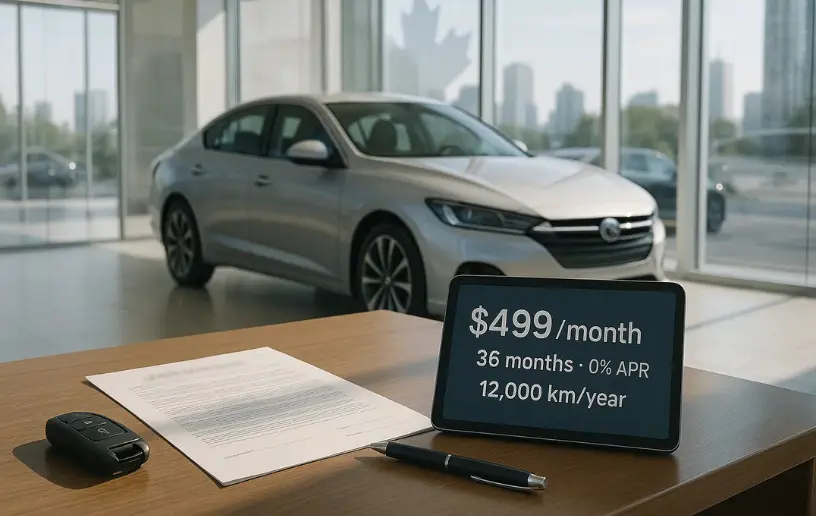
| Monthly Payment | $499 | $432 |
| Total Interest Paid | $4,940 | $6,104 |
| Administration Fee | $0 | $299 |
| Prepayment Penalty | None — open loan | Yes — 3 months interest |
| Total Cost of Loan | $29,940 | $31,403 |
At first glance, Offer B looks attractive. The rate is lower and the monthly payment is $67 less. But the total cost of borrowing tells a different story — Offer B costs Sarah $1,463 more over the life of the loan once the administration fee is included. And if she wants to sell the car or refinance before the 72 months are up, she faces an additional penalty on top of that.
Offer A costs more each month. It costs significantly less overall. That is exactly the kind of decision that gets made the wrong way when monthly payment is the only number on the table.
When the Lower Rate Is Not the Better Deal
It seems counterintuitive, but a lower interest rate does not always mean a cheaper loan. The term length is the variable most people underestimate.
Consider two offers on a $20,000 loan:
| Offer C | Offer D | |
| Interest Rate | 8.99% | 7.49% |
| Term | 48 months | 72 months |
| Monthly Payment | $498 | $348 |
| Total Interest Paid | $3,904 | $5,056 |
| Total Cost of Loan | $23,904 | $25,056 |
| Months in Debt | 48 | 72 |
Offer D has the lower rate and the lower monthly payment. It also costs $1,152 more in total interest and keeps you in debt 24 months longer, on a depreciating asset.
The lesson is straightforward: always look at total interest paid, not just the rate. A half percentage point difference in rate means very little when it comes attached to a term that is 24 months longer.
The Negative Equity Trap

This is the situation that catches a large number of Canadian car buyers off guard, particularly those who stretch into longer loan terms.
Negative equity also called being underwater — is when you owe more on your loan than the vehicle is currently worth. Cars depreciate quickly in Canada. A new vehicle loses roughly 20% of its value in the first year and close to 50% over five years. A 72 or 84 month loan on a new vehicle almost guarantees a period of negative equity, sometimes lasting three years or more.
Why does this matter when comparing offers? Because if you need to sell the car, trade it in, or the vehicle is written off in an accident before your loan is paid down, negative equity becomes your problem immediately. The insurance payout covers what the car is worth. It does not cover what you owe.
When comparing two offers, consider which one gets you to neutral equity faster. The shorter term loan almost always wins on this measure and gap insurance, which covers the difference between your loan balance and the insurance payout in a write off situation, is worth pricing out if you are going with a longer term.
Variable vs. Fixed Rate Loans in Canada
Most car loans in Canada are fixed rate — the interest rate is locked in for the full term and your payment never changes. Some lenders offer variable rate loans, where the rate moves in line with the Bank of Canada's prime rate.
Variable rate loans occasionally start lower than fixed rate offers, which can make them appear more attractive at first glance. The risk is straightforward: if the Bank of Canada raises rates during your loan term, your payments go up. For buyers on a tight monthly budget, that unpredictability is a meaningful risk.
For most Canadian car buyers comparing two standard offers, fixed rate is the more predictable and manageable option. If one offer is variable and one is fixed, factor in the rate risk before treating the variable option as the cheaper loan simply because it starts lower.
The Comparison Checklist: What to Ask Before You Decide
Before committing to either offer, work through this list with both lenders:
- What is the exact APR — not an estimated or promotional rate?
- What is the total cost of borrowing over the full term?
- Are there any fees beyond the interest — administration, origination, documentation?
- Is this an open or closed loan — are there prepayment penalties?
- What happens if I want to pay a lump sum during the term?
- Is the rate fixed or variable?
- What is the loan amount after all fees are included?
- Is there any optional product bundled into this loan I have not explicitly agreed to?
That last question matters. Payment protection insurance, extended warranties, and GAP insurance are legitimate products but they are sometimes added to loan offers without being clearly flagged as optional. Know exactly what you are financing before you sign.
Wishing to understand the auto loan terms? Read: Auto Loan Terms in Canada Explained
One Final Thing Worth Knowing
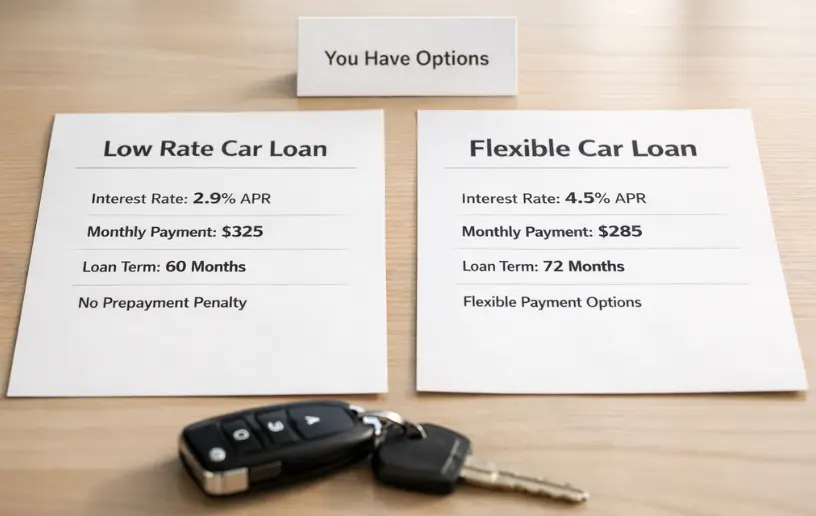
Negotiation does not stop at the vehicle price. The loan is negotiable too.
If you have a pre approval from your bank or credit union before you visit the dealership, you walk in knowing your rate and your ceiling. Dealerships often have access to a range of lending partners and the ability to match or beat a rate you already have. A pre approval is leverage — and leverage is exactly what you want when two offers are sitting on the table.
Not yet pre approved? Read: Getting Pre-Approved for a Car Loan in Canada
Want to understand how rates are set? Read: Understanding Car Loan Interest Rates in Canada
Before You Sign
Two loan offers that look similar on the surface can be thousands of dollars apart once the full math is done. The monthly payment is the number lenders lead with. The total cost of borrowing is the number that actually defines the deal.
Know what you owe at the end of the term, not just what leaves your account every month. Ask for every fee in writing. Understand the prepayment terms before you commit. And if one offer needs more explaining than the other to make sense — that is usually telling you something.
The right loan is not the one with the lowest monthly payment. It is the one that costs you the least over the full period you are paying it.
Want to see what rates you qualify for? At Auto Lending Canada, we work with all credit types across Canada. Find out what you qualify for today.