
Car Loan Interest Rates by Credit Score in Canada
21 September 2026A lot of people search their exact credit score number, 600, 682, 700, 750, wanting one specific answer: what rate does that number actually get me on a car loan? The honest answer is that no lender can quote you a precise rate from a score alone, since term length, the vehicle, your income, and the lender's own risk appetite all factor in too. But the score bands do map to real, predictable ranges, and knowing roughly where you sit tells you a lot about what to expect before you ever submit an application.
Why the Label "Good" or "Bad" Matters Less Than the Number
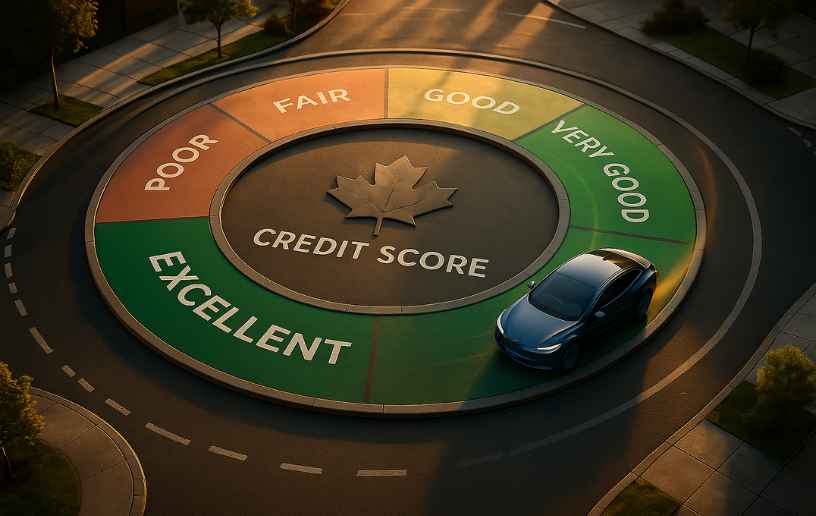
Our guide to what counts as a good credit score in Canada covers how Equifax and TransUnion define the 300 to 900 scale. That is useful background, but it does not answer the more practical question, which is how much that label actually costs you in interest. A "good" score and a "very good" score can sit fairly close together on the ratings chart while still translating into a noticeably different rate on a five or six year auto loan, simply because lenders price risk in finer increments than the four or five labels on a typical ratings table.
Typical Rate Ranges by Credit Tier
These ranges are illustrative, not a quote, and they move with the broader rate environment, lender, term length, and vehicle. Treat them as a realistic starting point for what to expect, not a guarantee.
| Score Range | Where You Typically Land | What to Expect |
| 760+ (e.g. 780, 850) | Top tier | The lowest end of a lender's posted range, plus the widest choice of terms and vehicles. |
| 725–759 (e.g. 745, 750) | Strong tier | Slightly above the top tier, with straightforward approval and heavy lender competition. |
| 660–724 (e.g. 682, 700) | Broad "good" range | Where most approved Canadian car loans actually land, with banks, credit unions, and direct lenders all realistic. |
| 600–659 | Fair credit | Bank approval gets harder, rates climb further, but specialty and direct lenders approve this range routinely. |
| Below 600 | Higher-risk tier | Highest rates, but a larger down payment, a cosigner, or a specialty lender can meaningfully change the offer. |
What Actually Explains the Gap Between Tiers
The difference between a top-tier rate and a fair-credit rate is not arbitrary. Lenders are pricing the statistical likelihood of missed or late payments based on your credit history, and that likelihood changes meaningfully between someone with a clean multi-year payment record and someone who has had recent delinquencies. The gap also reflects the loan term, since a longer term carries more risk over more years, and the vehicle itself, since an older or higher-mileage car is worth less as collateral if a loan ever needs to be recovered.
Approved Is Not the Same as Approved at a Good Rate
It is possible to qualify for a car loan at almost every point on the credit spectrum, but qualifying and qualifying for a competitive rate are two different outcomes. Our breakdown of the minimum credit score to apply for a car loan in Canada covers how low a score can go and still get an approval, which is a useful companion to this guide if your main concern right now is getting approved at all rather than optimizing the rate.
How to Move Up a Tier Before You Apply
If your score sits near the bottom of a tier, even a modest push can put you into the next bracket before you submit an application. Paying down credit card balances to lower your utilization ratio tends to move the needle fastest, often within a single billing cycle. Correcting any errors on your credit report, disputing them with Equifax or TransUnion directly, can also recover points you did not actually lose fairly. Our guide on rebuilding your credit with a car loan covers longer-term strategies if you are working from further down the scale and want a plan rather than a quick fix.
If Your Score Is Well Below Average
A low score does not mean you sit out the car market waiting to rebuild for a year or two. Bad credit auto lending exists specifically because banks are not built to serve every file, and our full guide to bad credit car loans in Canada walks through what realistic approval actually looks like at this end of the spectrum, including what a lender will typically ask for to offset the added risk.
The Bottom Line
Your exact credit score number is a strong predictor of your rate tier, but it is one input among several, not a fixed price tag. Two buyers with the same score can still land different offers depending on term length, the vehicle, and which lender they apply with. The most useful thing you can do with your score is understand roughly where it puts you, then shop more than one lender type to find out what that number actually translates to for your specific situation.
Auto Lending Canada works with buyers across British Columbia, Alberta, and Saskatchewan at every point on the credit spectrum. Start your application here to see your actual rate, not just a range.