
Car Loans in Victoria, BC: Rates, Requirements, and How to Apply
28 September 2026Victoria has a quieter car market than Vancouver's, but that doesn't make financing here any simpler. Ferry dependency, a housing crunch that's pushed a lot of workers out to Langford and the West Shore, and an older-than-average population all shape what lenders see when a Victoria application lands on their desk. If you're shopping for a car loan on the island, the mechanics are the same as anywhere in BC, but a few local details are worth knowing before you walk into a dealership.
What Victoria's commute patterns mean for your loan
A growing share of people who work downtown live in Langford, Colwood, or further out toward Sooke, commuting in on the Trans-Canada or the McKenzie interchange every day. That commute adds real kilometres, which matters more than people think when a lender is evaluating a used vehicle's mileage against its age. A five-year-old car with 120,000 km from a West Shore commuter isn't unusual, but it can push a used vehicle out of a tighter lender's age-and-kilometre caps depending on the program.
If your daily drive is long, factor that into which vehicle you finance. A lender might approve a shorter-term loan on a higher-mileage used car more comfortably than a longer one, since the vehicle needs to hold enough value to back the loan for the full term.
What actually moves your rate
Same fundamentals as anywhere else in the province: credit score does the heaviest lifting, followed by loan-to-value, term length, and income stability.
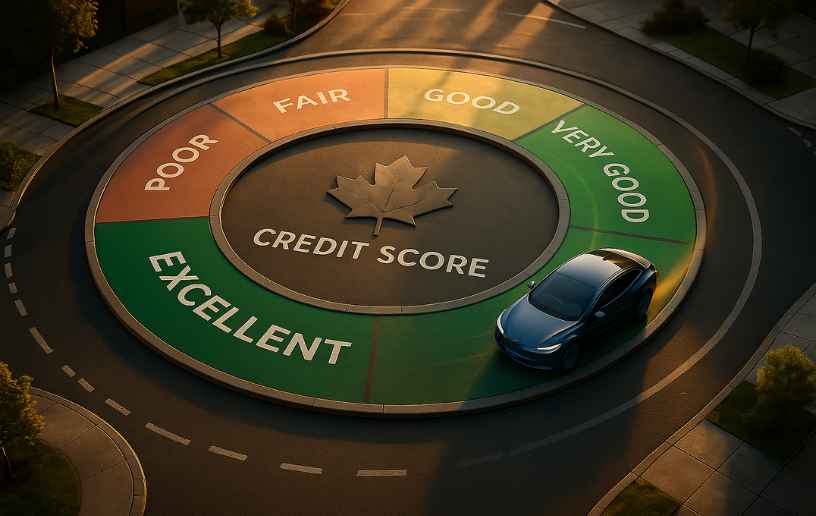
- Credit score: Scores in the 700s tend to land the lowest rates through banks and credit unions. Scores in the 600s still qualify, typically through a specialty or near-prime lender, at a higher rate. Below 600 moves into subprime territory, where approval is still realistic but the rate reflects the added risk. Our guide to bad credit car loans in Canada breaks this down further.
- Down payment and trade-in equity: More money down narrows the loan-to-value gap and usually improves your rate.
- Term length: Shorter terms cost less in total interest but raise the monthly payment. Longer terms do the opposite, and can leave you underwater on the loan for longer.
- Income and debt-to-income: Lenders want your car payment to fit comfortably next to Victoria's housing costs, which run high even by BC standards.
Documents Victoria lenders typically ask for
Have these ready before you start shopping lots along Douglas Street or out toward the West Shore auto row:
- Government-issued photo ID and a BC driver's licence
- Recent pay stubs, or a Notice of Assessment if you're self-employed
- Proof of address (utility bill or lease agreement)
- Banking information for pre-authorized payments
- Vehicle details if you've already picked something out
Government and public-sector employment is common on the island, and it tends to be viewed favourably by lenders because of its stability. If your income comes from provincial or federal government work, bring your most recent pay stub and be ready to confirm employment length; it can speed up approval since the income risk profile reads as low.
Ferry dependency and the real cost of ownership
If you regularly cross to the mainland, whether for work, family, or medical appointments not available on the island, ferry costs add a real monthly line to your transportation budget that a lender doesn't see but you should. This isn't unique to car ownership, but it does mean the payment that looks comfortable on paper needs to leave room for BC Ferries fares if that's part of your regular routine.
It's also worth thinking about vehicle size if ferry trips are frequent. Larger vehicles cost more per crossing, and that adds up over a year of regular trips in a way a one-time price comparison at the dealership won't show you.
ICBC and Vancouver Island driving conditions
Vancouver Island's climate is milder than most of the province, but Victoria still sees its share of wet-weather driving, and ICBC premiums reflect driving record and vehicle type more than they reflect the calendar. Get an insurance quote before you finalize a vehicle choice, not after, especially if you're moving from a smaller car to something larger for ferry or family reasons.
Dealer financing versus shopping the market
Victoria has a reasonable cluster of dealerships, mostly concentrated along Douglas Street and out in the View Royal and Langford corridor. A dealership's finance desk can be convenient, but they typically represent a handful of lenders rather than the full market. If your credit is strong, that may not matter much. If your file is thinner, if you're newer to Canada, or if you're rebuilding credit after a rough patch, a broker that shops multiple lenders at once tends to open up options a single dealer relationship won't.
For the province-wide picture on how BC financing works generally, our guide to car loans in British Columbia covers the mechanics in more depth than we have room for here.
Buying privately on the island
Private sales are common in Victoria, partly because the island's used car market skews toward vehicles that have been well maintained in a milder climate with less road salt exposure than the mainland. That reputation is generally deserved, but it's not a substitute for an actual inspection. Get a pre-purchase inspection and a vehicle history report before you finalize a private purchase, and confirm with your lender or broker whether they require proof of inspection on older vehicles before funding.
If your rate no longer fits
If you financed a vehicle a few years back and your credit has improved since, or rates have shifted, refinancing is worth a look. The process is the same comparison exercise as a new purchase: shop the offer across more than one lender rather than assuming your current one is still competitive.
Ready to apply from Victoria?
Auto Lending Canada works with drivers across British Columbia, Alberta, and Saskatchewan, including buyers on Vancouver Island navigating ferry costs, long West Shore commutes, and everything in between. Approval depends on your individual credit and income, but comparing multiple lenders is still the simplest way to see what you actually qualify for. Start your application here.