
Car Loan vs. Line of Credit in Canada: Which Is Better for Buying a Vehicle?
26 August 2026If you're shopping for a vehicle and already have a mortgage or a home equity line of credit, you've probably wondered whether you even need a car loan at all. Why not just draw the money from your HELOC or personal line of credit and skip the application entirely? Fair question. The answer depends on your finances, your discipline with revolving credit, and how much you value knowing your payment isn't going to move. That's a different question from the one we cover in our personal loan vs. car loan breakdown, because a line of credit doesn't behave anything like an installment loan. Here's what actually separates a car loan vs. line of credit in Canada, and how to figure out which one fits you.
Two very different products
A dedicated car loan is an installment loan. You borrow a fixed amount, agree to a fixed term (typically 24 to 96 months), and pay it back in equal installments covering both principal and interest. The vehicle itself secures the loan, which is part of why lenders can often offer more competitive rates than they would on unsecured borrowing. Once you sign, the payment doesn't move. You know exactly what you owe every month until the loan is gone.
A personal line of credit, including a HELOC, works completely differently. It's revolving credit, structured more like a credit card: you're approved for a limit, you draw against it as needed, and you pay interest only on what you've actually used. There's no fixed repayment schedule unless you build one yourself, and the rate is usually variable, tied to your lender's prime rate. Using a HELOC to buy a car in Canada means writing yourself a cheque against your home equity and paying it back on whatever timeline you set. That's genuinely flexible. It's also where the risk hides.
The application process differs too. A car loan is usually tied to the purchase itself, so the lender knows exactly what the money is for and can underwrite around that specific vehicle. A HELOC application involves appraising your home, confirming your equity position, and often takes longer to set up in the first place, which matters less if you already have one open and unused but matters a lot if you're starting from scratch a week before you need a car.
How the numbers usually compare
Because HELOCs are secured against real estate, their rates can sometimes look attractive next to unsecured personal lines of credit, and can occasionally land close to car loan rates depending on the lender and your credit profile. Standard, non-HELOC personal lines of credit generally carry higher variable rates than a secured car loan, since the lender is taking on more risk with no vehicle or property backing the debt. Our guide to understanding car loan interest rates walks through what actually moves your rate up or down, if you want a closer look at current pricing.
The variable-rate part is what trips people up. A car loan locks your rate for the life of the loan, so a $30,000 loan at a fixed rate costs the same in year one as it does in year five. A line of credit tied to prime moves with the Bank of Canada's rate decisions, so your "car payment" this year might not look anything like it does two years from now. On a $30,000 to $40,000 vehicle, that swing on a revolving balance adds up. Run your own numbers before assuming one option wins on cost. Our car loan calculator uses the real formula lenders apply, so you can weigh a fixed loan payment against what a variable line of credit would realistically cost you.
What each option looks like day to day
With a car loan, the structure does the work for you. One payment a month, the balance drops on schedule, and the loan disappears from your life on a date you already know. There's no temptation to pay only interest and let the balance sit, because the loan doesn't allow that. Every payment chips away at principal whether you think about it or not.
A line of credit hands that discipline back to you. Plenty of people who use a HELOC or personal line of credit to buy a vehicle intend to pay it down aggressively, and plenty do. But minimum payments on a LOC are often interest-only, so it's entirely possible to keep making the minimum for years without touching the principal, especially once the new-car feeling fades and other expenses start competing for that money. If you track your accounts closely and treat a LOC balance like a loan you're actively retiring, none of this is a problem. If that's not you, a car loan's built-in structure is doing you a favour whether you notice or not.
Credit score and utilization effects
This is where the two products pull apart in a way people don't expect. A car loan is an installment account, and credit scoring models generally reward a mix of installment and revolving credit. It also leaves your credit utilization ratio untouched, and that ratio (how much of your available revolving credit you're using) carries real weight in your score.
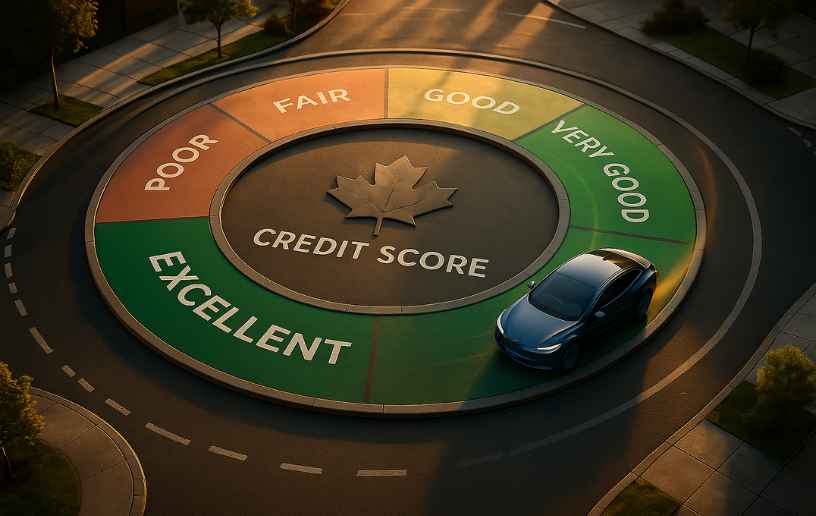
A line of credit is revolving credit, full stop, so drawing a large chunk of it to buy a vehicle raises your utilization on that account right away. Tap $25,000 out of a $30,000 HELOC limit and you're sitting at roughly 83% utilization on that line. Scoring models tend to punish high utilization even when the underlying debt is entirely manageable, which can dent your score right when you might need it strong for something else. Check where your score actually stands before deciding either way; our explainer on what counts as a good credit score in Canada lays out the ranges lenders look at.
When a line of credit can make sense
None of this makes a LOC the wrong tool. For a specific kind of buyer, it can be the better move. Substantial home equity, an excellent credit history, and the discipline to pay the balance down on your own schedule (not the minimum) can make a HELOC's lower secured rate and flexibility genuinely save you money, especially if you're paying something close to cash and expect to clear the balance within a year or two. It can also make sense if you're buying privately and want funds already sitting there instead of working through a separate loan approval.
The trade-off: you're putting home equity to work on a depreciating asset. If your situation changes unexpectedly, a variable-rate revolving balance offers a lot less certainty than a fixed payment you already knew was coming.
When a dedicated car loan is usually the safer call
For most buyers, car loan vs. line of credit isn't really close. If you don't have significant home equity to draw against, want a payment that won't move no matter what the Bank of Canada does next, or just prefer knowing your payoff date the day you sign, a car loan is the more predictable route, and usually the safer one. It's also more accessible if your credit isn't quite at the "excellent" tier lenders want before extending a large, flexible line of credit. Auto financing is built around the vehicle as collateral, so approval can be within reach even when a big unsecured or home-equity facility isn't.
There's no single right answer. It comes down to your equity position, your credit profile, your appetite for a variable rate, and whether you actually trust yourself to treat a revolving balance like a loan instead of available spending room.
Next steps
Price out both paths with your real numbers, not rough guesses. Run the loan amount through our calculator, check where your credit stands, and compare that fixed monthly payment against what a variable-rate line of credit would cost over the same stretch, assuming at least one rate increase along the way rather than today's rate holding forever. If a dedicated car loan looks like the better fit once you've done that math, find out what you'd actually qualify for before committing to anything. Get pre-approved with Auto Lending Canada and see your real rate and payment options before you decide.