
Equifax vs. TransUnion: Which Credit Bureau Do Canadian Auto Lenders Actually Use?
22 September 2026Pull your free credit score from two different apps and you'll often see two different numbers. Not a rounding difference, sometimes 20 or 30 points apart. That's not a bug in either app. Canada runs on two separate credit bureaus, Equifax and TransUnion, and they don't always hold identical information on you. Which one your lender actually checks can change what rate you're quoted, so it's worth understanding before you assume either number is the one that matters.
Why two bureaus can show two different scores
Equifax and TransUnion each build their files independently. Lenders and creditors choose which bureau, or bureaus, they report your payment activity to, and not every creditor reports to both. A credit card issuer might report monthly to both bureaus, while a smaller lender or a particular line of credit reports to only one. Over time, that means your two files can end up holding slightly different account histories, different derogatory marks, or different utilization snapshots, even though they're describing the same person.
The scoring formulas themselves also aren't identical between the two bureaus, even when they're built on similar underlying models. Two files with nearly the same information can still produce scores that land a bit apart just from how each bureau's model weighs different factors.
Which bureau do auto lenders actually pull
There's no single universal answer, and that's the part most explainers skip. Some banks and credit unions pull Equifax as their default. Others default to TransUnion. A number of direct and specialty auto lenders pull both bureaus on every application and use whichever score, or a blended view of both, fits their underwriting model. Which one shows up on your application often comes down to which bureau that specific lender has a reporting relationship and pricing agreement with, not anything about you personally.
This is part of why two lenders can quote you noticeably different rates from the same credit profile on the same day. One might be pricing off a TransUnion score that happens to sit a bit higher than your Equifax file, and the other is doing the opposite.
Why checking only one bureau can leave you guessing
Most of the free credit-monitoring apps Canadians use pull from just one bureau, commonly Equifax through some apps and TransUnion through others. If you've only ever checked one, you genuinely don't know what your other file looks like, and you won't know until a lender pulls it during an application. That's a reasonable amount of uncertainty walking into a negotiation, especially if you're close to a tier boundary where a small score gap could shift your rate tier in either direction.
Pulling both files before you apply, most Canadians can request a free report from each bureau directly, gives you the fuller picture. You're checking for the same things on both: your actual score, any accounts you don't recognize, incorrect balances, or old derogatory marks that should have aged off by now.
What to do if the two scores disagree meaningfully
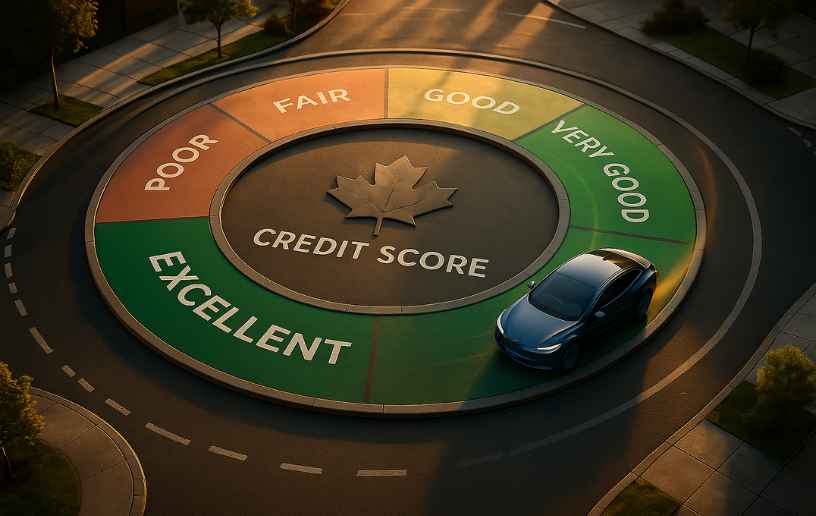
A gap of five or ten points between bureaus is normal and rarely changes anything. A gap of 30, 40, or more points usually means one file is missing something the other has, a paid-off account that was never updated, a dispute that resolved on one bureau but not the other, or an error that only shows up in one place. Our guide on what counts as a good credit score in Canada covers how the 300 to 900 scale works generally, which is useful background once you know which number you're actually starting from.
If you spot a real discrepancy, disputing it directly with the bureau that's showing the error is the fastest path to fixing it, and it's worth doing before you apply rather than after, since a correction can take a few weeks to process and reflect in your file.
How this connects to shopping multiple lenders
Because auto lenders don't all pull the same bureau, shopping more than one lender isn't just about comparing quoted rates side by side, it can also mean you're being evaluated against different underlying files. That's one more reason a single declined application or a single high quote isn't the full picture of what you can actually get approved for. If your first quote came in higher than expected, it's worth asking, even informally, whether it was priced off Equifax or TransUnion, since a different lender pulling the other bureau might see a meaningfully different number.
Soft-pull pre-qualification tools, which many direct lenders offer before a hard inquiry hits your file, are a low-risk way to see roughly where you'd land with a given lender without committing to an application first. Our explainer on rebuilding your credit with a car loan covers related strategies if either file needs work before you're ready to shop seriously.
The bottom line
Your Equifax and TransUnion files aren't guaranteed to match, and the lender you apply with determines which one actually decides your rate. Checking both before you shop, rather than assuming whichever app you already use tells the full story, means fewer surprises when an application comes back with a number that doesn't match what you expected.
Auto Lending Canada works with lenders across British Columbia, Alberta, and Saskatchewan who evaluate both bureaus. Start your application here to see your real rate rather than guessing from a single score.