
How Much Car Can You Afford in Canada? A Simple Formula for Your Budget
23 August 2026Most people start car shopping backwards. They find a vehicle they like, check what the payment would be, and decide whether that number feels okay. It usually does, because a finance manager is very good at making $612 a month sound reasonable. The better approach is to work out your number first, on your own, before you're sitting across from anyone whose job depends on you saying yes.
Here's how to get there.
Start with take-home pay, not the sticker price
Forget the price of the car for a minute. The number that matters is what the car costs you every month, all in: loan payment, insurance, fuel, and maintenance. A common rule of thumb is to keep that total under roughly 15 to 20 percent of your net (after-tax) monthly income. Lower if you're carrying rent or a mortgage that already eats a big share of your paycheque. Higher if you're debt-free with room to spare.
Say you bring home $4,200 a month. Twenty percent of that is $840, and that $840 has to cover everything, not just the loan. If insurance runs $180 and fuel and maintenance land around $220, you're down to roughly $440 for the actual payment before you've broken your own budget. That's a very different number than what a dealer's payment calculator will show you, because that calculator only knows about the loan.
Why the all-in number matters more than the payment
Insurance in Canada varies wildly by province, age, driving record, and vehicle. A 22-year-old in Ontario insuring a sports coupe is paying in a different universe than a 45-year-old in Nova Scotia insuring a Corolla. Fuel and maintenance shift with what you drive, too: a truck with a big engine costs more to feed than a compact hatchback, and an older vehicle tends to need more repairs than one still under warranty. None of that shows up when you're only looking at the loan payment, which is exactly why so many people end up "car poor." The payment's fine. The insurance bill that shows up in month two is the one that actually hurts.
The 20/4/10 rule, and where it gets shaky in Canada right now
You'll see this rule mentioned a lot: put 20 percent down, finance for no more than 4 years, and keep total vehicle costs under 10 percent of gross income. It's a decent gut check. It's also American in origin, built for a different rate environment than the one we're in now.
Four-year terms are increasingly rare on new vehicle financing in Canada. Seventy-two and 84-month terms are common, partly because vehicle prices have climbed and partly because a longer term is how dealers keep the monthly payment looking friendly. That's not automatically a bad thing, but it does mean the "4" in 20/4/10 doesn't reflect how most Canadians are actually financing. And 10 percent of gross income is a tighter number than most car budgets in this country, especially with insurance premiums where they've been running lately.
Treat 20/4/10 as a reference point, not gospel. If you can hit 20 percent down and a shorter term, good for you — you'll pay less interest overall and build equity faster. If you can't, that's normal too. Just don't let a longer term become the excuse to buy more car than you actually need. We've written before about what happens to the total cost of a loan once you stretch it to 84 months, and the short version is that the payment shrinks while the total interest paid grows by a lot more than most people expect.
Down payment and loan term move the math more than people expect
Two levers change what's "affordable" more than almost anything else: how much you put down, and how long you finance for.
A bigger down payment does two things at once. It lowers your monthly payment, obviously, but it also cuts the total interest you pay over the life of the loan, and it protects you from being underwater (owing more than the car is worth) in the first year or two, when depreciation hits hardest. Even an extra $1,000 or $2,000 up front can meaningfully change your monthly number. If you're still working out how much to put down, this breakdown of how down payments work on a Canadian car loan walks through the trade-offs in more detail.
Loan term is the sneakier lever. Stretching a $30,000 loan from 60 months to 84 months might drop your payment by $150 or so, and that's the part everyone notices. What gets missed is the extra interest you pay for the privilege, plus the extended stretch of time you'll spend owing more than the car is worth. A shorter term costs more per month and less overall. A longer term does the opposite. Neither is universally right. Pick on purpose, not because 84 months happened to be the default the finance software spat out.
Your credit score decides the rate, and the rate decides what you can afford
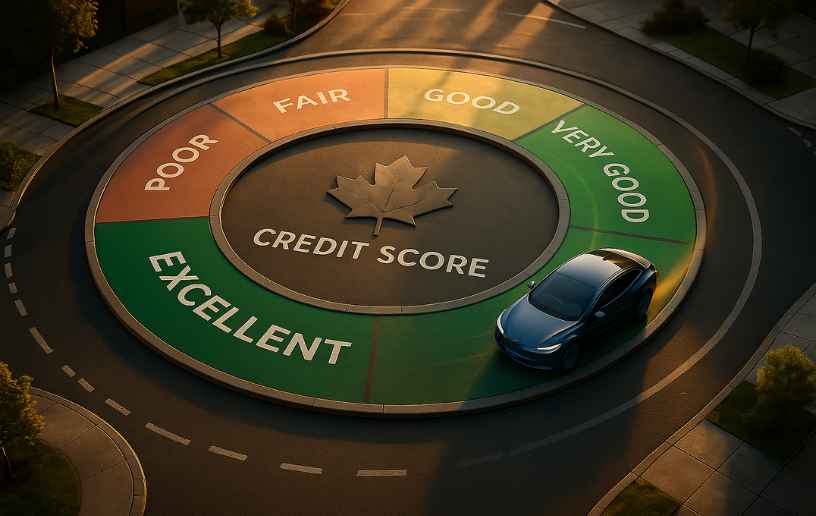
This is the part people skip, and it's arguably the most important one. The affordability math above assumes some interest rate, but the rate you'll actually be offered depends heavily on your credit. Two people financing the identical $28,000 vehicle over 60 months can end up with payments $60 or $70 apart purely because of where their credit sits. Same car, same term, same price, different rate.
Lenders in Canada generally sort applicants into tiers, and the gap between a "good" score and a "fair" one can be several percentage points of interest, which adds up fast on a five-year loan. If you're not sure where you stand, this overview of what counts as a good credit score in Canada is worth a look before you start shopping. It's a lot easier to plan around your real rate than to guess and hope.
One thing worth knowing: checking your own score doesn't hurt it. A soft pull, the kind you get from your bank's app or a free credit monitoring service, is invisible to lenders and doesn't move your score at all. It's hard pulls, the ones that happen when you formally apply for financing, that can ding it slightly, and usually only if you're racking up a lot of them over an extended period. Shopping around within a short window (most scoring models give you roughly two weeks) generally counts as one inquiry rather than several — here's a fuller rundown of how soft and hard inquiries actually affect your score.
What a lender will approve isn't the same as what's comfortable
Lenders calculate what's called a debt-to-income ratio, and they'll often approve you for more car than fits comfortably in your actual monthly budget. Not because anyone's out to trap you. Their formula doesn't know about your grocery bill, your kid's hockey registration, or the fact that you'd like to put something toward savings this year. It only sees income and existing debt.
So getting approved for a $650 monthly payment doesn't mean $650 is a good idea for you specifically. It means a lender's formula, applied to your income and your existing debts, produced that ceiling. Your job is to find your own number underneath it, using the all-in math from the top of this article, and shop within that number, not up to it.
Sanity-check your number before you shop
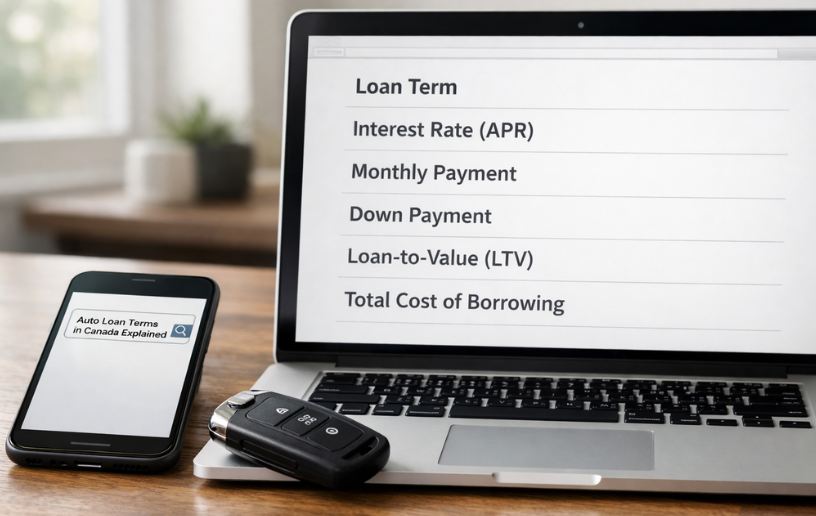
Once you have a rough monthly figure in mind, run it through a real car loan calculator before you go anywhere near a dealership. Plug in a realistic price, a down payment you can actually make, an interest rate somewhere near what your credit tier suggests, and a term you'd genuinely be comfortable carrying. Then look at what comes out. If the payment is higher than your budget allows, that tells you something useful — adjust the price range, add to the down payment, or shorten the term, before you're sitting in a sales office with a countdown clock running in your head. A calculator built on the real loan formula, not a simplified version, will get you close to what you'll actually see on paper.
None of this has to be guesswork. Getting pre-approved before you shop tells you your real rate and your real budget upfront, based on your actual credit and income rather than a rough estimate. You're negotiating from a position of already knowing your number, instead of finding it out for the first time at the finance desk. You can start a pre-approval with Auto Lending Canada in a few minutes and walk into any dealership knowing what you can genuinely afford.
The formula isn't complicated, even if the dealership math is designed to make it feel that way. Add up the real monthly cost of owning the car, not just financing it. Compare that to your take-home pay, not your gross salary. Know your credit tier before you fall in love with a specific vehicle. And treat whatever a lender approves you for as a ceiling, not a target. Do that, and the number you land on will still hold up six months from now, not just on the drive home from the dealership.