
Car Loan Calculator Alberta: Estimate Your Monthly Payments (2026)
25 August 2026Shopping for a vehicle in Calgary, Edmonton, Red Deer, or anywhere else in Alberta? A car loan calculator Alberta shoppers can actually trust isn't magic. It's the same amortization formula banks use internally, adjusted for two things that matter here specifically: Alberta charges GST only on vehicle purchases, with no PST on top, and the rate you'll actually qualify for depends heavily on your credit profile. Typing numbers into a generic online widget only gets you so far if you don't understand what it's doing. Below is the real formula, the inputs that move your payment the most, and three worked examples using vehicle prices and rates typical of the Alberta market in 2026.
How a Car Loan Calculator Alberta Buyers Use Actually Works
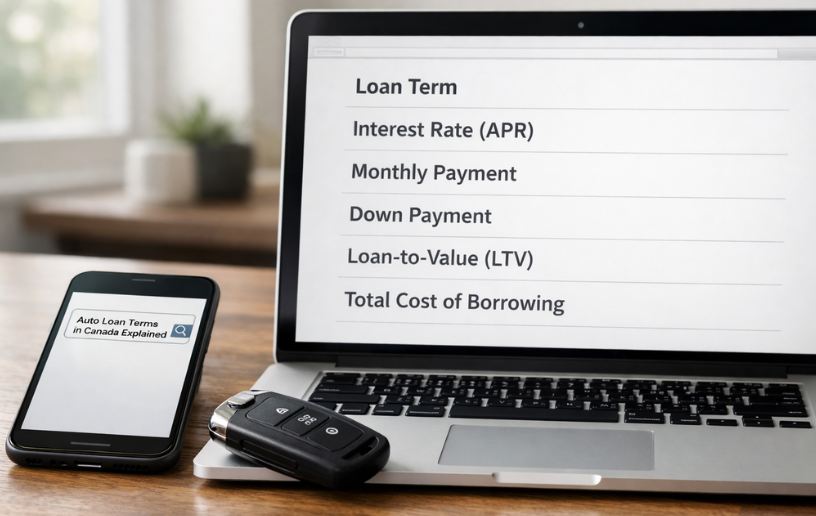
Every car loan calculator, no matter how polished the interface, runs the same standard amortization formula:
M = P × [r(1+r)^n] / [(1+r)^n − 1]
M is your monthly payment. P is the principal, meaning the amount you're actually financing. r is your monthly interest rate (annual rate divided by 12). n is the number of monthly payments in your term. It looks like a lot on paper, but it's just spreading the loan and its interest across every payment so the balance lands at zero on the exact month your term ends. We break this formula down step by step, with a full calculation, in our guide to the real car loan calculator formula used across Canada, which is worth a read if you'd rather build your own spreadsheet than lean on a tool.
The part people usually get wrong isn't the math. It's the principal. P is not the sticker price of the car. It's the sticker price plus GST, minus your down payment and trade-in value. Get that number wrong and every payment estimate after it is wrong too.
What Actually Feeds Into Your Alberta Car Loan Payments
Principal: price, GST, down payment, and trade-in
Alberta is one of the few provinces where a vehicle purchase only attracts the 5% federal GST. There's no provincial sales tax stacked on top, which is a genuine advantage over what buyers in Ontario or BC pay for a similarly priced vehicle. GST still applies to whatever amount you finance, though, so it belongs in the calculation. Most Alberta dealers apply your trade-in value as a credit against the purchase price before GST is calculated, which lowers the tax you owe compared to selling the car privately and buying separately. A larger down payment does the same thing from the other direction: it shrinks what you're borrowing, which shrinks both the monthly payment and the total interest that piles up over the loan.
Rate: what your credit profile actually gets you
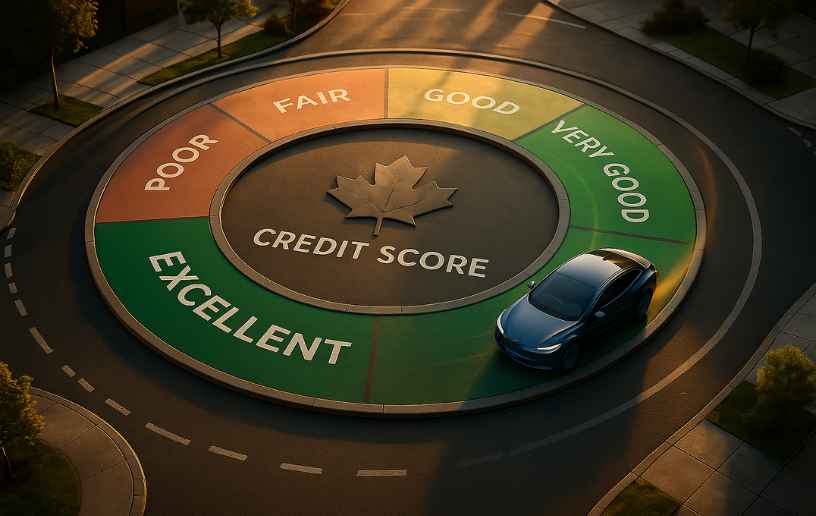
This is where the biggest swings happen. Lenders price auto loans based on credit score, income stability, loan-to-value ratio, and whether the vehicle is new or used. A borrower with strong credit might land in the high single digits. Someone rebuilding credit after a rough stretch will usually see a rate several points higher. Neither is guaranteed ahead of a full application, but knowing roughly where your profile sits helps you build a realistic estimate before you talk to a lender. Bank of Canada rate movements filter down into what lenders offer too. Our breakdown of recent BoC rate cuts and their effect on Canadian car loans covers how that's played out lately.
Term: the payment-versus-interest tradeoff
Term length is the lever most buyers underuse. Stretching a loan from 60 to 84 months lowers the monthly payment, sometimes noticeably, but it also means paying interest for two extra years on a vehicle that's losing value the whole time. Here's what that trade actually looks like with real numbers.
Three Alberta Car Loan Examples
These use the formula above, applied to vehicle prices and rate ranges you'd realistically run into shopping in Alberta right now. Your actual offer will vary by lender and by the specifics of your application.
Example 1: Calgary, used SUV, established credit
A used mid-size SUV priced at $28,000, with a $2,000 trade-in and a $3,000 down payment, financed at 7.49% over 60 months. After the trade-in credit, GST applies to $26,000 ($1,300), bringing the total to $27,300 before the down payment comes off, which leaves a financed principal of $24,300. Run that through the formula and you get a monthly payment of roughly $487, with total interest over the five-year term landing around $4,920. Buyers in this range tend to have more room to negotiate rate and term at the same time. Our Calgary car loan guide for 2026 gets into local dealer and lender specifics.
Example 2: Edmonton, new compact car, average credit
A new compact car priced at $32,500, no trade-in, $2,000 down, financed at 9.9% over 72 months. GST adds $1,625, and after the down payment the financed principal is $32,125. That comes out to a monthly payment near $593, with total interest over six years landing around $10,571. It's a fairly typical profile for a first-time or average-credit buyer financing new instead of used.
Example 3: rebuilding credit, older sedan
A used sedan priced at $18,000, no trade-in, $1,000 down, financed at 14.9% over 60 months. GST adds $900, and the financed principal comes to $17,900. The monthly payment lands around $425, with total interest near $7,600, noticeably higher relative to the loan size than the first two examples. That's what a higher rate does even on a smaller principal, and it's the kind of profile where comparing more than one lender's offer tends to make the biggest dollar difference.
How Rate and Term Actually Change What You Pay
Take the Edmonton example above, a $32,125 loan at 9.9%, and just change the term length. At 60 months, the payment is about $681 a month and total interest comes to roughly $8,729. Stretch the same loan to 72 months and the payment drops to $593, but interest climbs to about $10,571. Push it to 84 months and the payment falls further, to around $532, while interest rises to roughly $12,529. Going from five years to seven saves about $149 a month and costs almost $3,800 more in interest over the life of the loan. Neither choice is wrong. A lower payment can matter more for your monthly budget than the total cost does. But it's worth making that trade on purpose instead of by accident.
Rate does something similar, and sometimes bigger. A couple of percentage points on a $30,000 loan can shift total interest by thousands of dollars over a five- or six-year term, which is why it's worth knowing roughly where your credit profile lands before you start negotiating at a dealership. For a broader look at how Albertans across the province are approaching financing this year, including regional pricing trends, see our full Alberta car loan guide for 2026.
Using These Numbers as a Starting Point
A car payment calculator Alberta buyers run before visiting a dealership is only as good as the assumptions behind it. Sticker price, GST, your actual down payment, any trade-in, and a realistic rate for your credit profile all need to go in before the number means anything. Once you have a ballpark monthly payment in mind, it's a lot easier to negotiate from a position of knowing what you can afford, instead of working backward from whatever payment a dealer happens to propose.
It's also worth running the numbers more than once. Try the calculation with a slightly higher rate than you expect, and again with a slightly lower one, just to see how much your monthly payment actually moves. Doing that before you sit down at a dealership in Calgary or Edmonton means a salesperson's version of "affordable" doesn't get to be the only one in the room.
Want a number based on your actual situation instead of an estimate? You can start an application with Auto Lending Canada to see real rate options and get pre-approved before you shop. It takes a few minutes and gives you a concrete figure to work with instead of a range.