Car Loan Calculator BC: Estimate Your Monthly Payment (2026)
24 August 2026If you've ever punched numbers into a generic car loan calculator and gotten a payment estimate that looked nothing like what your dealer actually quoted, British Columbia's tax rules are probably why. A bc car loan calculator has to account for something most national calculators skip entirely: provincial sales tax gets added to the vehicle price before financing even enters the picture. Get that part wrong, and every number after it is wrong too.
Below is how to build a realistic monthly payment estimate for a vehicle purchase in BC, including how PST interacts with your loan amount and a full worked example you can adapt to your own numbers.
Why a Car Loan Payment Calculator BC Buyers Use Looks Different
Most calculators floating around online are built for a national audience. They ask for a price, a rate, a term, and that's it. Fine in provinces with simple sales tax rules. BC isn't one of them. Provincial Sales Tax on vehicles here isn't flat across the board: it generally scales with the purchase price and can differ depending on whether you're buying from a dealership or a private seller. Under current BC rules, a $20,000 car and a $70,000 car can land in different PST bands, and a private used-vehicle sale can be taxed differently than the same vehicle bought off a dealer lot.
Those bands and rates come from the province and shift from time to time, so we won't quote specific percentages here as though they're permanent. Confirm the current PST rate that applies to your situation directly with ICBC or gov.bc.ca before you finalize a purchase. What we can do is walk through how that tax fits into the loan math, which is where a lot of buyers get tripped up.
For a broader look at how financing works province-wide, including insurance and registration costs layered on top of the purchase price, our guide to car loans in British Columbia covers the full picture. If you're shopping specifically in the Lower Mainland, the Vancouver car loan guide gets into local dealership norms and typical price ranges.
The Car Loan Payment Formula, Explained Plainly
Every car loan calculator, BC-specific or not, runs the same math underneath. You don't need to memorize the formula, but knowing what feeds into it makes the output a lot less mysterious.
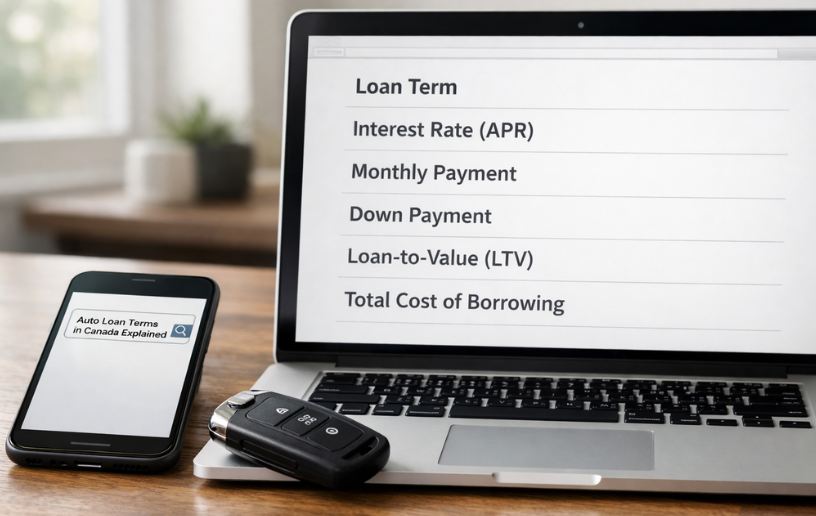
Three things determine your monthly payment: principal, interest rate, and term.
Principal
The amount you're actually borrowing: the vehicle price, plus any taxes and fees you roll into the loan, minus your down payment and trade-in value. In BC, this is where PST usually enters the equation, since most buyers finance the tax instead of paying it out of pocket at signing.
Interest Rate (APR)
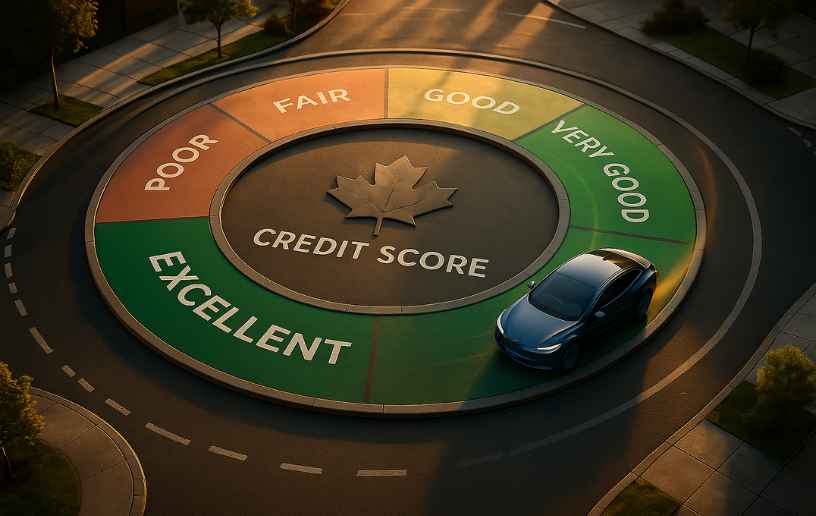
Your annual percentage rate is the cost of borrowing, converted to a monthly rate for the calculation (annual rate divided by 12). It depends heavily on credit history, the lender, whether the vehicle is new or used, and the loan term itself. Someone with strong credit and someone rebuilding credit can see very different offers on the same car, so treat any single rate you plug in as a starting point, not a guarantee.
Term
How many months you'll be paying the loan off: commonly 48, 60, 72, or even 84 months in today's market. Longer terms lower the monthly payment but increase total interest paid over the life of the loan.
The standard formula for a fixed-rate installment loan is:
Monthly Payment = P × [r(1+r)^n] / [(1+r)^n − 1]
P is the principal, r is the monthly interest rate (APR ÷ 12), and n is the number of monthly payments. It looks worse written out than it actually is. A calculator does the heavy lifting; what matters is knowing what to plug in and why. For a deeper breakdown of this formula applied more generally across Canada, we've covered it step by step in our car loan calculator and real formula guide.
How BC's PST Actually Affects the Amount You Finance
PST in BC is charged on the vehicle purchase separately from GST, and depending on how you're buying, it gets collected differently.
At a dealership, PST is typically calculated on the purchase price and added into the transaction. Most dealers will roll it into the amount you finance if you don't pay it upfront. For private used-vehicle sales, PST is generally paid directly to ICBC when you register and insure the vehicle, and the bands applied to private sales have historically differed from dealership rates, sometimes running higher as the vehicle price climbs. Luxury and higher-value vehicles can also fall into elevated PST bands regardless of where you buy.
These rules and the percentages attached to each band can change. Don't treat any number you read online, including ours, as the final word. Confirm current rates with ICBC or gov.bc.ca before you sign anything.
What matters for your calculator is simpler than the tax code itself: whatever PST applies to your purchase either gets added to your loan principal, which raises your monthly payment, or gets paid out of pocket at the time of sale, which keeps your loan amount lower. Some buyers pay the tax out of pocket specifically to avoid financing it, since that cuts total interest paid over the loan.
A Worked Example: $28,000 Vehicle in BC
Let's make this concrete instead of abstract.
Say you're buying a used vehicle priced at $28,000 from a dealership. For this example, assume a combined tax impact that adds roughly $2,240 to the purchase. This number is illustrative only. Your actual PST depends on the current band that applies to your vehicle and purchase type, so confirm with ICBC before assuming it applies to you.
Vehicle price: $28,000
Estimated tax added: $2,240
Total purchase price: $30,240
Down payment: $3,000
Amount to finance (principal): $27,240
Interest rate: 7.5% APR
Loan term: 72 months
Converting the annual rate to a monthly rate gives you roughly 0.625%. Plug that principal, rate, and 72-month term into the payment formula and you land on a monthly payment somewhere around $475 to $480, depending on rounding and exactly how the lender calculates the amortization schedule.
Now try the same vehicle with a bigger down payment. Put $6,000 down instead of $3,000 and your financed principal drops to $24,240. Same rate, same term, monthly payment falls to roughly $425. That's a real difference for a few thousand extra dollars up front, and it's exactly the kind of comparison a calculator is good for: testing a few down payment scenarios before you walk into a dealership. Our guide to down payments in Canada goes into more detail on how much you should realistically put down and when a smaller down payment still makes sense.
Typical Loan Terms in the BC Market
Loan terms in BC track pretty closely with the rest of the country, though local price levels, especially in Metro Vancouver and Victoria, push some buyers toward longer terms just to keep payments manageable. 60- and 72-month terms are common for both new and used vehicles. 84-month terms have become more available for buyers who want a lower monthly payment on a pricier vehicle, though that comes at the cost of more interest paid overall and a longer stretch where you may owe more than the car is worth.
Rates move with the broader lending environment and vary based on your credit profile, the age and mileage of the vehicle, and which lender you're working with. A calculator estimate using a single assumed rate is a useful starting point, but the rate you're actually offered after a credit application can land higher or lower than what you typed in.
Getting a More Accurate Estimate
A car loan payment calculator BC shoppers can actually rely on needs honest inputs, not guesses pulled out of thin air.
Confirm the PST band that applies to your specific vehicle and purchase type with ICBC or gov.bc.ca. Assuming the wrong band can throw your estimate off by a meaningful amount. Get a realistic sense of your own credit standing too, since the rate you qualify for affects your payment more than most people expect. And run a few scenarios, not just one: different down payments, different terms. Even a modest change in either one shifts the monthly payment noticeably.
Approval, and the rate that comes with it, depends on your individual credit profile and each lender's own criteria. A calculator estimate is a planning tool. It isn't a promise of what you'll actually be offered.
If you've run the numbers and have a sense of what you can comfortably afford, the next step is finding out what you actually qualify for. You can apply with Auto Lending Canada to get a real rate and payment estimate based on your credit profile instead of a generic assumption. It takes a few minutes and gives you a much clearer picture than any calculator alone can.