
Car Subscription vs. Car Loan in Canada: Which One Actually Costs Less?
18 September 2026Car subscription services have been showing up in more Canadian cities over the last couple of years, pitched as the anti-loan: no long-term contract, one flat monthly fee, swap vehicles whenever you want. For someone tired of financing paperwork, that pitch is appealing. But "no commitment" isn't the same as "cheaper," and the math behind a subscription works very differently from the math behind a car loan. Here's what each option actually costs once you account for everything a subscription fee is quietly covering.
What a Car Subscription Actually Includes
A car subscription bundles the vehicle, insurance, and often maintenance into a single recurring payment, usually billed monthly with no long-term commitment. Providers operating in Canada, including national rental brands offering multi-month plans and smaller local subscription services, typically price these bundles anywhere from around $700 to well over $2,000 a month depending on the vehicle class and what's included. You don't own anything at the end. You're renting access to a car, full stop.
The appeal is real: no credit check in some cases, no down payment, and the freedom to cancel or switch vehicles without the hassle of selling or trading in a car you're financing. For someone relocating to Canada for a short work contract, or someone who wants a vehicle for a few months without touching their credit profile, that flexibility has genuine value.
What a Car Loan Actually Costs You
Financing a car works differently. You're paying down a fixed loan amount over a set term, typically 60 to 84 months, at an interest rate tied to your credit profile. Insurance and maintenance are separate costs you manage yourself, not bundled into the payment. On a $30,000 vehicle at a mid-range rate, you might be looking at a payment somewhere between $500 and $650 a month before insurance, which in BC, Alberta, or Saskatchewan can add another $150 to $400 depending on your driving record, age, and where you live.
Add those together and a financed vehicle can easily land in the same monthly range as a subscription, sometimes higher once you're paying for full coverage insurance and setting aside money for maintenance and eventual repairs. On the surface, the two options can look deceptively close.
Running the Numbers Side by Side
Take a realistic example. A subscription for a mid-size SUV might run $900 a month, all-in, insurance included. Financing a comparable used SUV might run $480 a month in loan payments, plus roughly $220 in insurance, putting you at $700 a month. On paper the loan wins by $200 a month right out of the gate, and that gap only grows once you factor in what happens at the end of each arrangement.
The subscription customer walks away after 12 months having paid $10,800 and owning nothing. The financing customer has paid $8,400 over the same period and has built equity in a vehicle they'll eventually own outright, assuming they're not deep underwater on the loan. Our guide on paying cash versus financing a car breaks down that ownership math in more detail if you're weighing the full range of options, not just these two.
The Equity Difference Nobody Advertises
This is the part subscription marketing tends to skip past. Every payment on a car loan builds toward something you'll own free and clear, eventually turning into an asset you can sell, trade in, or simply drive payment-free for years after the loan term ends. A subscription payment builds toward nothing. It's closer to renting an apartment than buying a home: perfectly reasonable in the right circumstances, but not a wealth-building move.
If you're choosing between the two purely on flexibility, that's a legitimate reason. If you're choosing a subscription because it seems cheaper on a month-to-month basis without running the actual comparison, you may be paying a premium for flexibility you don't need.
When a Subscription Actually Makes Sense
There are situations where a subscription is genuinely the better call. If you're in Canada on a short-term work assignment and know you'll be gone within a year, financing a vehicle you'll have to sell or transfer before you leave adds complexity you don't need. If you want to try out an EV or a specific model before committing to years of payments, a short subscription lets you test that without the exit costs of an auto loan. And if your credit history in Canada is thin or nonexistent, some subscription providers skip the credit check entirely, which a traditional lender generally won't.
When Financing Wins for Most Drivers
For anyone planning to keep a vehicle for more than a year or two, financing tends to come out ahead, both on a monthly basis and especially over the full ownership period. You control the vehicle, you're not locked into whatever inventory a subscription provider happens to have available, and every payment moves you closer to owning the car outright instead of renewing an arrangement that resets to zero equity every month. If you're financing a used vehicle to keep costs down further, it's worth understanding how your down payment affects your loan before you shop, since a modest down payment can close a lot of the gap between a subscription fee and a loan payment.
It's also worth comparing financing against leasing directly, since leasing sits somewhere between the two in terms of commitment and cost. Our breakdown of leasing versus financing a car covers where that option lands relative to both a subscription and a traditional loan.
How Your Credit Profile Changes the Comparison
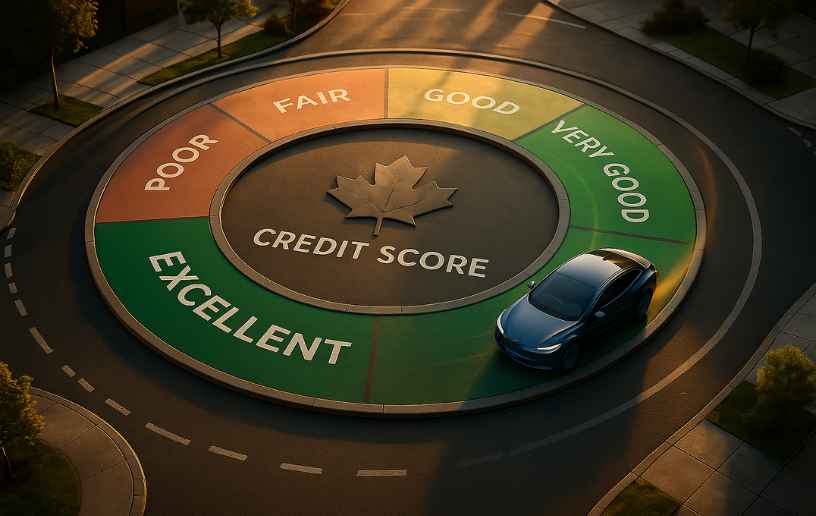
One thing rarely mentioned in subscription marketing is what each option does for your credit going forward. A car loan, paid on time, builds a payment history that lenders look at for every future application, whether that's a mortgage, a second vehicle, or a personal line of credit. A subscription payment generally doesn't get reported to the credit bureaus at all, since it's structured as a service fee rather than a loan. If you're newer to Canada or still building credit history, that difference matters more than the sticker price of either option. A financed vehicle can double as a credit-building tool. A subscription can't.
That said, if your credit history is thin or you haven't had time to establish it yet, a subscription's lack of a hard credit check can be the more practical starting point while you build toward qualifying for stronger loan terms down the road.
Insurance and Maintenance: Where the Real Costs Hide
Subscription pricing usually bundles insurance at a flat, provider-negotiated rate, which can work out well if you're young, new to driving in Canada, or have a record that would otherwise push your premiums up. But that convenience comes at a markup. If you already have a clean driving history and can shop your own policy, insuring a financed vehicle yourself is almost always cheaper than the insurance baked into a subscription fee, sometimes by $100 or more a month depending on the province and provider.
Maintenance works in the opposite direction. Subscriptions that include maintenance remove a real financial risk: an unexpected transmission issue or a major repair simply isn't your problem. On a financed vehicle, especially a used one, you're carrying that risk yourself, and it's worth budgeting for it separately from your loan payment rather than assuming a low sticker price is the whole story.
The Bottom Line
A car subscription can make sense for a short, defined stretch of time when flexibility matters more than cost. For most drivers planning to keep a vehicle for years, running the real numbers usually shows financing costs less per month and leaves you with an asset instead of a renewed bill. The only way to know which side of that line you're on is to compare an actual loan quote against an actual subscription quote for the vehicle you want, rather than assuming either option is automatically cheaper.
Auto Lending Canada works with buyers across BC, Alberta, and Saskatchewan to find financing that fits your budget, whether you're buying new, used, or just want to see what a real payment would look like before you decide. Start your application here to get a real number to compare against any subscription quote.