In-House Financing in Edmonton: How It Works and What to Watch For
19 September 2026Edmonton has no shortage of independent used car lots advertising in-house financing, guaranteed approval, and no bank needed. For someone who's been turned down by a bank or is rebuilding credit, that pitch is appealing, and in a lot of cases these dealers genuinely can approve buyers that mainstream lenders won't. What that approval actually costs, and what it does or doesn't do for your credit going forward, is worth understanding before you sign anything on the lot.
What In-House Financing Actually Means
In-house financing means the dealership itself is the lender, rather than arranging your loan through a bank, credit union, or a third-party lender. The dealer sets the terms, approves the application using its own criteria, and collects the payments directly, often in person or through a payment app rather than a bank's standard billing setup. Because the dealer isn't relying on a bank's underwriting rules, approval decisions tend to be more flexible, which is exactly why this model exists for buyers with credit challenges, inconsistent income, or a recent bankruptcy or consumer proposal.
Why It's So Common in Edmonton Specifically
Edmonton's economy has a lot of workers with variable income, including oil and gas contractors, tradespeople, and shift workers, whose pay doesn't always fit neatly into a bank's standard approval formula even when their actual ability to pay is solid. In-house lots have built a business model around approving exactly these buyers, which is part of why the city has such a visible cluster of them along its main commercial corridors.
What It Actually Costs You
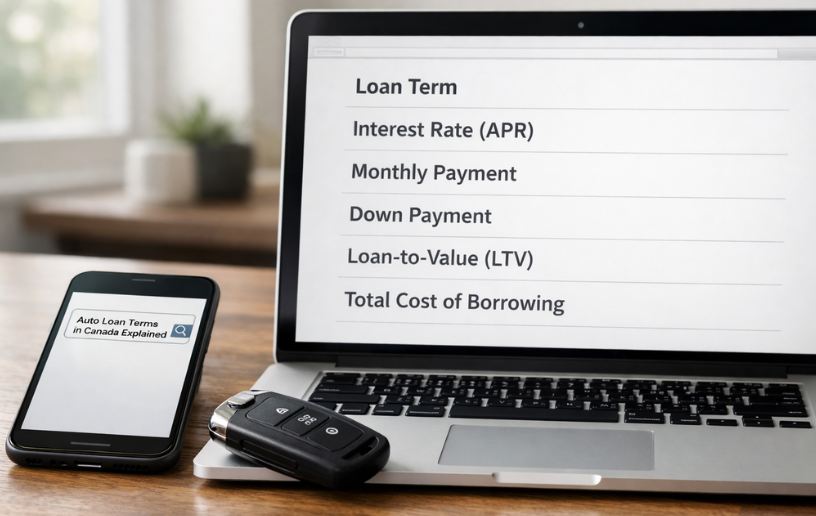
Flexibility on approval usually comes paired with a higher interest rate than you'd get through a bank or a lender working with prime or near-prime credit. That's not automatically a red flag, since the dealer is taking on more risk by approving buyers a bank wouldn't, but it means the total cost of the vehicle over the loan term can end up considerably higher than the sticker price suggests. Ask for the total cost of the loan, principal plus interest over the full term, not just the biweekly or monthly payment, before you agree to anything. A payment that sounds manageable can hide a rate well above what you'd find elsewhere.
The Detail Most Buyers Don't Ask About: Credit Reporting
One of the more important, and least advertised, differences between in-house financing and a regular auto loan is whether the dealer reports your payment history to the credit bureaus at all. A number of in-house lenders don't report routinely, which means months or years of on-time payments might do nothing to help you rebuild your credit score, even though you're paying reliably. If rebuilding credit is part of why you're financing a vehicle in the first place, ask directly whether the lot reports to Equifax and TransUnion before you sign, since that answer changes whether this loan helps your credit profile or just gets you a car.
Watch for GPS Trackers and Payment Devices
Some in-house lenders install a GPS tracker or a payment-disabling device as a condition of financing, which lets them locate or immobilize the vehicle if you fall behind. This isn't universal, and it isn't necessarily a dishonest practice on its own, but it should be disclosed clearly before you sign, not discovered after the fact. Ask specifically whether any tracking or remote disable technology is part of the vehicle before you drive off the lot.
Get a Second Number Before You Commit
The strongest leverage you have walking onto an in-house lot is a real financing offer from somewhere else, even an imperfect one. A lender who works across the credit spectrum, including buyers with bad credit or no credit history, can often put together a comparable approval with a lower rate and standard credit bureau reporting. Our guide to bad credit car loans in Canada covers what actually moves approval odds and rate with lenders outside the in-house model, and it's worth checking what you qualify for before you assume in-house financing is your only route. Our broader look at how in-house dealership financing works across Canada goes into more detail on the mechanics if you're weighing it against other subprime options.
What to Have Ready If You Do Go This Route
If in-house financing ends up being the right fit for your situation, bring proof of income, whether that's pay stubs, an employment letter, or bank statements if you're self-employed or working contract to contract. A reasonable down payment strengthens your position and can improve the rate you're offered, since it lowers how much the dealer is financing relative to the vehicle's value. And get everything, the total cost of borrowing, the payment schedule, and any conditions like GPS tracking, in writing before you sign, not verbally promised at the desk.
The Bottom Line
In-house financing fills a real gap for Edmonton buyers who can't get approved through a bank, but the flexibility comes at a cost that's worth measuring against what else is available. Before signing at an in-house lot, it's worth finding out whether a lender working across the credit spectrum can offer a comparable approval at a lower rate, with the added benefit of payments that actually help rebuild your credit.
Auto Lending Canada works with buyers across the credit spectrum in Edmonton and throughout BC, Alberta, and Saskatchewan. Start your application here to see what you qualify for before committing to an in-house deal.