
Is It Actually Easy to Get Approved for a Car Loan in Canada?
21 September 2026The question behind this search is usually not really about statistics. It is closer to a worry: what if I apply and get turned down? That worry keeps a lot of people driving unreliable vehicles or putting off a purchase they actually need, based on an assumption about approval odds that is often more pessimistic than reality.
The Short Answer
For most Canadians, yes, getting approved for a car loan is genuinely achievable, even outside a perfect credit profile. A car loan is a secured loan, meaning the vehicle itself backs the debt, which makes lenders considerably more willing to approve it than an unsecured product like a personal loan or credit card. Between banks, credit unions, and direct or specialty lenders, there is a real lender for nearly every credit situation in Canada. The harder question is not usually whether you can get approved, but what rate and terms you get approved at.
Why Approval Is More Common Than People Assume
A few structural things work in your favour that do not apply to other kinds of borrowing. Because the vehicle secures the loan, a lender has a fallback if payments stop, which lowers their risk compared to lending money with nothing backing it. This is also why the auto lending market has so many players. Banks focus on the strongest files, but that leaves a large, well-established segment of lenders, including specialty and direct lenders like Auto Lending Canada, built specifically around approving files that fall outside a bank's narrower criteria. Our overview of the different requirements lenders actually look at covers what that evaluation involves in practice.
What Actually Causes a Decline
When an application does get declined, credit score alone is rarely the whole story. Income and employment issues come up constantly, not because someone does not earn enough in absolute terms, but because the income is hard to verify, inconsistent, or already stretched thin relative to existing debt. Lenders look closely at your debt-to-income ratio, and a file can get declined even with reasonable credit if too much of your monthly income is already committed elsewhere. Our explainer on how debt-to-income ratio affects car loan approval breaks down exactly where that line tends to sit.
A mismatch between the loan amount and the vehicle's value can also trigger a decline, even for a strong applicant, since the lender is unwilling to finance more than the car is actually worth as collateral. And sometimes a decline happens after what looked like a solid pre-approval, which understandably feels confusing. Our breakdown of why a car loan can get declined after pre-approval covers the handful of reasons this happens and how to avoid it the next time.
Where Bad Credit Actually Fits Into This Picture
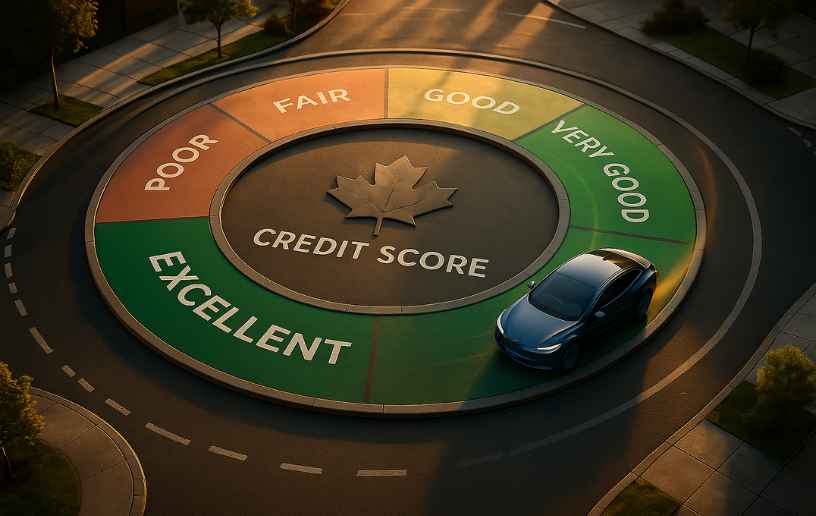
Bad credit changes your rate and your lender options far more than it changes whether approval is possible at all. Specialty lenders exist precisely because a meaningful share of Canadian buyers do not have prime credit, and treating that as a niche exception undersells how common it actually is. Our full guide to bad credit car loans in Canada walks through what a realistic approval looks like at this end of the credit spectrum, including what tends to offset a lower score in a lender's eyes.
What Actually Makes Approval Smoother
A few things consistently improve your odds regardless of where your credit sits. Applying with accurate, complete documentation the first time avoids delays that can make a file look less certain than it is. Being realistic about the vehicle and loan amount relative to your income keeps your debt-to-income ratio in a range lenders are comfortable with. And applying with a lender built to evaluate your specific situation, rather than assuming a single bank decision represents your only option, changes the outcome for a lot of applicants who assumed they would not qualify anywhere.
The Bottom Line
Car loan approval in Canada is more achievable than the anxiety behind the question usually suggests, largely because the loan is secured and the lender market is built to serve a wide range of credit profiles. Declines do happen, but they are usually explained by something specific and addressable, income documentation, debt load, or a mismatch between the loan and the vehicle, rather than being unpredictable or arbitrary.
Auto Lending Canada works with buyers across British Columbia, Alberta, and Saskatchewan, including files that have already been turned down elsewhere. Start your application here to see where you actually stand.