
Used Car Loan Rates in Canada (2026): What Affects Your Rate & How to Get the Lowest One
26 August 2026If you've started shopping for a used vehicle loan and noticed the numbers look a bit higher than what your friend got on their new SUV last year, you're not imagining things. A used car loan interest rate almost always runs above what lenders offer on new vehicles. Understanding why can help you avoid overpaying, or at least know what to push back on when a lender quotes you a number. This piece breaks down exactly what moves the rate on a used car loan, how used auto loan rates in Canada compare to new-car financing, and what you can actually do to land on the lower end of the range.
For a broader look at how used car financing works in Canada, including credit requirements and the approval process from start to finish, our complete guide to used car loans in Canada covers that ground. This one goes narrower and deeper: it's specifically about the rate itself, what drives it up or down, and how to negotiate your way to something better.
Why used car loan rates run higher than new car rates
Lenders price risk into every loan they write, and a used vehicle simply carries more of it than a new one. A new car rolls off the lot with a manufacturer warranty, no maintenance history to worry about yet, and a value that depreciates in a fairly predictable curve. A used vehicle is a different animal. It might have had two or three previous owners, a patchy service record, or mechanical issues that haven't surfaced yet. If the borrower defaults, the lender has to repossess and resell a vehicle that's already lost a chunk of its value, and could keep losing it fast.
That uncertainty gets baked into the interest rate on a used car loan. Automakers also use new-vehicle financing as a sales incentive, sometimes subsidizing rates just to move inventory off the lot, and there's no real equivalent of that for used cars. So even with identical credit, a buyer financing a five-year-old sedan will typically see a higher rate than someone financing the current model year of the same car.
The factors that actually move your rate
A used auto loan rate in Canada isn't pulled out of thin air. Lenders run every application through a handful of the same variables. Some of these you can control. Some you can't.
Vehicle age, mileage, and condition
The older the vehicle and the higher the odometer reading, the more risk a lender is taking on, and the shorter the car's remaining useful life relative to the loan term. Many lenders set hard cutoffs: a maximum vehicle age or mileage beyond which they won't finance at all, or will only do so at a noticeably worse rate. A five-year-old vehicle with average mileage will usually price better than a ten-year-old vehicle with 200,000 km on it, even when both buyers have the same credit profile.
Loan term length
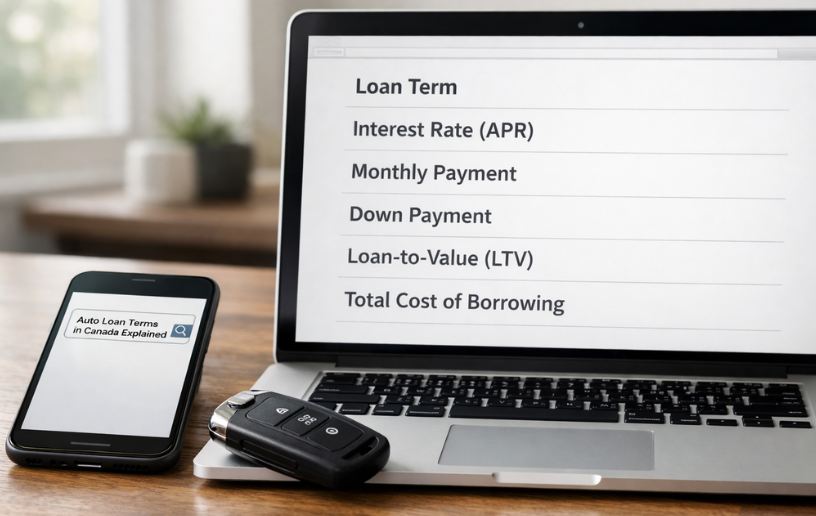
Stretching payments over a longer term lowers your monthly payment, but it usually raises your rate and definitely increases the total interest you pay over the life of the loan. Longer terms also give the vehicle more time to depreciate below the outstanding loan balance, which is its own risk factor lenders price in. If you want to see exactly how term length interacts with rate and total cost, our car loan calculator breakdown walks through the real formula lenders use, so you can run your own numbers before committing to a term.
Credit score tier
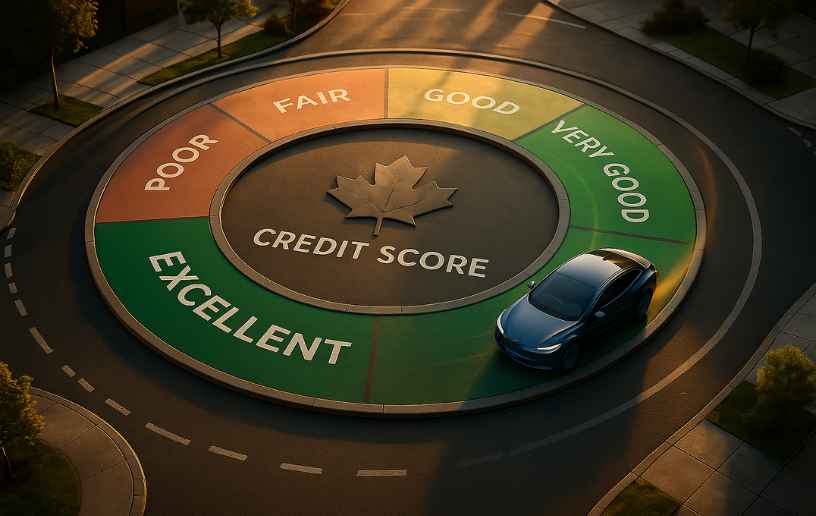
This is usually the biggest factor of all. Lenders group applicants into tiers, roughly excellent, good, fair, and poor, and each tier gets access to a different band of rates. The better your credit tier, the lower the rate you'll likely qualify for. Borrowers in lower tiers still get approved regularly, but should expect to land higher up the rate scale. If your credit sits anywhere below "good," it's worth reading our breakdown of no credit versus low credit car loans in Canada before you apply. The strategy for each situation is different, and knowing which one applies to you changes how you should shop.
Down payment size
Putting more money down reduces the loan-to-value ratio, which lowers the lender's exposure if the vehicle ever needs to be repossessed and resold. A larger down payment signals lower risk and can move you into a better rate bracket without touching your credit score at all.
Lender type: bank, credit union, dealer, or broker
Where you get the loan matters almost as much as your credit profile. Banks tend to offer competitive rates to applicants with strong credit but can be slower and stricter about who qualifies. Credit unions sometimes beat banks on rate for their members, though you usually need to live locally and join. Dealer financing is convenient, since you sign the papers in the same room where you bought the car, but dealers often mark up the rate they get from their lending partner, and that markup isn't always obvious to the buyer. A broker works differently. Instead of representing one lender, a broker shops your application across a network of lenders and brings back the best offer for your specific profile. That's usually where the real savings show up. For more on how rate-setting works across all of these lender types, see our detailed piece on understanding car loan interest rates in Canada.
How rate ranges typically stack up by credit tier
Exact rates change constantly. They move with the Bank of Canada's policy rate, with each lender's own funding costs, and with how aggressively a given lender wants new business that month. Any specific percentage you read today could be stale by the time you apply, so treat published numbers with some skepticism and confirm directly with a lender or broker before assuming a rate applies to you.
The general pattern holds fairly consistently across the Canadian market, even if the exact numbers move. Borrowers with excellent credit and a clean application typically sit at the low end of what lenders are offering that month. Good credit still qualifies for competitive used auto loan rates, just a step up from the top tier. Fair credit borrowers can usually still get approved, often through a wider pool of lenders, but should expect noticeably higher pricing. Borrowers with limited or damaged credit history are usually working with a smaller set of lenders willing to take on the risk, and the rate reflects that. Even in this tier, though, a solid down payment or a newer, lower-mileage vehicle can meaningfully improve the offer.
How ALC's brokerage model helps you get a better rate
One of the most common mistakes used-car buyers make is applying with a single lender, often whoever the dealer happens to point them to, and treating that first quote as the only quote. It might be competitive. It might include a markup you'd never think to question. Working with a brokerage like Auto Lending Canada means one application gets checked against multiple lenders at once, so you see the actual range of what's available for your vehicle, credit tier, and down payment instead of accepting whatever number lands in front of you at the dealership. Because brokers work with a network that includes banks, credit unions, and specialty lenders, someone who wouldn't qualify with one institution often finds a workable offer through another, without submitting a separate application to each one and racking up multiple credit inquiries along the way.
Practical ways to lower your used car loan rate
A few concrete moves can meaningfully shift the rate you're offered, and most of them are within your control before you ever apply.
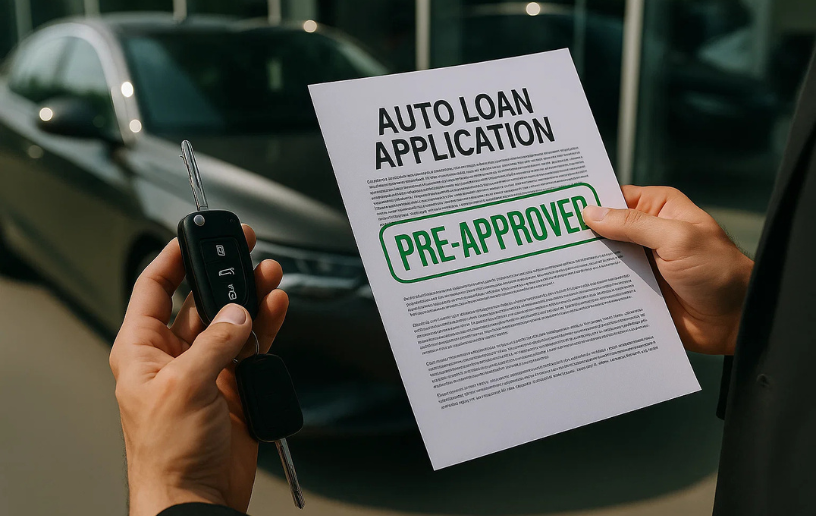
Save for a larger down payment if you can manage it. Even a few extra thousand dollars down changes the loan-to-value math in your favour and can bump you into a better pricing tier. Choose the shortest term you can comfortably afford: it costs more per month but less overall, and lenders often reward shorter terms with better pricing. Check your credit report for errors before you apply, since a mistake dragging your score down is a free fix once corrected, and pay down other revolving debt if you have room to, since your overall debt load factors into the lender's decision alongside your score itself. Get pre-approved before you set foot on a dealer lot. Walking in with a pre-approval already in hand gives you a real number to compare against, and genuine leverage to negotiate the dealer's financing offer down, or walk away from it entirely if it doesn't beat what you already have. Shop the loan the same way you'd shop the car. Comparing offers across multiple lenders is consistently the single most effective way to avoid overpaying on interest.
Next steps
Your rate on a used car loan comes down to the vehicle, your credit profile, and how many lenders you actually bother to compare before signing. None of those factors are locked in until you apply, and some preparation, a stronger down payment, a shorter term, a cleaned-up credit report, can move you into meaningfully better pricing. The fastest way to find out where you actually stand is to get pre-approved and look at real offers from multiple lenders side by side, instead of guessing at what a single dealer might quote you.
Get pre-approved with Auto Lending Canada and compare real used car loan offers from our lender network before you commit to a rate. Approval and pricing depend on your individual credit profile, vehicle, and financial circumstances, and they'll be confirmed directly by the lender. Getting pre-approved costs you nothing, and it gives you a real benchmark to negotiate from.