
Car Loans in Kelowna, BC: Rates, Requirements & How to Get Approved (2026)
26 August 2026Kelowna's car market moves fast. Between the lakeside commute from West Kelowna, the drive up to UBC Okanagan, and the extra traffic that shows up every tourism season, a reliable vehicle here isn't optional. It's how people get to work, get their kids to school, and get through winter on the Coquihalla. If you're shopping for a car loan in Kelowna right now, you've probably already noticed that rates and requirements swing a lot depending on where you apply. This guide covers what actually affects your rate, what lenders want to see, and how to approach financing whether you're buying new, buying used, or refinancing a loan you're already stuck in.
Financing options for buying a car in the Okanagan
Most people financing a vehicle in Kelowna choose between three paths: dealership financing, going straight to a bank or credit union, or working with a brokerage that shops your application across several lenders at once.
Dealership financing is convenient. You can drive off the lot the same day. But the rate on offer at a dealership isn't always the best one available to you. Dealers work with a handful of lender partners, and the person across the desk is often more focused on closing the deal quickly than on finding you the lowest possible rate. Going to your own bank is another common route, but banks in the Okanagan tend to run stricter credit requirements and offer less flexibility for anyone with a short credit history or a bruised score.
A brokerage like Auto Lending Canada works differently. Instead of representing one lender, we submit your application to a network of banks, credit unions, and specialty auto lenders and let them compete for your business. That matters most for buyers who don't fit the standard mold: newcomers to Canada, self-employed applicants, people rebuilding credit after a rough patch, or anyone who just wants to compare more than one offer before signing anything. Our guide to car loans in British Columbia covers the mechanics of BC auto financing in more depth if you want the province-wide picture.
What actually affects your car loan rate
There's no single number that sets your rate on a Kelowna car loan. Lenders weigh a handful of factors, and they don't all weigh them the same way.
Credit score
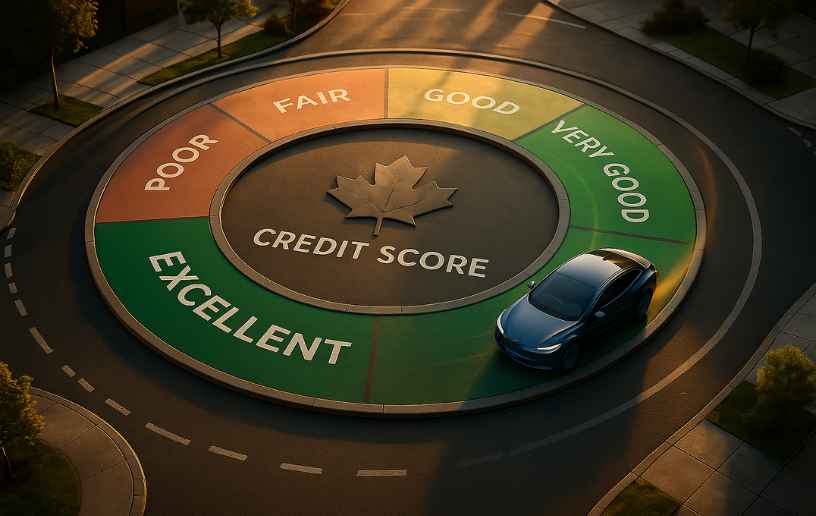
This is the biggest lever. Borrowers with strong credit, generally 700 and up, tend to see the lowest rates because lenders see them as lower risk. Scores in the 600s usually still qualify, just at a higher rate, and anything below 600 moves you into bad credit or subprime territory, where rates climb but approval is still often possible through the right lender. If your credit has taken a hit, read our breakdown of bad credit car loans in Canada before assuming you're out of options.
Loan term and vehicle age
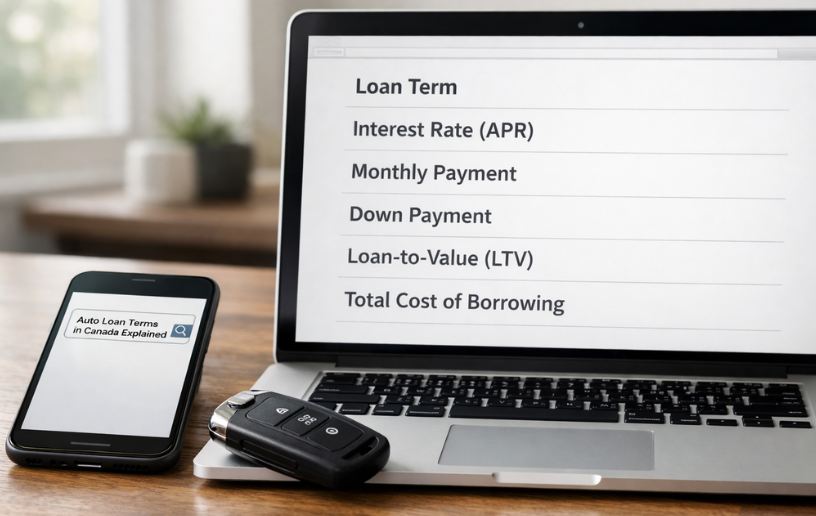
Shorter terms usually carry lower rates but higher monthly payments. Stretching a loan out to 84 or 96 months lowers the payment but usually costs more in interest over the life of the loan. Older or higher-mileage used vehicles also tend to carry a rate premium, since lenders see them as a riskier asset to finance.
Down payment and loan-to-value
Putting money down reduces how much you're borrowing relative to the car's value, which lowers the lender's exposure and can improve your rate. A trade-in does the same thing if it has positive equity.
Income and debt load
Lenders want your monthly payment to fit comfortably against your income and existing debts. This usually shows up as a debt-to-income ratio, and it's one of the first things underwriters check.
Two Kelowna buyers with near-identical credit scores can walk away with noticeably different rates once you factor in term length, down payment, and the vehicle itself. If you want to see how different combinations affect your monthly payment before you apply, our car loan calculator for BC is a good place to start.
What documents you'll need
Whether you're applying at a dealership, a bank, or through a brokerage, the paperwork stays fairly consistent across Kelowna lenders. Have these ready so the process doesn't stall: government-issued photo ID (driver's licence or passport), proof of income (recent pay stubs, a T4, or a Notice of Assessment if you're self-employed), proof of address, your BC driver's licence showing a Kelowna or Okanagan address if you have one, and banking information for pre-authorized payments. If you already have a specific vehicle picked out, having the VIN, listing price, and dealer information on hand speeds things up considerably.
Self-employed applicants and newcomers to Canada sometimes get asked for extra documentation, like business financials or proof of landing date, because lenders use these to fill in gaps a standard credit file wouldn't otherwise show.
Credit score considerations specific to auto financing
Auto lenders don't look at credit the same way a mortgage lender or credit card issuer does. Auto financing is secured against the vehicle itself, so lenders have more room to approve applicants with lower scores than you might expect, because the car itself is the collateral. That's part of why bad credit car loans exist as a distinct category instead of simply being unavailable.
Approval is never guaranteed, and rates for lower credit tiers will run higher to offset the lender's risk. If you've had a recent bankruptcy, consumer proposal, or repossession, some lenders specialize in exactly these situations while others won't touch them at all. That gap is exactly what a multi-lender brokerage approach is built to close, since you're not stuck with whichever single lender your local dealer happens to work with.
BC-specific costs to budget for
A few things are specific to buying a vehicle in British Columbia and worth building into your budget before you sign anything.
Provincial Sales Tax applies to most vehicle purchases in BC, and the rate depends on the purchase price and whether the vehicle is bought privately or from a dealer. Private sales can trigger a higher PST rate than dealer purchases. If you're buying from a dealer, GST applies on top of PST. These taxes are typically rolled into your loan amount if you're financing rather than paying cash, so confirm with your lender or broker exactly how the total gets calculated.
You'll also need to budget for ICBC insurance, since British Columbia requires basic coverage through ICBC before you can register and drive a vehicle. Insurance costs vary by driver history, vehicle type, and where in the Okanagan you're registering the car. Get a quote early, before you've already committed to a specific vehicle and monthly payment you might have to unwind.
Shopping at Kelowna car dealerships
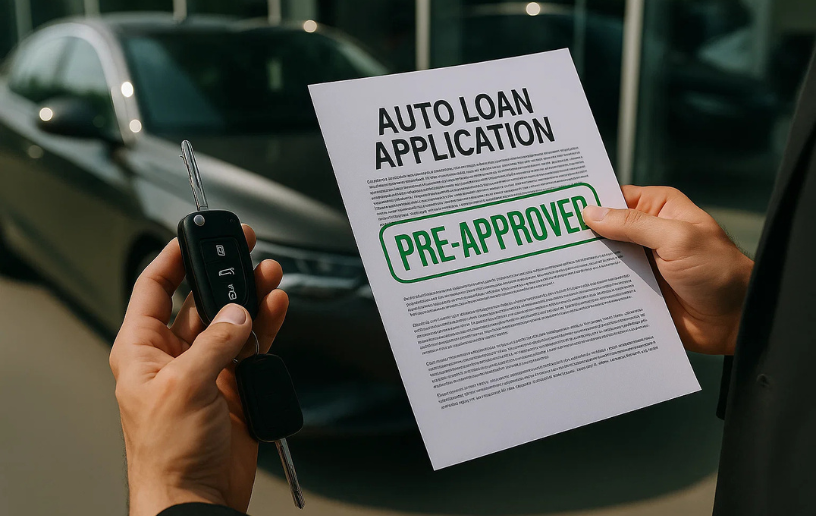
Kelowna has a solid concentration of dealerships along Harvey Avenue and out toward the Enterprise Way corridor, covering everything from new-vehicle franchises to independent used lots. If you're comparing car dealerships in Kelowna, get pre-approved for financing before you start seriously shopping. Walking in with a pre-approval changes the negotiation dynamic. You already know your rate and budget, so you're not stuck accepting whatever financing the dealership's finance office puts in front of you. It also lets you negotiate the vehicle price separately from the financing terms instead of having both bundled into one number that's harder to evaluate.
For buyers open to widening the search, the Lower Mainland market works in a similar way. Our Vancouver car loan guide covers what financing looks like there if you're cross-shopping vehicles between the coast and the Okanagan.
Refinancing an existing car loan
If you already own a vehicle and financed it at a higher rate than you'd likely qualify for today, or the monthly payment no longer fits your budget, refinancing is worth a look. Rates shift, credit scores improve, and a loan that made sense two or three years ago isn't necessarily still your best option. Auto Lending Canada handles refinancing applications the same way we handle new purchases: by comparing offers across our lender network instead of sending you back to whichever bank already holds your loan.
Next steps
Getting a car loan in Kelowna doesn't have to mean visiting five different banks or accepting the first number a dealership finance manager quotes you. Approval and rates always depend on your individual credit, income, and the vehicle you're financing, so no one can promise a specific outcome before you actually apply. But comparing multiple lenders at once, instead of relying on a single offer, is still the most reliable way to find out what you qualify for.
If you're ready to see where you stand, you can get pre-approved with Auto Lending Canada before you set foot on a dealership lot.