Second Chance Car Loans in Canada: What Lenders Look For
30 September 2026A second chance car loan is for drivers who still need reliable transportation after credit trouble — late payments, collections, a past bankruptcy, a repossession, or a stretch of thin history that banks treat as high risk. In Canada, “second chance” is not a single product name so much as a category: specialty and subprime lenders who fund files that prime banks decline, usually at higher rates and with tighter rules on vehicle age, term, and down payment.
If you are rebuilding after a hard stretch and need a car for work in British Columbia, Alberta, or Saskatchewan, understanding what lenders actually look for will help you apply once with a complete file instead of collecting declines.
What “second chance” usually means
Prime auto banks price for strong scores and clean payment history. When your file shows recent serious delinquency, a discharged bankruptcy still seasoning, a repossession, or heavy collections, those desks often say no. Specialty lenders step in with different risk models. They still want to get paid — they simply weight current income, down payment, and vehicle choice more heavily than a perfect past.
For the broader landscape of imperfect-credit auto financing, see our guide to bad credit car loans in Canada. If a repossession is part of your story, our page on car loans after repossession in Canada covers timing and documentation specifics.
Start your application here if you already know the vehicle type you want — you can finish details after a lender reviews your file.
What second chance lenders look for
Expect a practical underwriting lens:
- Current income stability: Pay stubs, bank deposits, or other proof that today’s job can support the payment. Recent stability matters more than a flawless five-year résumé.
- Debt-to-income: Rent or mortgage, existing loans, and minimum card payments relative to take-home pay.
- Down payment: Cash or equity that lowers the advance. On second chance files, more down often opens doors that a zero-down request closes.
- Credit detail, not just the score: How recent the negatives are, whether collections are paid or still open, and whether you have started rebuilding with on-time obligations.
- Vehicle fit: Age, kilometres, and market value within program guidelines. Stretching for a high-kilometre luxury unit on weak credit is a common decline reason.
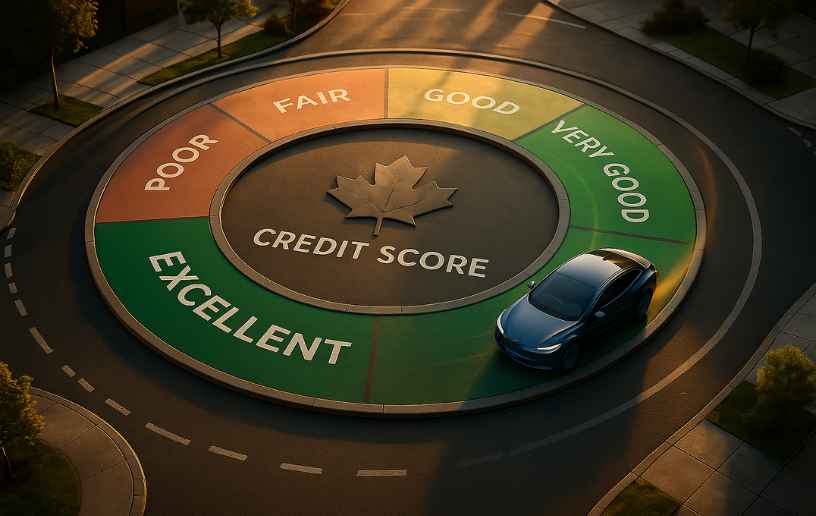
Rates will sit higher than prime. Our breakdown of car loan rates by credit score in Canada shows how pricing typically moves as your score recovers.
Rebuilding while you finance
A second chance auto loan can become part of a rebuild if you make every payment on time and keep other accounts current. The loan itself reports; steady performance can help future refinancing or a better rate on the next vehicle. It is not a shortcut to a prime score overnight — it is a chance to demonstrate reliability with a secured obligation you actually need.
Parallel habits help: paying down revolving balances you can afford to clear, avoiding new hard inquiries while the deal is structuring, and keeping utilization reasonable. For a longer view on using an auto loan as part of recovery, see how to rebuild your credit with a car loan in Canada.
Documents that make a second chance file easier
Incomplete applications stall or decline. Before you shop:
- Government ID and proof of address in BC, Alberta, or Saskatchewan.
- Recent pay stubs and three months of bank statements when hours vary.
- A realistic budget that includes insurance and fuel, not just the payment.
- An honest explanation of past credit issues if a lender asks — short, factual, and focused on what is different now.
- A vehicle shortlist that fits likely advance limits rather than a stretch unit.
Dealer desks versus broker networks
A single dealer may only place you with one or two lenders. If those programs stop at a credit cut-off you miss, you hear “no” even when other specialty lenders would still look. A broker that shops multiple second chance and near-prime programs can compare structures without you walking into every lot for a fresh hard pull.
That does not guarantee approval. It does mean you are not judging the whole market from one desk’s yes-or-no.
What approval can look like
Second chance approvals often come with a higher rate, a shorter or capped term, a required down payment, and strict rules on vehicle age or kilometres. That is the trade-off for access when a bank says no. As you build clean payment history on the loan, future options usually improve — provided you do not overextend on the payment itself.
Nobody can promise you will be approved. What you control is a complete, honest file, a vehicle that fits program rules, and shopping lenders who actually work with challenged credit in your province.
Common scenarios that still get a hearing
Specialty lenders see patterns like these regularly: a driver with a past bankruptcy who has stable income again; someone who fell behind on cards during a layoff and is now employed; a thin-file applicant with solid deposits but little scored history; a post-repossession buyer who has waited through seasoning and can put money down. None of those stories guarantee a yes. They do explain why a bank decline is not automatically the end of the road.
Ready for a second chance application?
Auto Lending Canada helps drivers across British Columbia, Alberta, and Saskatchewan compare auto loan options — including files that need a second look after credit trouble. Start with clear numbers and let lenders respond to your real situation.