First-Time Buyer Car Loans in Canada: What Lenders Look For
01 October 2026Buying your first financed car in Canada is less about finding the “perfect” vehicle and more about matching a payment you can keep to a lender who will fund your file. If you have little or no auto credit history — or you are stepping from cash buys and transit into your first loan — the process can feel opaque. This guide walks through how first-time buyer car loans usually work, what lenders look for when your file is thin, and a practical path to apply in British Columbia, Alberta, and Saskatchewan.
For a broader shopping checklist (vehicle type, inspection, and ownership basics), see our first-time vehicle buyer guide. Below we focus on the loan itself.
What “first-time buyer” means to lenders
Lenders do not all use one definition. Some treat you as a first-time auto borrower if you have never had a car loan on Equifax or TransUnion. Others care more about overall credit age — how long your oldest trade has been open — even if you have credit cards. A thin file (few accounts, short history) can price differently from a thicker file with past late payments. Knowing which bucket you sit in helps you set expectations on rate and down payment.
If you are still building score before you shop, our overview of how to build credit before your first car loan covers habits that actually show up on Canadian reports.
Start your application here if you already know the vehicle type you want — you can finish details after a lender reviews your file.
What lenders usually require from first-time buyers
- Government ID and proof of address in your province.
- Income proof: pay stubs, bank deposits, or other documentation if hours vary or you are self-employed.
- Credit consent: so the lender can pull Equifax and/or TransUnion and price risk.
- Down payment or trade: often more important when auto history is thin — cash down lowers the advance and signals commitment.
- Vehicle fit: year, kilometres, and value must match what the program will fund. Stretching for a high-mileage private sale can kill an otherwise workable file.
Employment and income stability matter as much as score for many first-time files. See employment verification for car loans in Canada if your hours or job start date are recent.
Rates, terms, and thin-file pricing
Advertised “from” rates assume strong credit and clean structure. First-time buyers often land in mid or near-prime pricing rather than the absolute lowest band — especially with short credit age or no prior installment history. Longer terms shrink the monthly number but raise total interest and keep you underwater longer if the car depreciates fast.
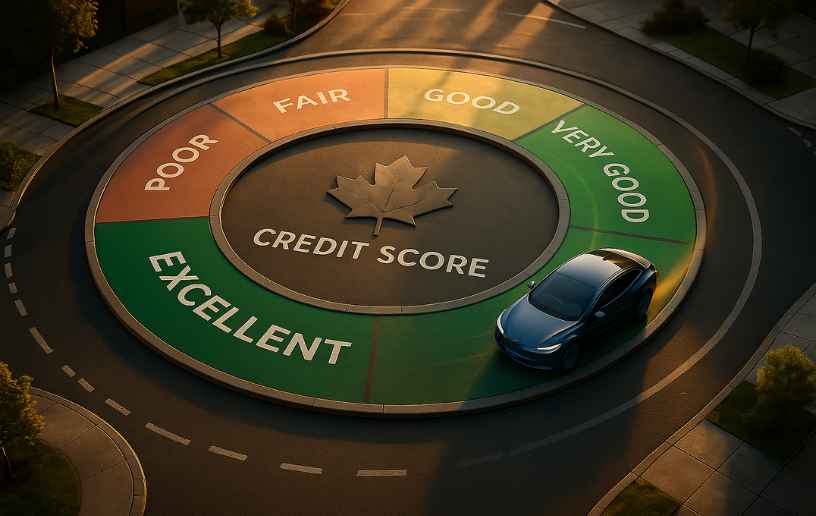
Use car loan rates by credit score in Canada as a map of how bands typically move. Pair that with a realistic budget that includes insurance, fuel, and maintenance — not just the payment on the worksheet.
How much car can you actually afford
A common first-time mistake is shopping payment instead of total cost. Insurance in BC, Alberta, or Saskatchewan can surprise new owners, and winter tires plus routine maintenance add up. Decide a max monthly all-in number before you fall in love with a trim level. If your only path to a lower payment is an 84-month term on a used car you will outgrow in three years, rethink the vehicle — not just the term.
Our affordability guide, how much car can you afford in Canada, walks through income-based rules of thumb without pretending one formula fits every household.
Cosigners, joint applications, and going solo
A cosigner with stronger credit can open programs you cannot reach alone — but it also ties their file to your payment behaviour. Joint applications share responsibility differently than a pure cosign. Neither path is “better” in every case; both deserve a clear conversation about who drives, who pays, and what happens if someone loses income. Do not treat a cosigner as a shortcut to a vehicle you cannot support on your own income long term.
Dealer desk vs broker for first-time buyers
A franchise desk may only submit you to one or two captive lenders. That can work if your file fits their box. If your credit age is short, your down payment is modest, or the vehicle is used and older, a broker network that shops multiple lenders across BC, Alberta, and Saskatchewan often finds more structures to compare — without you walking lot to lot and stacking inquiries. Ask how many lenders will see your file before you sign a credit application at a single store.
How to apply without stacking hard inquiries
- Pull your own credit so you know the starting point.
- Set a full ownership budget (payment + insurance + fuel).
- Gather ID and income proof before you visit lots.
- Submit one complete application through a broker or lender network that can shop multiple programs.
- Compare rate, term, fees, and vehicle rules before you sign.
When you are ready, follow how to apply for a car loan in Canada — accurate details beat a rushed form every time.
What approval can look like for first-time buyers
Approvals often come with a clear down payment ask, limits on vehicle age or kilometres, and a rate that improves as you build on-time installment history. Nobody can promise you will be approved. What you control is a complete file, a realistic vehicle choice, and shopping lenders who actually fund first-time and thin-file drivers in BC, Alberta, and Saskatchewan.
Ready for your first financed car?
Auto Lending Canada helps drivers across British Columbia, Alberta, and Saskatchewan compare auto loan options — including first-time and thin-file applicants. Start with a clear application and let lenders respond to your real numbers.