Car Loans for Retirees in Canada: Financing on Pension and Fixed Income
04 October 2026Retirement changes how car loans get underwritten. You may have decades of on-time payments and a strong score — or a thinner recent file if you closed cards and paid everything off. Income often shifts from payroll to CPP, OAS, workplace pensions, RRIF withdrawals, or investment deposits. Lenders still finance retirees across Canada; they just need a clear picture of fixed income and a payment that fits after insurance and living costs.
This guide covers how car loans for retirees usually work, what documentation helps on pension and fixed income, how rates and vehicle choice interact with a fixed budget, and a practical path to apply without overstating what any lender can promise.
Start your application here if you already know the vehicle type you want — you can finish details after a lender reviews your file.
How lenders view retirement income
Banks and auto lenders are built around employment verification and pay stubs. In retirement, the “employer” becomes government benefits, pension administrators, and financial institutions. That is workable when statements show consistent deposits. CPP, OAS, GIS (if applicable), company pensions, and RRIF or annuity payments all count when they are documented and recurring.
Part-time work, consulting, or seasonal gigs on top of pension income can help — but lenders will want bank statements that prove the pattern, not a verbal plan to pick up shifts. For how verification usually works when income is not a T4 job, see our employment verification guide and the related notes in thin credit file car loans if you have little recent revolving activity.
Credit score vs cash flow in retirement
A strong score helps pricing, but payment capacity matters as much — sometimes more — on a fixed income. Lenders look at:
- Documented monthly income: Pension stubs, benefit letters, RRIF statements, and bank deposits over several months.
- Debt and housing: Mortgage or rent, other loans, and credit card balances relative to income.
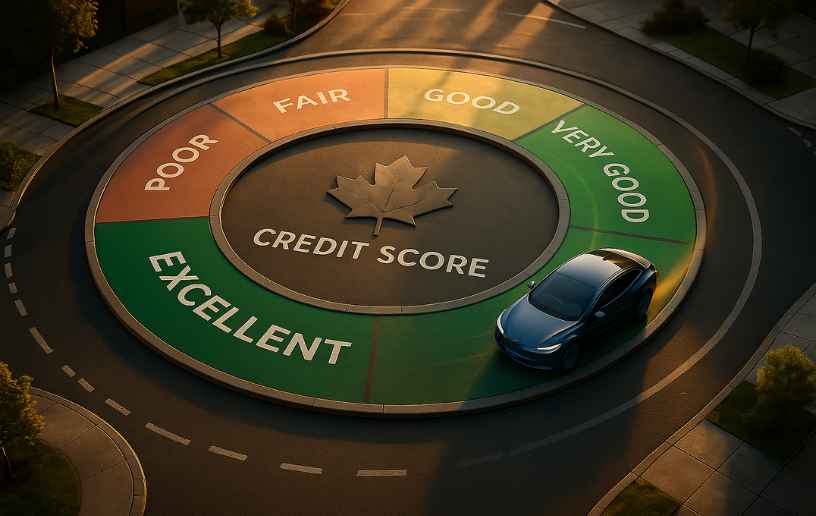
- Credit behaviour: Recent lates hurt; a long clean history helps. Score bands still influence rate — see car loan rates by credit score.
- Down payment: Savings or a trade can reduce the loan amount and open more programs.
- Vehicle age and kilometres: Stretching term on an older car can leave you upside-down if repairs hit a fixed budget.
If you had credit challenges earlier and are rebuilding in retirement, our second chance car loan overview explains how lenders weigh recent behaviour over old negatives.
Choosing a vehicle you can keep affordable
Retirees often want reliability over status: a comfortable sedan or crossover for medical appointments, grandchildren, and highway trips, or a smaller truck for acreage work. The right question is not only “what payment fits this month?” but “what payment still fits if insurance rises or a repair hits?” Use a realistic affordability check — our how much car can you afford guide walks through payment, insurance, fuel, and maintenance together.
Prefer vehicles that fit common lender age and kilometre caps so you are not forced into a short term with a high payment. A modest down payment from savings often beats stretching to a newer, pricier unit that crowds the monthly budget.
Practical application steps for retirees
- List every recurring income source with the latest statements or benefit letters.
- Pull Equifax and TransUnion reports; note unused cards you may want to keep open for file thickness.
- Set a firm maximum payment after insurance, fuel, and a repair buffer.
- Shortlist vehicles in that budget and confirm insurance quotes before you apply.
- Submit one complete application with income docs attached so lenders are not waiting on pension paperwork.
Process details match standard auto applications — see how to apply for a car loan in Canada. No lender can guarantee approval or a rate before reviewing your file and the vehicle.
Common misconceptions
Some retirees assume age alone blocks financing. Age is not a formal decline reason the way insufficient income or an unfinanceable vehicle is. Others assume a paid-off credit history with no open accounts is ideal — a thin recent file can actually make pricing harder. Keeping a small card paid monthly and documented pension deposits usually helps more than closing everything.
Joint applications with a spouse or adult child are sometimes used when one income stream is limited, but both parties should understand they share responsibility for the loan. Do not co-sign casually.
Spousal income, estates, and timing
If you and a spouse share household expenses, decide whether the loan will be sole or joint before you apply. Joint applications combine incomes and credit histories — that can help approval, but both names carry the debt. Do not add a co-borrower who cannot comfortably make the payment alone if something happens to you.
Timing matters around pension start dates, RRIF conversions, and selling a previous vehicle. Applying in a month where deposits look temporarily low (for example, between final paycheques and first pension deposits) can understate your real income. Wait until statements show the steady retirement pattern, or include separation/pension award letters that explain the transition.
Getting started on pension income
Whether you are newly retired in BC, living on a fixed pension in Alberta, or replacing an aging vehicle in Saskatchewan, financing is about clear income docs, a payment that survives fixed monthly costs, and a vehicle lenders will advance on. Auto Lending Canada works with lenders who already fund drivers across BC, Alberta, and Saskatchewan — including retirees on pension and mixed fixed income.
ALC serves BC, Alberta and Saskatchewan. Start your application here.