Leasing vs. Financing a Car in Canada: Which Should You Choose?
29 August 2026Standing in a dealership finance office, staring down a stack of paperwork, most Canadians hit the same fork in the road: lease or finance? It's one of those decisions that seems simple until you actually try to compare the numbers side by side, and the honest answer is that neither option is "better" in any universal sense. It depends on how you drive, how long you keep vehicles, and what you want your money doing five years from now. This guide breaks down leasing vehicle vs financing in plain terms, so you can figure out which path actually fits your situation.
The Core Difference: Renting Use vs. Buying an Asset
When you finance a car, you're borrowing money to buy it outright. You (or the bank) own the vehicle from day one, the loan gets paid down with every payment, and once the balance hits zero, the car is yours free and clear. You can drive it into the ground, sell it whenever you want, or hand it down to a kid heading off to university.
Leasing works differently. You're essentially paying for the portion of the vehicle's value you use up over the lease term, plus interest (called the "money factor" in lease paperwork) and fees. At the end of the lease, you hand the keys back, unless you decide to buy the car for its predetermined residual value. If you want to go that route later, it's worth understanding how lease buyout financing works, since the process and the numbers involved catch a lot of people off guard.
Monthly Payments: Why Leasing Looks Cheaper
This is usually the first thing people notice when comparing leasing a vehicle vs financing: lease payments are almost always lower than loan payments on the same car. That's because a lease payment covers depreciation over a few years, not the entire value of the vehicle. A finance payment, on the other hand, is chipping away at the full purchase price.
Say a $40,000 crossover has a 55% residual value after a 36-month lease. You're really only financing the roughly $18,000 of depreciation, split across three years, plus interest. Finance the same vehicle over 60 or 72 months and you're paying down the full $40,000 (minus your down payment), which stretches the term out but also means every payment builds equity you'll eventually own. Lower monthly payments on a lease can free up cash flow. That convenience has a cost attached, though, and it shows up over the long run.
Total Cost Over Time
Here's where the math gets less flattering for leasing. If you plan to keep driving for the next decade, financing almost always wins on total cost. Once a loan is paid off, your only ongoing costs are maintenance, insurance, and fuel. No more payments, full stop.
Leasing, by contrast, tends to be a payment you make forever if you keep leasing new vehicles back to back. Sign a new lease every three years and you'll never experience that stretch of payment-free driving that financed owners eventually get. Over 10 or 15 years, someone who finances a car and drives it until it's not worth fixing anymore will typically spend less than someone who leases continuously, even accounting for the finance owner's higher repair bills in the later years. That said, if you genuinely trade in every 2-3 years regardless of ownership structure, the cost gap narrows quite a bit, since you'd be paying off only a small slice of the loan before trading anyway.
What You Actually Own at the End
Equity is the other half of this equation. With a car loan, every payment builds ownership stake. Sell the car partway through the loan and whatever's left over after paying off the balance is yours. Pay it off completely and you hold a depreciating but fully-owned asset you can sell, trade, or keep driving payment-free.
Lease payments don't build equity in the same way. You're not accumulating ownership, you're paying for usage. There can be some value if the car's actual worth at lease-end exceeds the residual value baked into your contract (some owners have profited by buying out a lease and immediately reselling it, particularly during periods when used car prices spiked), but that's more of a market fluke than something to plan around.
Mileage Limits and Wear-and-Tear Charges
Leases come with rules that financed cars simply don't have. Most Canadian leases cap you at 16,000 to 24,000 km per year, and going over triggers per-kilometre penalties, often somewhere between 10 and 20 cents per extra kilometre. Rack up 10,000 km over your allowance and that's an unexpected $1,000-$2,000 bill waiting at lease-end.
Then there's condition. Leasing companies inspect the vehicle when it comes back and will charge for anything beyond "normal wear and tear" — a cracked windshield, curbed wheels, a torn seat, stone chips that turned into rust. If you've got kids who eat crackers in the back seat or a dog that rides along on gravel roads, those charges add up fast. Finance a car and none of this applies. Drive as many kilometres as you want, let the interior get lived-in, and the only person who cares is you (or a future buyer, if resale value matters to you). Anyone weighing this trade-off should look at a full breakdown of how leasing works in Canada before signing anything, since the fine print on mileage and wear charges varies a lot between manufacturers.
Credit Score Impact
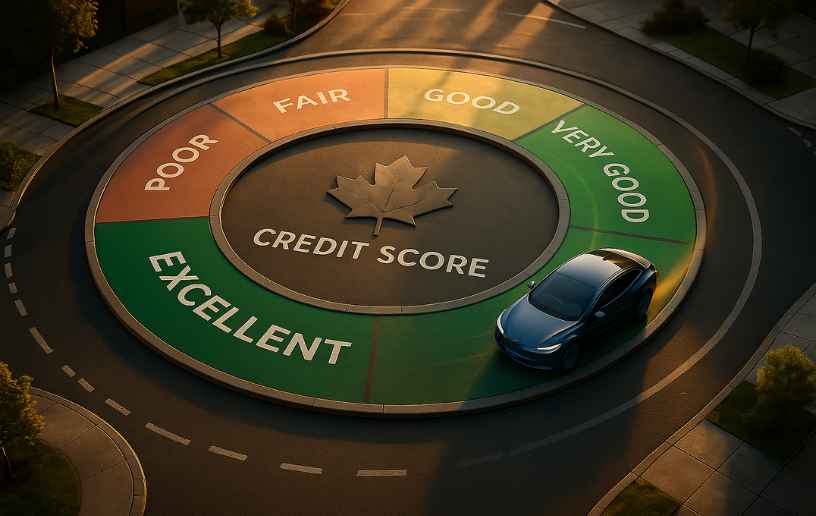
Both leasing and financing show up on your credit report as installment credit, and both affect your score in similar ways: a hard inquiry when you apply, on-time payments that build positive history, and a new account that can briefly lower your average account age. Missed or late payments hurt your score just as much whether you're leasing or financing, so this isn't really a deciding factor for most people.
Where it can matter is at renewal or lease-end. If you lease and plan to sign another lease down the road, lenders will look at your payment history from the current lease, same as they would with any loan. There's no meaningful advantage either way for your credit score itself. What does matter is your debt-to-income ratio and monthly payment obligations, both of which get evaluated whenever you apply for new credit, whether that's a mortgage, another vehicle, or a line of credit.
Down Payments and Interest Rates for BC, Alberta, and Saskatchewan Drivers
Interest rates matter more than most buyers realize, and they apply to both leases and loans, just under different names (interest rate for financing, money factor for leasing). A stronger credit profile typically unlocks better rates on either path, so it's worth checking your credit standing before you start shopping, regardless of which option you're leaning toward.
Down payments work a bit differently depending on the route. On a lease, a bigger down payment (often called a "cap cost reduction") lowers your monthly payment, but if the car gets written off or stolen early in the term, that money is often gone for good unless you've got gap insurance. On a finance deal, a down payment reduces the loan principal directly, which means less interest paid overall and equity built up faster.
For buyers across BC, Alberta, and Saskatchewan, provincial sales tax treatment on leases versus loans and regional insurance costs can shift the math slightly, so it's worth running the numbers for your specific province rather than assuming what applies in Ontario applies here too. If you do decide financing is the right move, comparing your options matters. A dealership loan, a bank loan, and a credit union car loan can carry meaningfully different rates and terms, and it's also worth understanding how a car loan compares to a line of credit before you commit to a structure.
So, Is Leasing a Vehicle Better Than Financing?
It depends entirely on what you value. Leasing tends to make sense if you like driving a newer vehicle every few years, want lower monthly payments, drive a predictable and moderate number of kilometres annually, and don't mind never building equity. It's also a reasonable fit for anyone who uses a vehicle for business purposes and can benefit from writing off lease payments.
Financing tends to make more sense if you drive a lot of kilometres, plan to keep vehicles for 7-10+ years, want to eventually own an asset outright, or simply hate the idea of handing back a car and starting the payment cycle over again. If you're the type who keeps a vehicle until it has 250,000 km on it, leasing is almost certainly the more expensive path over your driving lifetime. For a closer look at how the actual leasing process, costs, and contract terms work if you're still on the fence, this step-by-step guide to leasing a car in Canada covers what to expect from the application through to signing.
There's no universally right answer here, only the right answer for your driving habits, your budget, and how long you actually plan to keep the vehicle. If financing looks like the better fit after weighing all of this, getting pre-approved before you walk into a dealership puts you in a stronger negotiating position and gives you a clear sense of what you can actually afford. Get pre-approved for vehicle financing with Auto Lending Canada and see your options before you commit to either path.